Stopping a fleeing car involves more technology than you might expect; law enforcement officials explain their tools

photo by: Chris Conde/Journal-World
Stinger Spikes Strips, seen here on Feb 26, 2022, are used by the Douglas County Sheriff's Office to stop fleeing vehicles.
The Lawrence Police Department is updating the technology it uses to stop drivers who lead officers on car chases — a not uncommon occurrence, as residents who’ve heard and seen the pursuits can attest.
The department will begin using spike strips that it says are easier and safer to deploy than those it currently uses. Officers have already received training in classrooms and in practical situations on how to use the devices, which flatten the tires of fleeing vehicles, said police spokesman Lt. David Ernst.
“The previous model was somewhat cumbersome to deploy and had to be facing up to be effective,” Ernst said.
The new spike strips are safer because they reduce an officer’s exposure to dangers on the road and are effective no matter which side is up, Ernst said. One of the department’s policies on spike strips says officers should have adequate cover and the ability to escape an approaching vehicle.
The new Stop Stick strips come in three 3-foot connected sections at the end of an 80-foot cable. The sections fit into a thick plastic sleeve that slides easily across the ground. The strips can be thrown in a bundle and reeled into position with the cable. If a vehicle runs over one of the sections, that section would need to be replaced, but the other sections would still be usable, Ernst said.
The old Stinger Spike Strips were made of a heavy metal and had a lot of ground contact, making it harder to slide in and out of position, Officer Sean Crellin said. Any pothole or bump in the road could cost the officer a few more precious seconds to clear the strip and themselves from the roadway. The cable attached to the old strips was only 40 feet long and used a plastic stick that officers had to wrap the cable around by hand, running the risk of degloving, Crellin said.
Degloving occurs when the cable gets wrapped around an officer’s hand or finger and then gets ripped away if the spike strip gets dragged by a fleeing vehicle, causing severe injuries.
“It is a serious concern for our safety,” Crellin said.
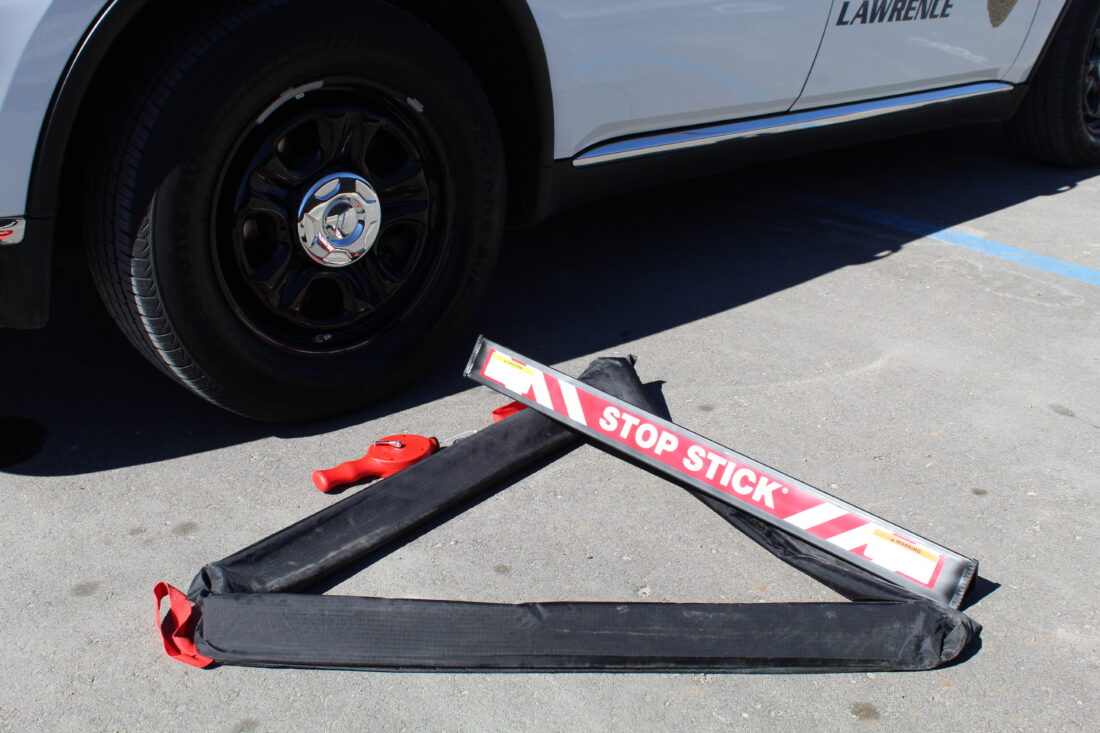
photo by: Chris Conde/Journal-World
The Lawrence Police Department recently purchased Stop Stick spike strips for 42 of its patrol vehicles. The new strips are inserted into a plastic sleeve that slides easily on the ground, seen here on Feb. 26, 2022.
The Stop Stick is constructed with an internal core made of small spikes arranged in a triangle, inserted into a sleeve. When a vehicle runs over the strip, the casing crushes and the metal spikes puncture the tire. The new strips come with a five-year warranty, and the manufacturer will replace the damaged sections for no charge after a successful deployment, Crellin said.
The full spike strip costs $418, and the department has purchased 42 of them.
The Lawrence Police Department doesn’t track the number of car chases it is involved in and could not provide an estimate of how many chases occur or how often spike strips are deployed, Ernst said.
The Douglas County Sheriff’s Office is waiting to make the change to newer spike strips, Sheriff Jay Armbrister said. The office has used the Stinger Spike Strip for more than 20 years, and some of the spike systems it purchased in the 1990s are still in use today, he said.
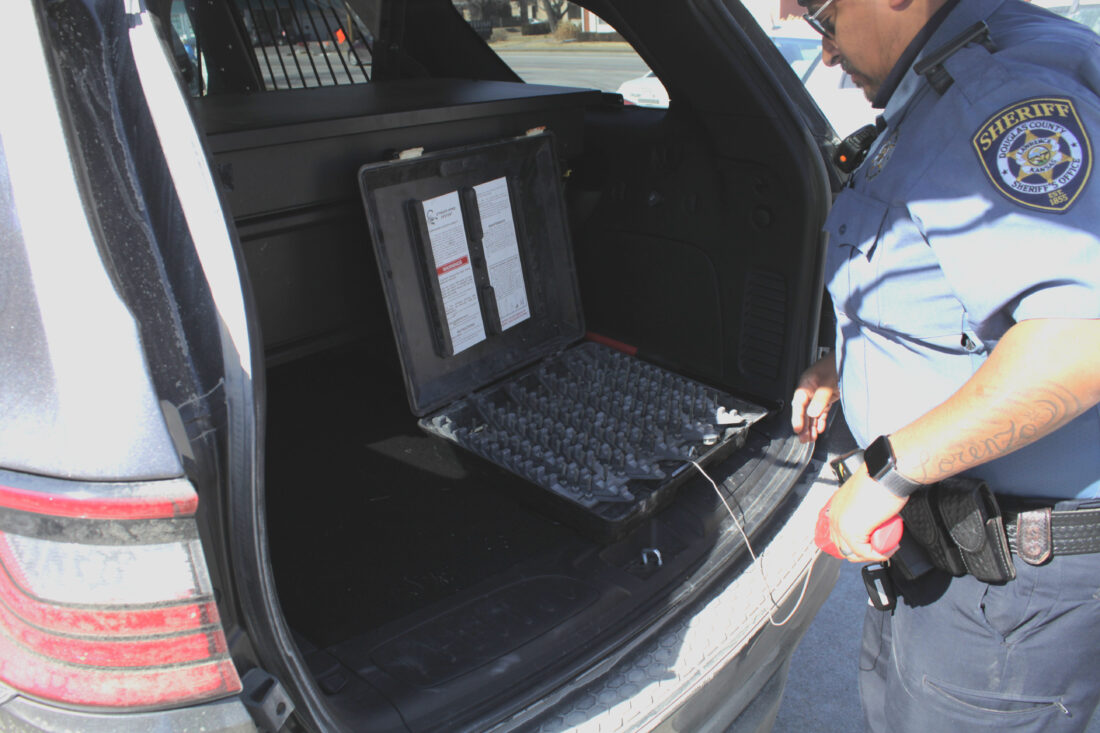
photo by: Chris Conde/Journal-World
Deputy Chris Chavez unloads the Stinger Spike Strips from the back of his patrol vehicle on Feb 26, 2022.
The Stinger strips cost $510 each, but the spikes can be replaced for $2 apiece. If the strip manages to spike all four tires of a fleeing vehicle, it usually damages 10 to 12 spikes. Each of the sheriff’s patrol vehicles is equipped with a Stinger Spike unit, Armbrister said.
“The technology has changed very little, and their durability is exceptional,” Armbrister said.
The Sheriff’s Office has considered updating its spike strips, but for now, the Stinger System is its preferred tool for the job, Armbrister said.
Stinger spike strips are a flat lattice of metal spikes that stretch out across the road. The spikes are only on one side of the strip, and officers have to place the strip exactly where they need it in the path of the fleeing vehicle. The strips used by deputies have recently been outfitted with the longer reel style cable.
The training for deputiess with the Stinger strips requires a combination of classroom and field exercises.
The safety of the deputy as well as other motorists is key when deploying the strips, Armbrister said. The training is just one part of keeping deputies and surrounding drivers safe, and the way the spike strips work also plays a big role, Armbrister said.
“The tires of the pursued vehicle will deflate slowly, causing the car to slow down gradually instead of all at once, which could cause the vehicle to crash or veer in an unwanted direction,” Armbrister said.

photo by: Chris Conde/Journal-World
Stinger Spikes Strips, seen here on Feb 26, 2022, are used by the Douglas County Sheriff’s Office to stop fleeing vehicles.
While the sheriff’s office hasn’t updated its spike strip technology yet, it has recently acquired a new tool to deploy in vehicle pursuits.
“We now have access and the ability to deploy an unmanned aircraft (drone) during pursuits if time, equipment, and personnel allow it,” Armbrister said.
The time factor is crucial, as it can prevent the use of any technology or allowing law enforcement to develop a safe strategy. That’s when a deputy might have to use a Tactical Vehicle Intervention (TVI) maneuver, Armbrister said.
“There are times when we are working alone or in a chase where we cannot get personnel out in front of us to spike a vehicle,” Armbrister said. “The longer a pursuit proceeds, the higher the chances become for someone to get hurt.”
The TVI is a maneuver where an officers use the front of their vehicles to bump the rear quarter panel of a fleeing vehicle in an attempt to spin the vehicle 180 degrees, stopping it in the process. Armbrister said he would prefer to use spike strips to slow a fleeing vehicle, but when lives are on the line, quick action is necessary.
“I feel when a person flees from law enforcement, there is very little, if any, difference to that same driver driving down the road pointing a loaded handgun at any driver or pedestrian in the area,” Armbrister said.
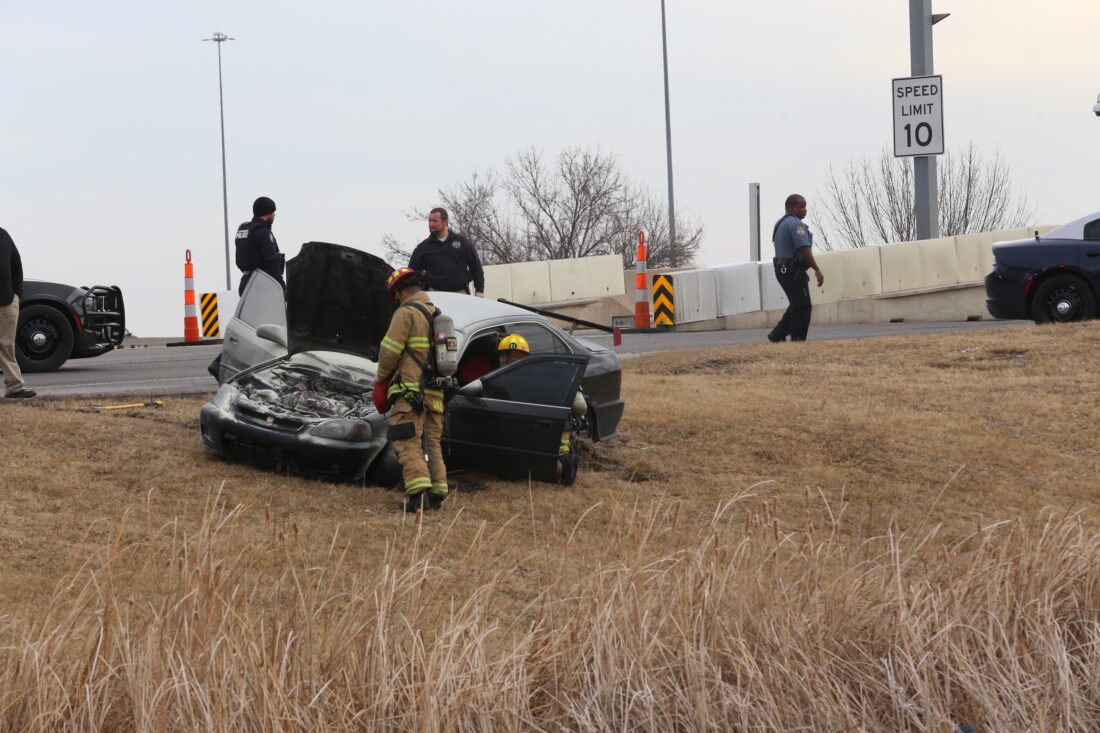
photo by: Chad Lawhorn/Journal-World
A vehicle briefly caught fire after a sheriff’s deputy performed a tactical vehicle intervention maneuver in the 1100 block of North Third Street on Jan. 27, 2022. The vehicle led authorities on a chase through Old West Lawrence and the downtown area before turning north toward the interstate.
The Lawrence Police Department does not use the TVI maneuver, said police spokesman Lt. David Ernst.
Car chases are one of the most dangerous situations an officer, or any motorist, can be involved in, and the frequency is increasing in Douglas County, Armbrister said. The daily driver can be best prepared for emergency vehicles and potential risks by keeping eyes on the road and on their side and rearview mirrors.
Drivers should always pull over when an emergency vehicle is present and wait long enough to be sure that more aren’t coming. Newer cars have better seals that keep noise out, sometimes making it harder for drivers to hear approaching sirens, so drivers need to be extra vigilant, he said.
If the risk to other drivers or pedestrians appears high, a deputy can decide to discontinue a pursuit, but sometimes chasing the suspect is the only option to keep the peace, Armbrister said.
“It’s very hard to outrun a radio, and while you may get away, you will not get away with it,” Armbrister said.
The sheriff’s office was unable to provide vehicle pursuit totals at the time of this report.
Drivers who flee police and engage in reckless driving, fail to stop at a roadblock or drive around spike strips can be charged with a level 9 person felony and face jail time up to one year.
Douglas County District Attorney Suzanne Valdez said that her office was committed to prosecuting drivers who endanger the lives of others. In her first year as district attorney, Valdez brought charges of fleeing and eluding while in a vehicle in 49 cases.
The DA’s office provided totals from the last decade of the number of people charged. The numbers show an increase in cases charged over the years with an average of 28 incidents charged from 2012 to 2016 up to an average of 42 incidents charged from 2017 to 2021.
“Fleeing and eluding incidents are a catastrophe waiting to happen,” Valdez said.
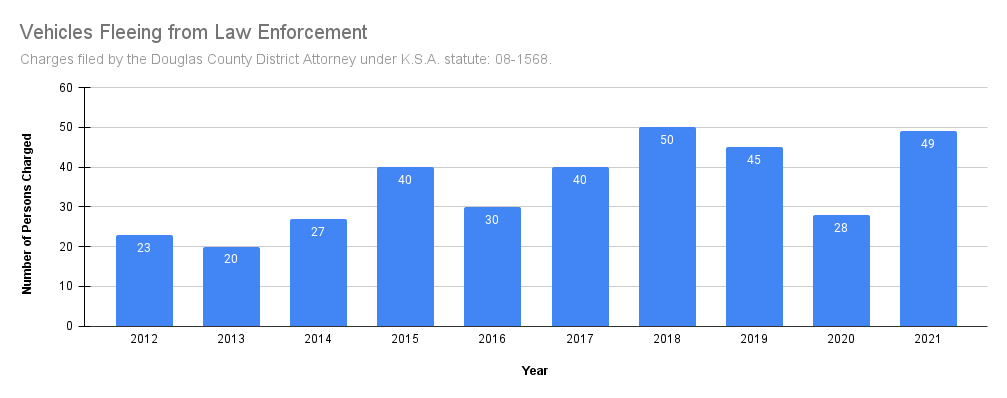
photo by: Chris Conde
Data provided by the Douglas County District Attorney’s Office.
Public Safety

24-year-old ordered to stand trial in connection with Lawrence mother’s drug death

Former LHS teacher admitted having sex with a sophomore 26 years ago, but a lot turns on whether she was 15 or 16 at the time
23-year-old man charged with second-degree murder in downtown Lawrence homicide
Lawrence Police Department receives KDOT’s top traffic safety award for second straight year
Police arrest 23-year-old on suspicion of first-degree murder in downtown Lawrence homicide