KU pharmacy students are unfazed by recent accreditation status
Students show no change after School of Pharmacy program is accredited with probation
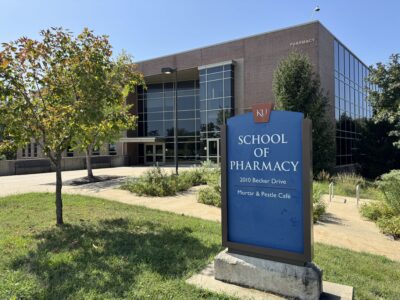
photo by: Dmitry Martirosov/Journal-World
The University of Kansas School of Pharmacy, as seen on Thursday, Sept. 17, 2026.
University of Kansas students attending the School of Pharmacy are not bothered by an accreditation status that placed one of their programs on probation earlier this year.
There is “no problem” with the School of Pharmacy, one student told the Journal-World on Monday, adding that the whole thing was blown out of proportion.
KU’s School of Pharmacy received an “accredited with probation” status in June for the school’s Doctor of Pharmacy program from the Accreditation Council for Pharmacy Education, a Chicago-based accreditor that sets national education standards for pharmacists. The council marked the program as “noncompliant” or “partially compliant” with five of the council’s seven standards and placed it on a “focused” review, which could include on-site evaluation visits.
In their June report, the accreditation council said the program was found to be noncompliant because of inadequate staffing in the Experiential Education program, as well as in the program’s recruiting and admissions efforts.
The program was also cited as noncompliant because of “inadequate faculty strength” in the school’s Pharmacy Practice department “to appropriately deliver the didactic and experiential components of the curriculum,” the report said.
Connor Cupp, a third-year graduate student at the School of Pharmacy, said he has become aware of some recruiting issues relating to faculty, but added that he doesn’t lack support and wouldn’t have chosen to attend school anywhere else. Another student said they hadn’t noticed a change, and that David Dietz, the dean of the pharmacy school, has addressed the issue to students directly.
Other issues cited in the report include communication and transparency issues, and failure to provide “sufficient and timely disclosure of financial adequacy” to deliver the program.
Reached for comment, KU spokeswoman Erinn Barcomb-Peterson said the School of Pharmacy “acknowledges concerns of the Accreditation Council for Pharmacy Education and is actively implementing improvement plans across all standards.”
She added, “the school is supported by university and KU Medical Center leadership to ensure that improvements happen with alignment to ACPE accreditation standards.”
KU’s Doctor of Pharmacy program is one of only two such programs currently listed on the accreditation council’s website as accredited with probation. The other is at a small private college in South Carolina.
The KU School of Pharmacy serves about 480 students each semester — though that number is significantly lower than prior years, according to KU data. A decade ago the School of Pharmacy enrolled 727 students, but hasn’t reached those levels since.
The School of Pharmacy will remain accredited until June, 30, 2030. A focused evaluation of the program is scheduled for spring of next year.
KU

Turnstile rocks KU campus as Day on the Hill returns after two-decade absence

UPDATE: Closure of Hilltop childcare center is final, but the building seems likely to stay
KU to lead national effort to address special education needs and tackle industry’s pressing concerns

Opinion: KU faculty, staff should be nervous about the new spending rules proposed for college athletics
KU enrollment grows for third straight year, achieving a new record