

Survey: 4 in 5 employers in Kansas say they have confidence in 3-year college degrees
Regents approved a pilot program in June for a reduced-credit bachelor’s degree
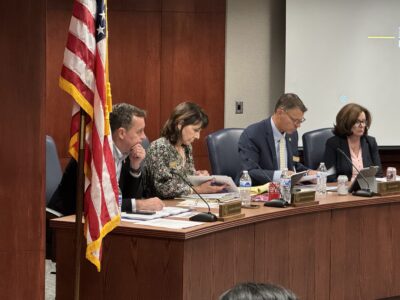
photo by: Dmitry Martirosov/Journal-World
Pamela Ammar, second from left, goes through documents at a Kansas Board of Regents meeting in Topeka on Wednesday, Sept. 16.
Kansas employers are overall supportive of the idea of graduates who obtained a bachelor’s degree with as few as 90 credit hours — instead of the standard 120 hours — despite prior fears that such initiative may draw pushback and turn companies off, according to new survey results which sampled more than 230 employers across the state.
Four in five respondents said they would feel “very” or “moderately” confident in the skills of college graduates who earned what is colloquially known as three-year college degrees — or reduced-credit college degrees — for entry level roles. More than half said they would hire graduates with reduced-credit degrees, while 40% said it would depend on the role. Another 60% said they believe reduced-credit degrees could help with workforce shortages. Meanwhile, 14% said organizational fit and job readiness might be an issue, and about 11% said a lacking depth of knowledge stemming from fewer credit hours earned might pose a concern as well.
The survey results were gathered by the Docking Institute of Public Affairs at Fort Hays State University and presented to the Kansas Board of Regents’ Academic Affairs Standing Committee on Wednesday. Regents invited the institute to conduct the survey after approving a pilot program in June for a reduced-credit bachelor’s degree for state universities — now known as a bachelor of specialized studies after committee members approved the name change. The program stipulated that for a degree to be approved, a proposal must show that there is enough market demand before it can be offered to students.
That would also help make sure the scope of any prospective program remains narrow, which is the intent of the Regents.
One common concern among opponents of reduced-credit college degrees is that they could devalue traditional, four-year degrees in the eyes of potential employers. With many companies in the U.S. already skeptical of the worth of a college education, reducing the amount of study pupils are engaged in might make matters even worse.
But Regents on Wednesday clarified that a bachelor of specialized studies in Kansas is going to be pretty narrow in scope and will not apply to all academic fields — far from it.
In a brief interview with the Journal-World, Regent Pamela Ammar, who chairs the academic affairs committee, said that any program approved by the Regents will only apply to specialized — or limited — academic fields. Ammar did not say which fields may offer a bachelor of specialized studies, but hinted at technical fields as an option. Ammar also said that before any bachelor of specialized studies is offered to students, such proposals will be vetted through a slow and rigorous process
Also, students who wish to pursue an advanced degree in the future, like a master’s, will be hampered by having earned a bachelor of specialized studies with only 90 credit hours. Advanced degrees will still require a minimum 120 credit hours to apply.
Ammar on Wednesday also said that two pilot programs are currently being considered, with initial introduction planned for later this year.
The survey by the Docking Institute had one goal in mind: to measure the overall mood of Kansas employers about the idea of reduced-credit bachelor’s degrees. The survey sampled nearly 20 business sectors, with the largest percentage of respondents being from the manufacturing sector, followed by the health care, agriculture and construction sectors.
The 231 total employers sampled vary in size, with nearly half having between one and 49 employees, a third having between 50-249 employees, 15% employing 250-999 employees and 6% having 1,000 or more.
IN OTHER BUSINESS
• Regents unanimously approved a proposal that would place the power to decide a professor’s appeal request to their post-tenure review decision in the hands of the Regents chair, instead of the full, nine-member board. The change is meant to “ensure efficient resolution” of the appeals and to protect the privacy of the faculty members submitting such appeals, and would not require the chair to consult with the full board for consideration. They would, however, need to confer with the Board of Regents’ president and CEO before issuing a decision. The proposal is the latest in a line of changes tightens regulations around tenured professors.
• Regents also unanimously approved a new Memorandum of Agreement between KU and the Kansas University Police Officer’s Association, the union representing the KU Police Department, that increases the salaries for KU’s 17 police officers, 17 security officers and four detectives. The new agreement increases the salary of a KU police officer from $53,000 to $66,000; security officers will see a $6,189 increase to their salaries, putting them at $38,189; and detectives will receive a more than $10,000 boost, putting their salaries at $73,981. Police officers, security officers and detectives who work between 6 p.m. and 6 a.m. will also receive a shift differential increase of 15 cents per hour, raising their total shift differential during those hours from 60 cents in 2023 to 75 cents.
• Teri Hall, the interim vice president of academic affairs of the Board of Regents, provided an update on diversity, equity, inclusion and critical race theory, or DEI-CRT. Hall told members of the Academic Affairs Standing Committee that she had been working with a group of people to determine the best way to enact the state requirements for DEI-CRT. Hall said the group is considering making a rubric that might be helpful for state universities as they evaluate courses and other programs. Regents in June approved changes to the definition of the term and adopted a “Statement of Understanding” to comply with state law. Under the new policy, state universities are prohibited from requiring a student to enroll in a class with DEI-CRT-related content in order to satisfy their degree requirements. Hall said the group will make sure they approach the topic with a “good-faith effort.” “No one wants the ‘gotcha calls,'” she said, “or the bots that (find) things on our website.”
KU
Survey: 4 in 5 employers in Kansas say they have confidence in 3-year college degrees

Opinion: Is it a good idea to continue to have a KU-Mizzou rivalry rooted in the Civil War?

KU, other state universities, propose new policies to lease property without Regents approval

Regents to consider more changes to tenure process for university professors; KU police set to receive pay increase

As KU donor David Booth launches new book, he talks about staying invested in the market and in Lawrence
