After 43 years across Kansas airwaves, Darrell Brogdon reflects on his career ahead of his retirement
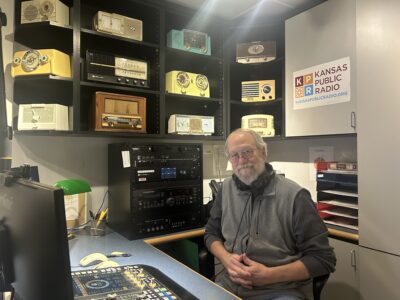
photo by: Bremen Keasey/Journal-World
Darrell Brogdon has been a mainstay on Lawrence airwaves by working at Kansas Public Radio for over 40 years. He is retiring as the Program Director at the station in March, and Brogdon reflected on his career and creation of the Retro Cocktail Hour.
If it wasn’t for his new neighbors back when he was a kid, Darrell Brogdon might have never graced the airwaves across Kansas.
While growing up in Kerrville, Texas, — a small town northwest of San Antonio — the general manager of the local radio station KERV-AM moved next door. One of his buddies got a job at the station, and Brogdon felt he could also get one. When he was 17, he snagged a gig as a weekend DJ from 6 p.m. to 12 a.m. on Saturdays.
At first, Brogdon thought he would be a graphic designer, but he became transfixed by his work at the station.
“The more I worked in radio, the more I was seduced by the siren song,” Brogdon said.
Thankfully for many Lawrencians, Kansans and worldwide audiences, Brogdon, the program director at Kansas Public Radio, found his calling and crafted a legacy of great radio — like the Retro Cocktail Hour — that has lasted over 40 years.
KPR announced earlier this month that Brogdon will be retiring as the station’s program director, with his final day coming on March 6.
Although he won’t be leaving the station entirely — he’ll still produce the Retro Cocktail Hour — Brogdon is stepping away at a time when public radio is facing significant challenges and changes. Brogdon spoke with the Journal-World to reflect on his long and storied career in radio, what inspired the Retro Cocktail Hour and some of the challenges ahead for the team.
Before he moved to work in Lawrence, Brogdon did a little bit of everything in Texas as he was trying to learn more about broadcasting.
In his first job in Kerrville, his responsibilities included having to take readings off the radio transmitter and even turn it off once he signed off the air at night. Brogdon said the station played a little bit of everything across genres, from jazz, to big band music, to country — one sponsor even played a polka selection once an hour. Once it got later at night, Brogdon said he would decide to play what he wanted to play since he figured “the boss is asleep.”
Brogdon said he was like a “sponge” in that first job, trying to learn everything he could and trying different things — including “stupid stuff” with his friends — to figure out what works.
When he headed to college at the University of North Texas in Denton, Brogdon decided to study broadcasting and wound up “working at three radio stations simultaneously” — two in Denton and one in Dallas. Even with that kind of experience in radio, Brogdon said he was convinced he was going to work in TV, and he got a job in Houston after graduating.
Through his experience in public television, Brogdon said he learned quickly that there is a lot more that can go wrong. In television, you need 10 people to make a show get off the ground and he said “if not everybody is up to the task, the whole thing could fall apart.” After two years working in television, he learned he didn’t like it that much, and soon took a job back in radio in Beaumont, Texas, where he was the program director for the public radio station.
Brogdon said in that job, you kind of serve as the “audience’s representative,” making decisions on what the station is “going to be” like and what “it is going to do,” and those choices have to be made with the audience in mind. One of the decisions he made in Beaumont was to bring in more jazz to the station, which became a popular choice for listeners.
“You learn what people are going to like to listen to on the radio,” Brogdon said.
Brogdon learned the most common mistake people make with radio is only playing music they like instead of “playing for an audience.” After jumping back into the radio world, he said working in this role helped change his mindset.
“I had a lot of preconceived ideas,” Brogdon said. “They all were shattered by being in that position.”
Although he was happy back in the radio world, Brogdon was looking for something else — including different weather.
Not only did Beaumont have lots of oil and chemical refineries that gave the air an acrid smell, Beaumont’s heat and humidity seemed to last all year, with the winter lasting “a couple of days” before jumping back to weather so humid that “your teeth sweat,” Brogdon said.
When Brogdon visited Lawrence, he was immediately struck by the change — and the fact it had four seasons.
“I really wanted to be here,” Brogdon said. “I thought the town was incredible.”
Brogdon joined KPR in 1982 as the program director and produced all sorts of shows during that time. That included the live, radio sketch comedy show “Right Between the Ears,” which started in 1985 and ran until 2017 after he decided to “close it up.” Brogdon said that show was distributed nationally, and it recorded at venues across the Midwest, most frequently at Liberty Hall.
Although he enjoyed working on the show with the cast and writers, Brogdon said that working on it — along with his other workload — was a “bear,” and he became exhausted, but it is a key part of his legacy at the station.
“We’d really been fortunate and gotten to do a lot of fun things,” Brogdon said.
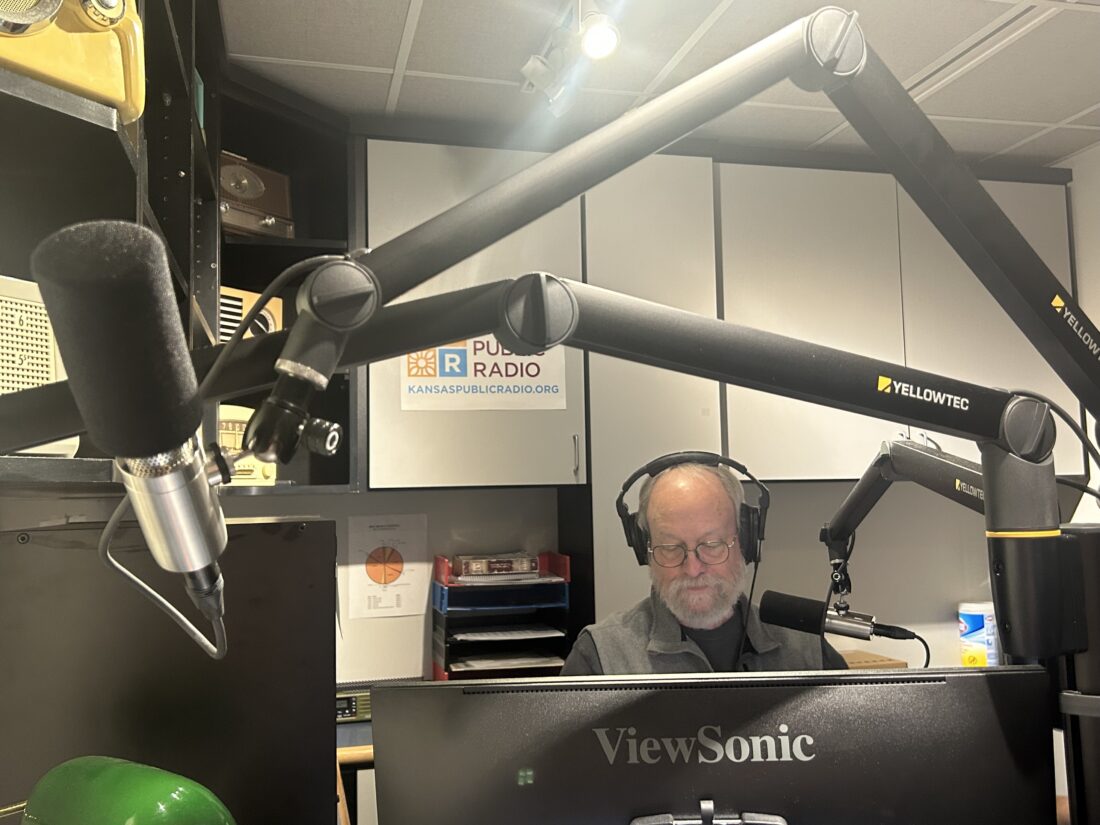
photo by: Bremen Keasey/Journal-World
Darrell Brogdon has been a fixture at the KPR studios at 1120 W. 11th St. for over 40 years. As he steps back from his role as Program Director, he believes the station is in a good position to face the difficult challenges ahead.
Brogdon said his mom was a member of the Columbia Records Club when he was a kid. Every month, the company would send out records, so she had a lot of them sitting around. But none was more memorable for Brogdon than Martin Denny’s Exotica.
Whenever Brogdon was watching TV growing up, the album’s cover art of a woman staring out beyond bamboo curtains, seemed to be “staring at (him) from under the television,” and intrigued him. When he took a listen to the record, “it turned him onto a different kind of music.” One that was a kind of “ersatz” music that bundled together all sorts of styles — jazz, pop, Polynesian influence, Afro-Cuban sound, exotic percussions — that became a music of escape to a tropical island or a caravan in the Sahara, according to Brogdon.
“It’s like a mid-air collision between four or five different influences,” Brogdon said.
That type of funky style became a key fixture in the rotation of songs in the Retro Cocktail Hour, which he began producing in 1996, serving up “just weird stuff you wouldn’t expect,” Brogdon said. The idea was spurred in part by a period in the 90s when record companies began reissuing various albums in their back catalog, like instrumental pop or old Frank Sinatra records. For a moment, there was a “Space Age, bachelor pad music” fad that hipsters became attracted to, and Brogdon felt that could be a potential bridge to get more young listeners.
Since the station played a lot of jazz and that overlapped with the minor craze, Brogdon launched the show, playing an eclectic mix of sounds that epitomized the Space Age vibe — including the aforementioned Exotica “private eye” jazz, Bossa Nova, industrial musicals and production library music.
The production library music was some of the most fun to play, Brogdon said, and truly embodied an era. Popular in the 1950s and 60s, Brogdon called it “‘Let’s go shopping’ music,” for its optimistic tone that sounded like “we’re going to conquer the world” that was befitting of the national mood for that era. Exotica — which as a genre had its heyday from 1956 to 1963, Brogdon said — grew a bit because of enlisted men returning from serving in the South Pacific during World War II having a taste for the Polynesian-kind of sound, according to Brogdon. Playing that again in the 1990s helped spark the craze for the Retro Cocktail Hour.
“It was so unusual at the time that I think people just got a kick out of hearing it,” Brogdon said. “(People) either never heard before or remembered hearing years ago when it was new.”
Right away, there was some buzz, Brogdon said. The one-hour show grew to two hours and he started hearing from people about how much they enjoyed listening. The show also was syndicated to air on over 100 stations across the country.
Some of the growth happened thanks to the internet. By 1996, the show was made available to stream “in a primitive way” on the KPR website, Brogdon said, and he soon was hearing from listeners not just across the U.S., but from all over the world. Brogdon said he heard from listeners in China, the U.K., Europe and South America. Once, he said he got an email from a man on a sailboat who was listening to the show off the coast of Saipan.
“It just kind of blew my mind,” Brogdon said.
Over the many years of working in public radio, Brogdon said one thing remained constant: change.
The developments in technology may have helped boost the Retro Cocktail Hour to people across the world, but also changes, like the growth of the internet and the rise in popularity of podcasts, have created a “new media landscape,” Brogdon said.
In reading histories about radio as a format, Brogdon said the innovation of television in the 1950s also disrupted the radio industry in a similar way, hitting the “industry like a rocket.”
At the time, radio stations struggled on the solution of how to remain relevant, with networks “throwing money” at the problem in the hopes that would fix it, Brogdon said. Things like long form radio pretty much went away during that period, but it also brought the rise of the DJ in the radio format. With the new technologies and the changes in listening habits, Brogdon said it will be interesting to see how the medium tries to navigate the changing landscape.
“Radio has got some real exciting challenges ahead,” Brogdon said.
Public radio in particular has some interesting challenges. While fights and debates over the amount of public funding that stations would get seemed to go on every year, Brogdon said the federal government “ripping out” all funding for public media in the last budget is a significant challenge for stations. Along with the COVID-19 pandemic, those changes have “thrown a monkey wrench” into radio.
In the face of the challenges, Brogdon said it feels “bittersweet” to be stepping back from many of his duties at KPR. Although he will still be doing the “really, really fun parts” of his old job — namely, producing the Retro Cocktail Hour — he won’t be doing the same day-to-day as the program director, which will be quite a change after 43 years.
But while he steps back, Brogdon said he feels the team at KPR is the “best team (he’s) ever worked with,” and he is confident they will be able to help lead the radio station to serve the community as best as it can — something he long loved to do.
“It was mine to do for 43 years, now it’s going to be someone else’s,” Brogdon said. “I am glad I’m going to be able to contribute in some small way because I love these people, they’re just the best.”
KU
After 43 years across Kansas airwaves, Darrell Brogdon reflects on his career ahead of his retirement

KU’s Physics and Astronomy department hosting ‘Pluto Day’ event, celebrating science of space and the dwarf planet’s KU connection
KU names dean of College of Liberal Arts and Sciences as university’s next provost; promotes from within to fill Liberal Arts dean
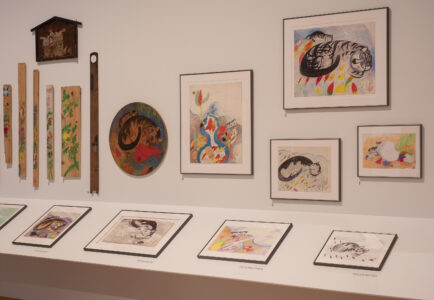
Two special exhibitions opening Thursday at Spencer Museum of Art to highlight contemporary Japanese and Asian-American art

Lawrence startups win grants to help get their health and tech innovations to market