

Bill to limit how DEI is taught in universities pulled from hearing schedule, but may still come back
Lawmakers also may try to address DEI through budget bill
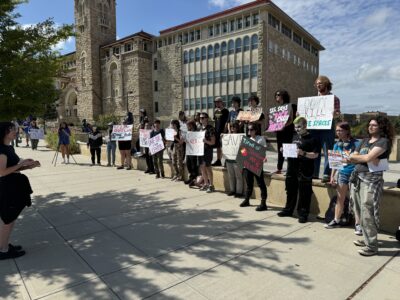
photo by: Chad Lawhorn/Journal-World
University of Kansas students on Sept. 17, 2024 protested a merger of several student offices related to diversity, gender, sexuality and other issues.
A bill that would further tighten how universities could teach diversity, equity and inclusion topics in the classroom was scheduled to get a key vote in the Kansas House on Wednesday, but the hearing never materialized.
On Thursday, an assistant with the House Education Committee told the Journal-World a hearing on HB 2428 — often known as the Freedom from Indoctrination Act — did not get either a hearing or a vote during the Education Committee’s round of business on Wednesday.
It is unclear when or whether the bill will get a hearing before Feb. 19, which is the day where the House is scheduled to conclude its work on most bills that need to be sent to the Kansas Senate for consideration. The House Education Committee has posted its agenda for next week, and HB 2428 is not listed for any action during the week, although the agenda can and does frequently get updated.
What is clear is that University of Kansas leaders are concerned about the impact the bill could have on the university’s operations, if it becomes law.
“It does create concerns,” KU Chancellor Douglas Girod told the Journal-World in a brief interview on Wednesday, prior to news of the canceled hearing.
Girod said the bill — while providing some definitions about what constitutes diversity, equity and inclusion topics — still is lacking in clarity, which may leave professors and administrators unsure about what type of class content would trigger the provisions of the bill.
Additionally, Girod said there would be costs to comply with the law, which would require the university to offer some new civics courses, and to add new offerings to its freshmen orientation program, among other requirements. KU has estimated a first year cost of $1.8 million to develop and staff such courses and to meet other requirements of the bill.
Lastly, is the elephant in the classroom, so to speak.
“I think it may cause some issues of impinging on academic freedom,” Girod said.
While the act wouldn’t technically stop universities from offering classes that teach or even promote concepts associated with DEI, the act would prohibit universities from requiring students to take any of those classes in order to receive a degree from the university. The bill has limited exceptions, including for degree programs in women or gender studies, for example.
The act provides a far more specific definition of DEI-related content than what currently exists in state law. Topics that would be considered DEI-related — and thus barred from being a requirement of degree programs — include: whiteness; systemic racism; institutional racism; microaggressions; systemic bias; gender identity; social justice; race-based reparations; and gender-based equity, among other topics.
Proponents of the bill dispute that it would impinge on the academic freedom of the faculty, and a section of the bill specifically states that nothing in the bill should be considered a limitation of academic freedom.
But there has been a question among academics if the law would essentially create a de facto elimination of DEI topics if any class that includes such material can’t be a required course in a degree program.
Proponents of the bill have sought to clarify that a course that teaches DEI concepts could still count towards a degree, but that universities must provide alternative classes so that a student could receive a degree without taking any classes that have DEI material.
Girod on Wednesday said he understood that distinction, but said the bill “sure feels like” it will limit the academic freedom of professors. That’s in part because a key concept of academic freedom involves academics, rather than lawmakers, determining what students must learn to be a degree holder in a particular field.
“I think what they are trying to say is you can’t require people to take those classes, but we have fields of study where you have to have that kind of education to be effective as a social worker or as a doctor, as a nurse or whatever. So that’s where there is not clarity on some of those issues.”
The bill does provide an exception that says students who are seeking a degree in gender studies can be required to take classes that teach DEI topics. The bill, though, doesn’t create such an exception for social work, for example, which was cited as a problem by several members of that industry during a hearing on the bill earlier this month.
Supporters of the bill, though, focused on the types of classes where DEI concepts are a large part of the curriculum. Some English classes were brought up as an example where students were being asked to rethink their beliefs on gender.
The issue of DEI concepts being taught in universities has become a major issue within the Republican Party, which has said higher education is straying from its core mission and is losing the confidence of the public.
As the Journal-World has reported, House Bill 2428 is modeled after a proposal crafted by the Goldwater Institute, an Arizona-based advocacy group that touts the benefits of limited government, economic freedom and individual liberty. It is working to get legislatures across the country to adopt a bill called the Freedom from Indoctrination Act.
In addition to defining DEI-related content and prohibiting universities from requiring students to learn such content for a degree, the act has several other provisions. They include:
• Universities would be prohibited from what they can ask faculty members to do as it relates to DEI practices. Schools could not require or incentivize faculty members to participate in workshops or training related to DEI issues. Schools also couldn’t force or encourage instructors to distribute any materials related to DEI issues.
• The act would require all undergraduate degree programs to include at least one course that focuses on the “study of American institutions.” The act creates a detailed definition of what such a course must include. Such a course must teach an “understanding and appreciation” of the U.S. Constitution and the role of “limited federal government,” the “dual sovereignty of the States,” separation of powers in the federal system, and the network of checks and balances that exist in the Constitution. The concept of equal protection under the law and freedom of speech also must be taught, and the course should discuss landmark Supreme Court cases that have “shaped law and society.” The course also must include “significant use” of founding documents, including the Constitution, the Declaration of Independence and the Federalist Papers.
If House Bill 2428 doesn’t get a hearing in the House before Feb. 19’s “turnaround” deadline, the prospect of the bill becoming law this session diminishes considerably. However, it is still possible that KU and the other state universities could end up facing many of the same requirements, but just in a different form.
Lawmakers have the ability to insert “provisos” into the state’s budget bill. Those provisos essentially create requirements that must be met before the universities can receive certain pots of state funding. That is how the legislature implemented several DEI limitations during the last school year, including one that prohibits state employees — including faculty and staff members of universities — from using their preferred pronouns in the signature lines of their work email accounts.
Those budget provisos can essentially be added at any time during the legislative session.
Girod said those provisos are particularly difficult for universities to deal with because — unlike a law — they technically are only in effect for one year, unless they are renewed again by the legislature.
Those provisos are in the works, though, as discussion in the House has included adding a proviso that would withhold $2 million each from KU, Kansas State, Wichita State, Emporia State, Fort Hays State and Pittsburg State unless they make certain certifications related to DEI and critical race theory and the presence of those topics within the university operations.
Thus far the Kansas Senate hasn’t proposed a similar budget proviso, the Kansas Board of Regents were told by staff members on Wednesday, but the topic could be in play when the House and the Senate begin to negotiate on a final budget bill.
State Government
Bill to limit how DEI is taught in universities pulled from hearing schedule, but may still come back
Bill compels teachers, students to undergo annual sexual abuse prevention training
TOPEKA — Erin Merryn wants the Kansas Legislature to require public school teachers and their students in ...
Girod says KU concerned about multiple legislative proposals, including tuition freeze, changes to tenure

Legislative committee weakens proposed ban on cell phones in schools; now gives districts chance to opt out of provisions
Bill would require Kansas schools to stock naloxone, provide fentanyl prevention education
