KU to host Brazilian Studies Association starting this summer; the director hopes it can expand KU’s international reach

photo by: University of Kansas
The University of Kansas Campanile, at left, houses a carillon.
An international association that deals with the study of Brazil will move to be based at the University Of Kansas starting this summer.
KU announced in a press release Thursday that the university will host the Brazilian Studies Association (BRASA) starting in July 2026. It will host the association for six years.
Luciano Tosta, an associate professor in the Department of Spanish & Portuguese and director of the Center for Global & International Studies at KU, will serve as the executive director for the association.
Tosta said BRASA was first formed in 1992 after the Latin American Studies Association realized there were a growing number of Brazilian scholars that were a part of the association and figured it made sense to have a group focused solely on Brazil. The group has become “a major organization of scholars interested in Brazil,” according to Tosta, and it has scholars in a wide variety of disciplines — from political science, to geography, to the medical field.
“It is truly interdisciplinary,” Tosta said.
While the association has been hosted at a variety of universities across the US — Tosta said it is currently at Tulane University before it will move to KU in the summer — there has always been a KU connection to BRASA. Tosta said that Elizabeth Kuznesof, a professor emeritus with the school’s Department of History, was the president of BRASA from 1996 to 1998.
Tosta said the university has a “significant” number of Brazilian scholars already on campus and a good chunk of Brazilian students. He attributes that to KU’s history with Brazilian scholars, and also noted the university also has a large and “rare” collection of Brazilian books in one of the libraries. While KU is already a known commodity for Brazilian studies, Tosta said housing BRASA will “elevate (KU’s) profile as a leading site” further and create more connections.
“It will increase our global engagement opportunities for partnerships with Brazilian and other international universities,” Tosta said.
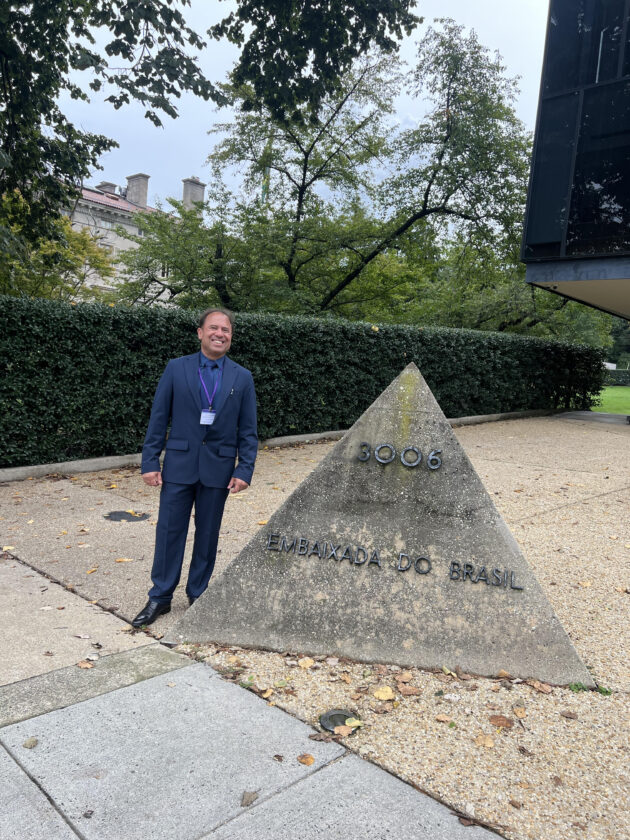
photo by: Contributed
Luciano Tosta, an associate professor in the Department of Spanish & Portuguese and director of the Center for Global & International Studies at KU, will serve as the executive director for the Brazilian Studies Association, which will be located at the University of Kansas starting in July 2026.
While the country is thousands of miles away, studying Brazil can provide an interesting outlook into the U.S. as well. The two countries are often compared against each other, Tosta noted, due to a lot of similar circumstances. Both are large and diverse countries geographically; both have a similar history of colonization but have surpassed the cultural relevance of its former colonial masters; both are multicultural societies and share a history of importing African slaves into the country.
In more modern times, Tosta said the similarities continue with the United States. Brazil has an extensive history of immigration that helped make it a melting pot — it has the largest number of people with Japanese descent outside of Japan and the highest number of people with Syrian and Lebanese heritage outside of the Middle East — and the country has in recent years seen increasing tourism from African Americans because of Brazil’s large Afrodescendent population. Additionally, its politics have recently become an international focus — especially in September 2025 after its former president Jair Bolsonaro was sentenced by a panel of Supreme Court justices to over 27 years in prison for a coup attempt.
“There are several elements that make the country very interesting to engage with,” Tosta said.
The housing of BRASA at KU also indicates to Tosta that the university is committed to being a key player in international studies, and he is looking forward to leading as executive director.
“This is a commitment to scholarship and research that helps KU internationalize,” Tosta said.
KU
KU leaders reject pay proposal from faculty union; administration says it will seek an impasse in negotiations if deal not reached in 7 days

KU research dollars set a new record in 2025; university conducted more than $600M in research activities
A memorial unites Iranian students at KU as they grieve civil-rights protesters killed by Iran’s dictatorship

Expect bowling, a scavenger hunt, casino games and more as KU’s Kansas Union celebrates its 100th anniversary this year

After 43 years across Kansas airwaves, Darrell Brogdon reflects on his career ahead of his retirement