

Haskell Indian Nations University still suffering from hiring freeze, interim president tells business leaders
KU, Baker University also share priorities as part of Chamber event
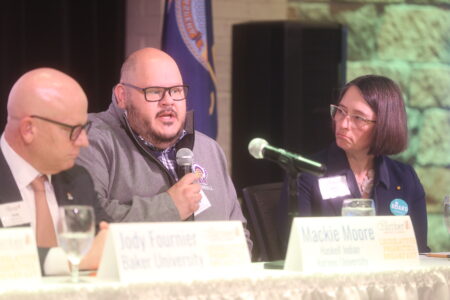
photo by: Chad Lawhorn/Journal-World
Haskell Indian Nations University Interim President Mackie Moore, center, is pictured at The Chamber's annual Legislative Priorities Breakfast on Jan. 9, 2026.
Valentine’s Day in 2025 was a heartsick day at federal agencies across the country as job cuts and hiring freezes began to take hold following an executive order by President Donald Trump.
Parts of the order were blocked by federal courts, and national headlines have faded on the topic of federal workforce reductions. On the campus of Lawrence’s Haskell Indian Nations University, though, the hiring freeze still trumps all other issues.
“In the past year, we haven’t been able to hire anybody,” Mackie Moore, the interim president of Haskell, told a crowd gathered Friday for the Lawrence chamber of commerce’s annual Legislative Priorities Breakfast.
Haskell’s top legislative priority is simply to get some new employees, Moore said.
“Our main thing and our main need right now is we need personnel,” Moore said. “We need people to be able to do the job.”
Moore, the dean of Haskell’s College of Business, has been the university’s interim president since June. Updates from Haskell have been rare in recent months, as the school is unlike most in the country in that it is part of a federal agency — the Bureau of Indian Affairs — that is tightly controlled by an even larger federal bureaucracy, the Department of the Interior. As such, most attempts to get updates on operations at the university are directed to Washington, D.C., where they often go unanswered.
But on Friday morning, Moore was part of a panel of local leaders who made public presentations as part of an event meant to communicate with lawmakers.
“On a positive note, at least we are still here,” Moore said of Haskell, which provides tuition free education to Native Americans from across the country. “It was a tough 2025, but 2026 is a new year, and I have full faith in the people that we have. We are doing the best we can with what we have, and that is all that I can ask.”
Moore, though, said he will be going to Washington, D.C., in the near future and will be asking for help on the hiring front. In addition to meeting with officials within the Bureau of Indian Education, he also said he will be meeting with lawmakers who have made proposals to create new structures that would make Haskell more of a federally-supported, independent entity that doesn’t have to operate under the BIA’s rules.
U.S. Sen. Jerry Moran, R-Kansas, previously told the Journal-World that Haskell had been “neglected and mismanaged,” and that the best path forward for the school was “to be led by an independent Board of Regents . . . and no longer obstructed by the BIE.”
Moran, Sen. Roger Marshall, Rep. Tracey Mann and Rep. Derek Schmidt, all Republicans in the Kansas delegation, among others, are pushing for the passage of a bill that would create a new, more independent governance model for Haskell.
Moore on Friday stopped short of endorsing the current bill, but said he wanted to discuss possible modifications with lawmakers.
“Some of the things they have put out are not exactly where they need to be for us to be a totally stand-alone operation,” Moore said. “We are working with them to get a better, more accurate picture of what that looks like.”
Moore was not available for questions following Friday morning’s event, so information about how many vacant position Haskell currently has, or other such operational details, aren’t currently clear.
Moore told the crowd that he is focused on having conversations about the “best avenue forward for the future of Haskell.”
“That’s one thing that I think everybody, including the community, wants to see — what’s best for Haskell,” Moore said. “Figuring that out is what we’ve got to do. It is not an easy fix. It is not an easy answer.”
Representatives from the University of Kansas and Baker University also participated in Friday’s event, and spelled out goals and priorities for the next year.
Kelly Whitten, associate vice chancellor for state relations at KU, said the university’s primary goal during the upcoming state legislative session remains educating lawmakers about KU’s importance to the overall Kansas economy.
A specific project that KU will seek state assistance on is an outreach program for KU’s Alzheimer’s Disease Research Center to spread new types of diagnostic and care options across the state.
A second project involves artificial intelligence and the need for state government and others to have access to super computing power. KU leaders believe the right location for a super computing center in Kansas would be on a KU campus. The super computing capabilities could be used by researchers from across the state, but also for purposes within state government and private industry.
“The future is here with AI,” Whitten said. “We don’t want the State of Kansas and the university to fall behind.”
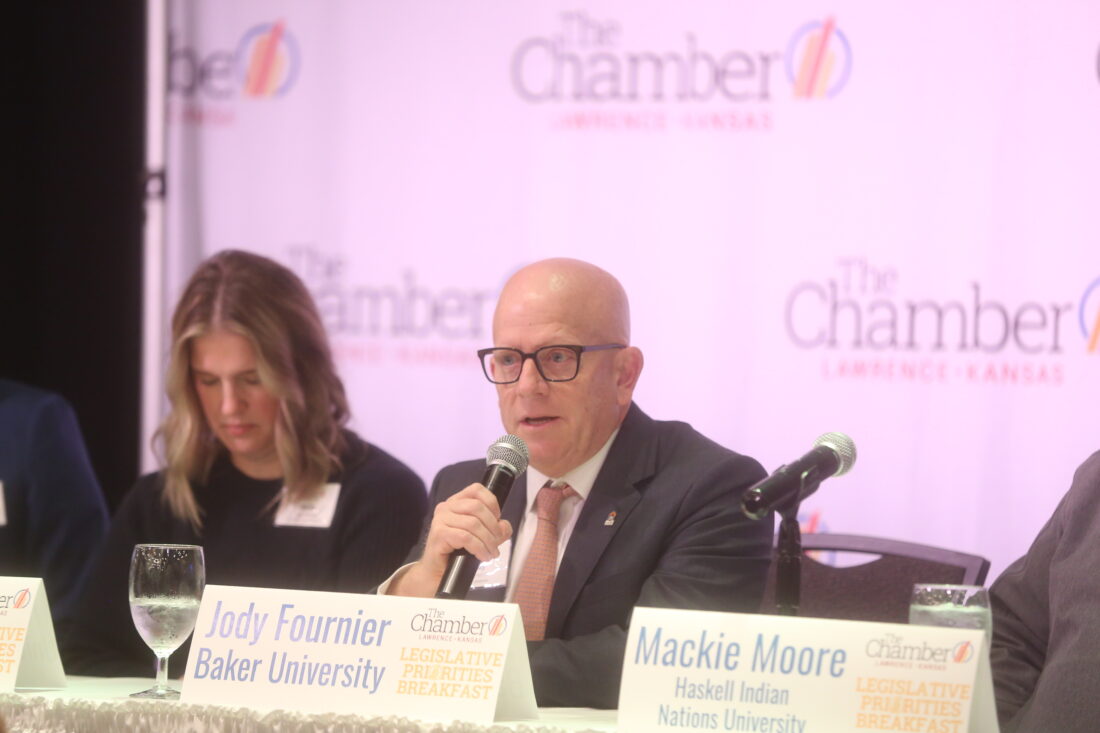
photo by: Chad Lawhorn/Journal-World
Baker University President Jody Fournier is pictured at The Chamber’s Legislative Priorities Breakfast on Jan. 9, 2026.
New Baker University President Jody Fournier also made a presentation at the event. As a private university based in Baldwin City, Fournier said his university isn’t making specific proposals to state legislators.
Rather, Fournier said he wanted the broader Lawrence community to know that Baker is taking economic development seriously, and is looking at its course offerings to see how it can best be a growth driver for the region.
Fournier said programs in logistics — the large Burlington Northern Santa Fe Rail hub in Edgerton is about 10 miles east of the Baker campus — is an emerging area of study for the university. He also said healthcare, including mental and behavioral healthcare, is on the university’s horizon. He also said Baker, which does not have a school of engineering but offers pathways into the profession, is exploring “new directions for engineering.”
State Government
Haskell Indian Nations University still suffering from hiring freeze, interim president tells business leaders

Area legislators gather ahead of next week’s session with concerns of balancing money, human services
Bill seeks harsher penalties for child endangerment
TOPEKA — Jordan Chessher senses an urgency surrounding an effort to increase the criminal penalties in Kansas for ...
Lawrence Democrats take aim at Mann’s congressional seat
Five Lawrence organizations receive $336,000 in federal funds to assist crime victims
