

Lawrence Community Shelter served over 800 individuals in 2025, operated at almost full capacity in December
Annual report breaks down usage throughout 2025
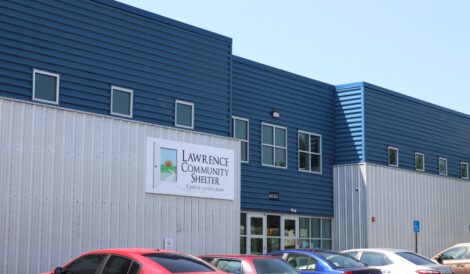
photo by: Josie Heimsoth/Journal-World
The Lawrence Community Shelter is pictured in August 2025.
Lawrence Community Shelter served 806 individuals in 2025 and was operating near full capacity as winter began, according to the organization’s annual report.
Many of the individuals served at LCS participated in multiple programs with 123 individuals in the 90-day program to transition them out of homelessness, 137 at The Village – a non-congregate emergency shelter providing private “Pallet” cabins for individuals experiencing homelessness, and 706 in the night-by-night program.
LCS’ overall utilization remained high throughout the year with beds filled at an average rate of 89% across programs and demand intensifying during colder months.
In November 2025, the City of Lawrence announced that it won’t partner with churches and other community sites for walk-in winter shelter, and said the added capacity that opened at LCS that year would be enough to handle the demand. The city would previously partner with churches to provide overflow shelter when LCS filled up.
However, in the month of December, LCS operated with nearly all of the beds being used – with only one bed shy of LCS’ full capacity, according to the report, and left almost no excess space for additional guests. Night-by-night services were also highly utilized, averaging about 95% attendance and sometimes exceeding capacity during winter emergency operations.
As the Journal-World reported, the Lawrence Community Shelter opened Pallet 24, which consists of 24 prefabricated, 64-square-foot cabins behind LCS’ main building at 3655 E. 25th St. The project added 48 more beds to LCS; each cabin having two beds, air conditioning, heating and lighting.
“Pallet 24 completed construction in September 2025, and while it initially had a slow start, once Weather Emergency Shelter took effect it saw a rapid increase in its utilization, hitting its maximum capacity of 48 individuals on 11 days of the month of December and averaging a utilization rate of 90%,” the report said.
While there were many individuals who transitioned to housing, the report said there was a limited number of clients who moved to permanent stability. There were 77 clients that exited to U.S. Department of Housing and Urban Development-defined permanent housing, meaning they are not expected to return to homelessness.
Meanwhile, 127 total exited to other housing destinations such as 15 people with Rapid Re-Housing placements – moves into permanent housing that are supported by a short- to medium-term assistance program to help people quickly exit homelessness and stabilize in their own rental unit, five people with housing vouchers, six people to a licensed care facility, seven into transitional housing, and 49 into placements with family or friends.
Case management services focused heavily on documentation, benefits access, and employment support. During the year, 90 individuals received help obtaining identification, 56 received assistance accessing government benefits, and 56 received employment assistance.
LCS’ 2025 financials show a roughly $4.27 million operating budget. Individual donations totaled $152,706 and fundraising events raised $91,093, both exceeding what was budgeted. However, foundation funding fell short of projections with $54,302 in earnings.
Expenses were driven primarily by staffing, with payroll totaling $3.06 million and overall operating expenses reaching $3.97 million, both below budget. Because spending remained controlled, the shelter posted $295,531 in operating income and maintained about $960,234 in cash.
The shelter’s client population included adults aged 25-54, with the largest group being ages 35-44 with 208 people. Men comprised about 61% of clients and women about 27%. The population was majority white with 419, but also included 136 Black/African American clients and 106 multiracial clients.
There were 49% of clients who reported a disability, 46% reported a mental health disorder, and 30% said they have a chronic health condition. Substance use disorders were reported by about 27% of clients. In addition, 461 adults served by the shelter reported zero income, meaning well over half of clients had no earnings.
Many of the LCS clients experienced repeated or prolonged housing instability. Over 199 individuals had been homeless more than 12 months, and 216 had experienced homelessness four or more times in the past three years.
Other News
Lawrence Community Shelter served over 800 individuals in 2025, operated at almost full capacity in December

Douglas County Extension invites residents to free program on prescribed burning and wildfire safety
Lawrence Police Department seeking help in identifying two burglary suspects
A majority of properties in Douglas County to see 1% to 8% value increases for 2026; commissioners briefed on county’s property tax system

Former police officer who responded to Jan. 6 attack to speak in Lawrence about his experience
The latest legal notice filings in Douglas County
State law requires residents of a county to be notified of a lot of different legal matters that are underway at ...