United Way introduces team to connect people in need directly with Douglas County resources
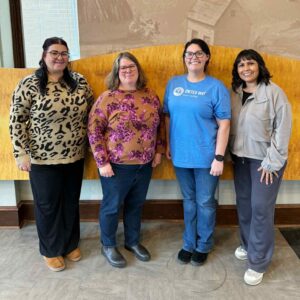
photo by: Contributed
The United Way of the Kaw Valley’s new community resource navigation team includes Ashley Mason, from left, Heather Coates, the director of community resource navigation; Hannah Swartz-Brown and Sandy Davalos Wainwright.
Heather Coates of the United Way of Kaw Valley knows there are so many nonprofit groups in the community that do amazing work. But she also knows it can be difficult for people in need of assistance to figure out where to turn.
Coates and the United Way are working to make that process smoother for everyone involved. She began working with the United Way in October 2025 as the director of community resource navigation, where she built a team working on the front lines to connect people who need help with the resources they need.
Coates and her team have been out in the community since March and so far have received around 50 referrals to help out people in Douglas County. Coates said the work of the community resource navigators is really holistic — doing “a lot of listening” about the issues in someone’s life and looking for the holes that resources can help fill.
“We don’t just sit at a table, hand you a pamphlet and say good luck,” Coates said. We sit down, talk to you, get information from you and follow up after that.”
The navigators’ work is not just a way to help more individuals, but they also are working on finding ways to make the process easier for local nonprofits by centralizing the referral process on its website. Coates said she and her team hope to fill any gaps to help the community.
“We want to help the people in the community but also help the organizations do their work better,” Coates said.
BECOMING A HUB FOR RESOURCES
Coates said a community navigator program had long been discussed by the United Way but was able to be put into effect last year thanks to a grant from Blue Cross Blue Shield.
With that assistance, Coates has a team of three navigators to cover Shawnee County, the City of Lawrence and rural Douglas County — including Baldwin City, Eudora and Lecompton. Those three navigators have also undergone training as community health workers to better serve any residents.
The navigators are out in the field between “60-70% of the time,” according to Coates, whether that is embedding at local organizations or directly helping people who reach out to the office.
Coates said the navigators help in a variety of ways. Some clients can be overwhelmed because there are “too many things going on in their lives;” others may have fallen on hard times and never needed this kind of help before. Coates said navigators can help clients walk through complicated processes like explaining how to apply for Medicaid benefits — especially important because those applications are often lengthy.
Once the navigator connects with the person, Coates said the navigator will follow up with a call or a visit to make sure they “found the help they worked for.” If they have multiple needs, then the navigator can help them “go down the list” of resources for what next can help them.
For people in need of help, the possibility of finding resources can feel overwhelming. Coates said the community navigators can become a “hub of resources” for people needing assistance.
“I think a lot of people have that going on in their life, we just want to be someone who will help you,” Coates said.
A SYSTEM TO GET A COMMUNITY ‘SNAPSHOT’
The United Way hasn’t just added community navigators to help make it easier to access resources, but they’ve been working to improve the connection with improvements on its website.
Coates said the team implemented a tool on its website where any member of the public could type in their zip code and find a list of resources for what they need. The United Way, using a resource called FindHelp, currently lists over 2,000 potential resources ranging from legal assistance questions to financial services.
Although the site is public, Coates said that the United Way has a special license which gives it “backdoor” access so it can send referrals through that system. Coates said that United Way people could directly talk with other organizations through that platform. Once it refers an individual to a nonprofit, the organization can directly follow up to make sure they got the help they needed without sending “all these emails.”
“It kind of puts it all in one place,” Coates said. “Messages go through one platform which should make it more efficient.”
The platform also will be able to provide important data for the nonprofit community about local needs. Coates said with the all-in-one platform, people can see what people are asking for the most in support and how long it takes to fulfill those resources, which gives a “good snapshot” of data that can help guide policy or funding. For example, if the data finds that more people are being referred for substance abuse treatment, it can lead to more funding for those programs so there is enough supply for the demand.
“I think it’s good for the community to know where (are) the cracks people are falling through,” Coates said.
THE REAL WORK BEGINS
While the first few months of the program were about building relationships with other nonprofits and local organizations, Coates said it is time for the real work of assisting people to begin for the community navigators.
“Once we started going, (the workload) started going,” Coates said.
Along with adding more resources each day on the platform to “make it more robust,” Coates said her team has been out in the community walking people through whatever they need to get back on their feet. She said the United Way as an organization has in general always been a sort of community connector, and she thinks this program is a way to extend that reach more directly.
“By nature, we’re all helpers,” Coates said. “We want to help the folks in the community.”
Other News
Douglas County commissioners express interest in fireworks sales dates that include a weekend

Douglas County commissioners to discuss whether to increase the number of days fireworks can be sold in the county
Lawrence’s first bike lanes with physical barriers are installed on Ninth Street
Data center company plans up to $1,000 a year in tax, utility credits for De Soto households
Supernatural thriller filmed in Lawrence to have multiple showings at Liberty Hall