‘It’s basically King Lear in a coma’: KU alumnus’ novel unites his love of Shakespeare with his expertise in neurology
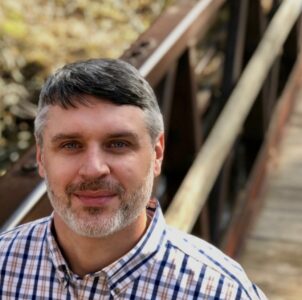
photo by: Contributed
University of Kansas alumnus Dr. Sean Pauzauskie is a neurologist and novelist.
Back in 2005, Sean Pauzauskie, then a senior at KU, took the advice that many an English major ignores.
“You can be a writer, but get a day job,” he was told by his mentor David Bergeron, a professor of English and well-known Shakespearean scholar.
It turned out to be a good advice — not just from the perspective of paying the bills, but also from the perspective of telling stories.
The day job Pauzauskie picked? Neurologist.
“I was an English and biology underachieving double major,” he said, looking at maybe an academic career in Shakespearean studies or Slavic literature, but just felt like he “was maybe too much of a people person” to devote his life to literary scholarship in a university office.
Plus, he didn’t want to “give up the science,” so medical school it was.
Two decades later, he’s employed as a clinical neurologist in Fort Collins, Colorado, and is the medical director of the Neurorights Foundation. He is also — after years of toiling over manuscripts on his days off — a published author.
On Thursday he will be in Lawrence to read from his debut novel, “Stage of Fools,” a take on William Shakespeare’s tragedy “King Lear” — a take that’s set not in ancient Britain but in a modern hospital in San Francisco.
“The idea for the book actually came from taking care of patients who were comatose and families asking what’s going to happen to them,” Pauzauskie said. “It’s basically King Lear in a coma.”
If you’re a bit rusty on the bard, King Lear is the story of an aging monarch that begins with his unwisely dividing his kingdom among his daughters, largely pursuant to their flattery of him, and ends in spectacular, if soaringly poetic, grief for all.
It’s the play that has the famous line “How sharper than a serpent’s tooth it is to have a thankless child!” And “I am a man more sinned against than sinning.”
Pauzauskie’s book takes its title from Lear’s observation “When we are born, we cry that we are come to this great stage of fools.”
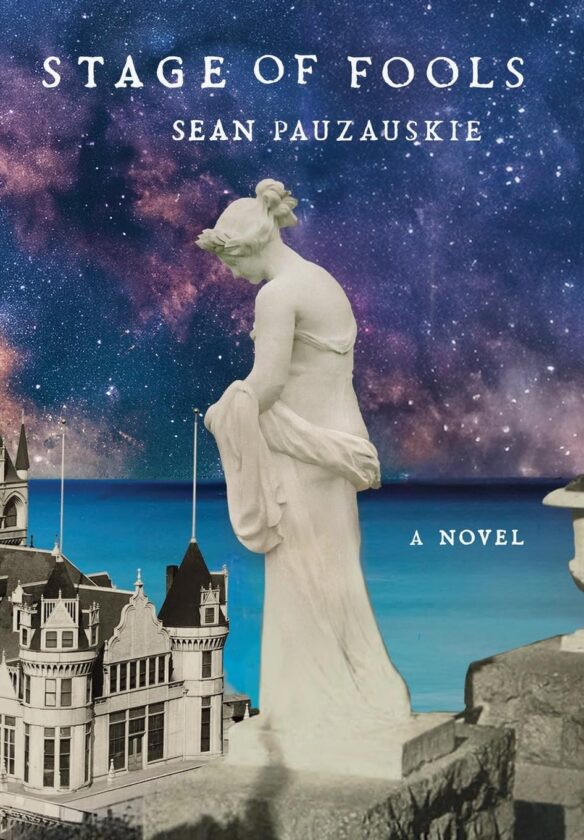
photo by: Contributed
The cover of Sean Pauzauskie’s debut novel
The emotional arc of “Stage of Fools,” he said, is “can this character grapple with his past so that when he wakes up (from the coma) he can do better than King Lear and save his family?”
For added action and tension, there’s also an Alaskan murder mystery “braided in.”
Pauzauskie, who had kept in touch with Bergeron from his college days, reached out to his old prof for advice and support while writing the novel. Bergeron directed him to numerous retellings of Lear — a recent one being Edward St. Aubyn’s “Dunbar,” which casts Lear as a media mogul — as well as to scholarly writings on the tragedy.
Pauzauskie also took some inspiration from one of his favorite novelists, Ian McEwan, whose 2016 book “Nutshell” plays around with Hamlet from the perspective of an unborn child.
Asked what his medical colleagues think about his side gig, Pauzauskie said, “It’s not something I lead with in the doctor’s lounge, like, ‘hey guys, I wrote this novel,’ because I still want to be perceived as being a serious physician.”
But it’s not something he downplays either. He attends literary conferences around the country — later this month he’ll be at Princeton — and this week he hosted a book club at his house where some fellow physicians came over and chatted about “Stage of Fools.”
It was good to have that “barometer” of professional feedback, he said.
He also noted that literary doctors aren’t really that unusual.
“I think there’s a pretty well-established archetype in our culture of the physician-writer,” he said. “You have guys like Abraham Verghese, Daniel Mason, (Anton) Chekhov and Walker Percy,” who won the National Book Award for 1961’s “The Moviegoer.”
“There’s precedent here,” Pauzauskie laughed. “I’m not just out here being weird.”
He cited an “intuitive connection between literature and the work that we do as physicians.” Fundamentally, that connection is story-telling.
“If you listen well enough, the patient will tell you what’s wrong,” he said, but “you have to be a good observer, you have to pay attention.”
And to be a story-teller, a writer, you also have to be a good listener. “How else are you going to be able to convey human nature in an accurate way?” he said. “All doctors are story-tellers in some way, shape or form.”
“Stage of Fools,” in addition to being a take on King Lear also features a neurotechnology device — an ultrasonic thalamic stimulator, which introduces sound waves into the brain to try to wake someone from a coma.
This element of the book ties into Pauzauskie’s role as the medical director of the Neurorights Foundation, a nonprofit that hopes to guide responsible use of emerging neurotechnologies, or “tools that can record, interpret and even manipulate brain activity” — tools that once seemed the realm of science fiction but that are now upon us.
A few years ago, Pauzauskie brought such tools and the consequent need to protect people’s neurological data to the attention of a Colorado lawmaker, who successfully pushed for a state law that grants the same privacy protections to neural data that people have with other biological data like fingerprints and facial images.
While “Stage of Fools” will introduce readers to the very real ultrasonic thalamic stimulator, other neurotechnologies will make an appearance in two of Pauzauskie’s upcoming novels, which, with “Stage of Fools,” will round out a trilogy.
Pauzauskie is scheduled to speak at 7 p.m. Thursday at The Raven Book Store, 809 Massachusetts St., where he will also sign copies of his novel for the public.
KU
KU’s center for eating disorders invites public for open house
KU professors, middle school band director, radio personality among this year’s Phoenix Award honorees: ‘It’s a cool mix’
Hilltop childcare center has been losing money for at least two years, records show

Turnstile rocks KU campus as Day on the Hill returns after two-decade absence
UPDATE: Closure of Hilltop childcare center is final, but the building seems likely to stay