

Facing federal cuts, changes to training, Douglas County CASA appreciates donations and support from multiple KU organizations to continue growing

photo by: Bremen Keasey
The Douglas County CASA offices.
Nonprofits can struggle to raise money even at the best of times, according to Erick Vaughn, the executive director for Douglas County CASA. But federal budget cuts and economic uncertainty have stretched donors even more this year and made things even harder.
“We’re asking more and more often of individuals and sponsors and businesses,” Vaughn said.
Vaughn’s organization helps train volunteers called Court Appointed Special Advocates to advocate for children who have been removed from their homes and placed under court protection after experiencing abuse or neglect. In about 75% of those cases, the child is removed from their home and placed in foster care, with Vaughn estimating that around 140 children are in out-of-home placements across Douglas County each year.
Although the local group in Douglas County was steadily growing, the U.S. Department of Justice under the Trump administration issued 360 notices of termination for federal grants in April, and the national CASA organization was targeted, as the Journal-World reported. And while Vaughn noted some of the federal grant funding was eventually reinstated, it was lower than usual. The local organization got about $10,000 — much lower than the $20,000 to $50,000 it usually receives.
During this time, Vaughn said CASA has been especially thankful for its longstanding ties to two groups at the University of Kansas — the Kappa Alpha Theta sorority and the KU School of Music. The fundraising that both of them do for CASA is critical for the group to not only continue its growth and help more kids in need, but to ensure it can train its volunteers effectively — something made harder by federal direction against diversity and inclusion training.
Despite the hardships, Vaughn said the group has been able to serve more children and add more volunteers, who provide a caring adult presence in the kids’ lives and also investigate and monitor the kids’ cases and report some information to the court.
But Vaughn also knows that there’s still room to grow.
“We’re very excited about moving into next year and having that growth,” Vaughn said.
This year, Vaughn said CASA has been able to serve 101 children in need across Douglas County. But the organization still has about 55 children on its waiting list, and hiring more supervisors to support the volunteers’ efforts would expand CASA’s capacity by about 20 to 30 more kids, Vaughn said.
That’s one way where outside donations like those that Kappa Alpha Theta collects can make a big difference.
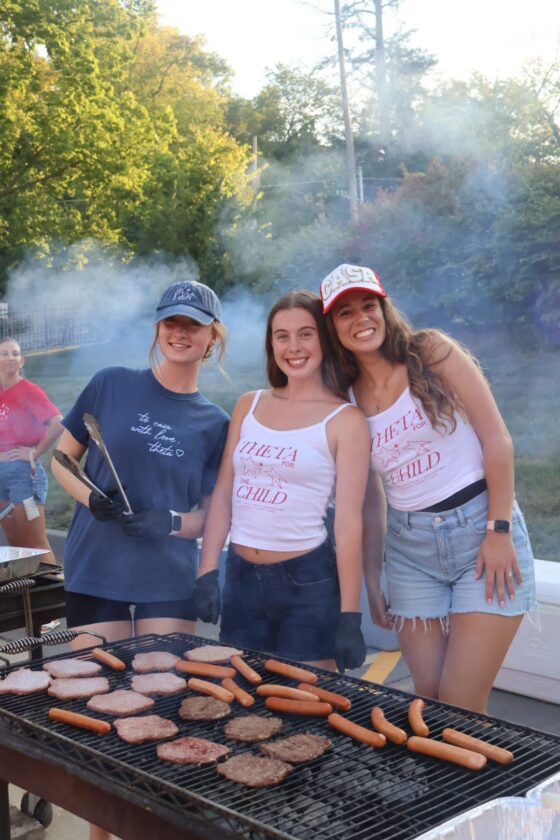
photo by: Contributed
Members of KU’s chapter of Kappa Alpha Theta helped raise just under $30,000 for Douglas County CASA this past calendar year. Erick Vaughn, the executive director of Douglas County CASA, said those funds helped the organization grow its volunteer base and better train their volunteers.
The national Kappa Alpha Theta organization has partnered with CASA since 1989, and all of its chapters work with their local CASA organizations. Jaiden Rensch, the previous philanthropy chair for the Theta chapter at KU, sought to expand the support that Theta provided to CASA, expanding its fundraisers from a single day to a weeklong event.
Rensch said during that week in the fall semester, Theta partnered with local businesses like Jefferson’s and Uplift Coffee for deals where a percentage of the sales would support Douglas County CASA. They also organized a cookout fundraiser and cornhole tournament. Combined with the spring semester fundraisers that raised $12,000, the sorority raised a total of $29,500 for Douglas County CASA this year.
Vaughn said those funds were invaluable to the organization. He said the chapter always raises “surprisingly large amounts” — the Journal-World previously reported that it raises around $20,000 and $30,000 a year for CASA — and that the fundraiser seemed to have even more engagement from the campus community this year. Rensch said that interest and engagement showed how important their efforts were.
“Our members and the greek community as a group came together to support Theta’s mission behind CASA to ensure every child has someone fighting for them,” Rensch said.
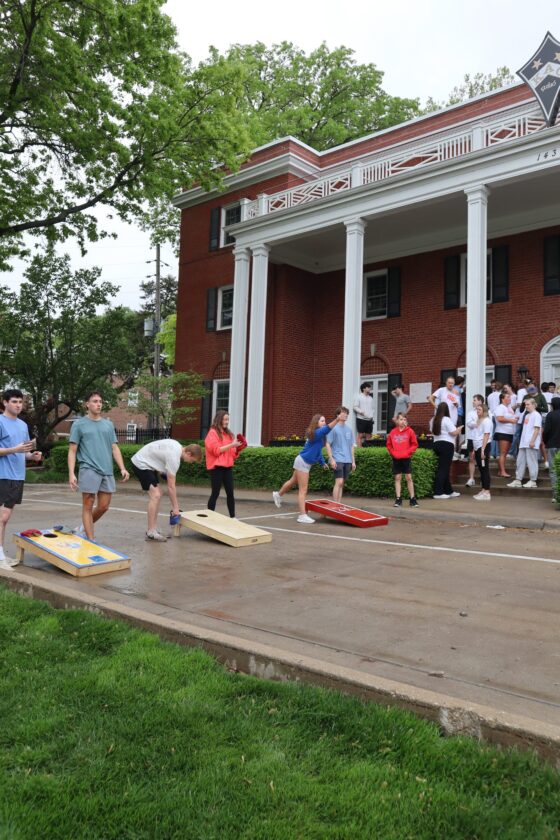
photo by: Contributed
KU students playing cornhole during a tournament hosted by the University of Kansas chapter of Kappa Alpha Theta. Across multiple fundraisers in the year, the sorority raised just under $30,000 for organization that helps support children placed under court protection after experiencing abuse or neglect.
Then there’s the Winds Across the Prairie concert by the Wind Ensemble of the KU School of Music, which is held each year in a scenic location as a benefit for CASA. This year, it raised $178,000.
Together, the sorority and Winds Across the Prairie raised enough funds to cover around 20% of the organization’s budget, Vaughn said.
Those kinds of fundraisers are also crucial in raising awareness about CASA’s mission, Vaughn said, which can be just as important in getting volunteers. This past year, Vaughn said CASA aimed to be more present locally and was involved in “new community events and activities (to get) the word out.” Through that, CASA found 27 people who wanted to be trained as volunteers.
When those volunteers are trained, Vaughn said there will be a few adjustments to how the curriculum is presented — again due to changes on the federal level.
The national CASA program was required as a condition of federal grants to change its training to remove “diversity and inclusion-type training topics” and certain data about racial disparities, Vaughn said. But Douglas County CASA doesn’t plan to stop training volunteers on these topics, he said, because the organization believes the information helps make sure the volunteers “are as prepared as possible.”
Instead, Vaughn said Douglas County CASA is making a few tweaks to reduce the risk to its grant funding. It’s telling volunteers during the training that this information is not part of the national organization’s training rubric, as well as ensuring that none of the money that Douglas County CASA uses for training will come from federal sources. That’s another key reason to have funding sources other than the federal government, Vaughn said.
“We are able to be flexible in how we provide our curriculum in a way that will be more effective and supportive of them,” Vaughn said.
Looking ahead to next year, Vaughn said Douglas County CASA plans to hire another advocate supervisor — a position that supports the organization’s volunteer case workers. But the toughest task for the organization will still be increasing awareness of its mission. Vaughn said that has been made easier by the efforts of KU’s Theta chapter and the KU Wind Ensemble.
“We cannot do (our work) without groups like Theta and all the people in Douglas County supporting us,” Vaughn said.
Other News

Lawrence startups win grants to help get their health and tech innovations to market
Southwest Middle School student Maci Perrins wins fourth consecutive Douglas County Spelling Bee championship
‘This is our family’: At Night to Shine, people with special needs are honored for who they are

City of Lawrence and Lawrence Arts Center invite public to community fair and documentary screening
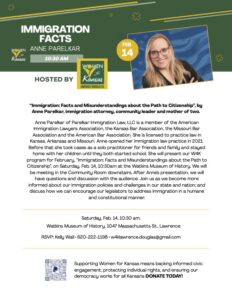
Lawrence chapter civic organization to host talk with immigration lawyer outlining complications of immigration process
