County leaders revise Douglas County Crisis Line’s budget to give it more flexibility in allocating funding
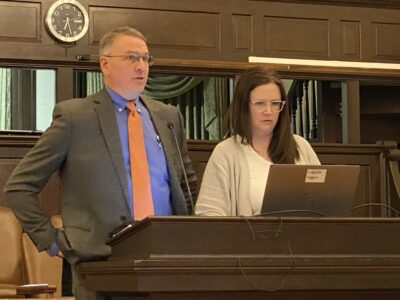
photo by: Austin Hornbostel/Journal-World
Kansas Suicide Prevention Headquarters president and CEO Steve Devore, left, and vice-president of policy and prevention Monica Kurz presented to the Douglas County Commission at its Wednesday, Jan. 4, 2023 meeting. KSPHQ runs the Douglas County Crisis Line.
County leaders voted Wednesday to give the Douglas County Crisis Line a little more flexibility in its 2023 budget.
At its regular meeting, the Douglas County Commission approved a revision to the crisis line’s budget, which was requested by Kansas Suicide Prevention Headquarters. The change doesn’t increase the budget for the mental health crisis line; it just allows for more flexibility in where the agency can allocate county funding.
About half of the crisis line’s funding for 2023 comes from the county. State funds cover about 44%, and the remainder is to be covered by KSPHQ, the agency that has overseen the crisis line project since April 2022.
On top of providing 24/7 crisis line coverage for Douglas County residents, the hotline also handles dispatch and referrals for Bert Nash Community Mental Health Center’s mobile crisis response team, which launched in September 2022. KSPHQ vice president of policy and prevention Monica Kurz told commissioners Wednesday that the mobile team had responded to 31 calls from the crisis line since it launched.
That success has caused a need for KSPHQ to adjust what positions it directs funding to, KSPHQ president and CEO Steve Devore told commissioners. For example, the top position in the original funding agreement — a crisis line program coordinator — will be changed to a crisis line director in the amended agreement, which Devore said is intended to reflect the evolution of the agency’s staffing model and scope of service since last April.
“This program is important enough, and is really at the heart of the mission of what we do, that we want to be able to provide those same funds to be able to help make this program as vibrant and as successful as possible,” Devore said. “You’re going to see we’re putting in our own resources to make sure that this is as successful as we possibly can.”
In other business, commissioners:
* Discussed when the commission might receive another update about the status of the Treatment and Recovery Center of Douglas County, the yet-to-open behavioral health crisis center.
Douglas County Administrator Sarah Plinsky told commissioners she doesn’t have an answer for when that might be, and that’s because county staff is still reviewing the materials submitted by Bert Nash Community Mental Health Center during the most recent update about the center in mid-December. Bert Nash is aiming to be the entity tasked with operating the center.
Commissioner Shannon Reid said that rather than regular public updates about the center each week, she would prefer to get updates with more substance, and the commission didn’t direct county staff to provide more frequent updates at meetings.
* Tabled one rezoning request and approved another.
One of the requests, submitted by BG Consultants on behalf of Garber Enterprises Inc., asked to rezone about 11 acres adjacent to Kansas Highway 10 just northwest of Rock Chalk Park outside Lawrence from “cluster preservation” to “light industrial.”
The Journal-World previously reported that Garber Enterprises wanted to build about six mini-warehouse-style buildings totaling roughly 100,000 square feet on vacant land next to the South Lawrence Trafficway.
Commissioners held off on deciding on that request so that county staff could revise the resolution to remove any additional conditions recommended by planning staff. It’ll appear on the commission’s consent agenda next week for final approval.
The second request — which commissioners approved Wednesday — was from Axiom Partners LLC on behalf of the current property owners, Jay and Mary Bessey, and sought to rezone approximately 10 acres at 316 East 900 Road east of Baldwin City along U.S. Highway 56 from “transitional agricultural” to “general business.”
The property contains the former Marion Springs Elementary School, a structure listed with the National Register of Historic Places, and the applicant intends to operate a “rural business incubator” on the property. That would involve repurposing the building to include a small manufacturing business, a machine shop in the school’s gymnasium and office spaces in the school’s classrooms. Changes to the structure would be subject to review and approval by the Kansas Historical Society first, and the application notes that the intent is to leave the building as unchanged as possible.
Other News
U.S. Sen. Roger Marshall faces Democratic, Libertarian challengers in general election

Incumbent Douglas County commissioner and newcomer challenger face off for District 5 seat
Primary winner faces incumbent’s write-in campaign in Douglas County Commission District 4
A student-run coffee shop will open at Community Connections at Pinckney next week
Douglas County commissioners to discuss proposed changes to funding agreements with community partners