Lawrence mother and daughter navigate changes in relationship after dementia diagnosis
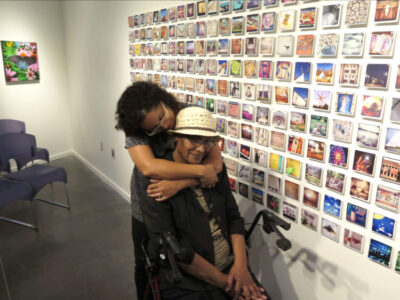
photo by: Courtesy of Ann Dean
Ann Dean and her mother, Fairris, pose for a photo during Dean’s art exhibit at the Lawrence Arts Center in 2019. Dean is a photographer, and she told the Journal-World art runs in the family.
The past decade has been one of change for Lawrence resident Ann Dean and her mother, Fairris.
Dean originally moved to Lawrence to attend the University of Kansas, and she moved her mother here around 10 years ago. That was one of many changes for Fairris, now 86, who was born in rural Mississippi and raised in St. Louis.
“She lived in that same house until I moved her up to Lawrence about 10 years ago,” Dean told the Journal-World in a phone call Wednesday.
Dean is an artist by trade; she’s a photographer, and also teaches classes on the subject at the Lawrence Arts Center. Art is something that runs in the family, she said, and a skill her mother passed to both Dean and her brother, who lives in San Francisco.
“She was an artist, a painter,” Dean said. “And she very much instilled the arts in both of us.”
But Fairris doesn’t paint anymore, Dean said, another change. Still more things have changed in the past decade, too, like how Fairris stopped driving herself places the day she moved to Lawrence.
But the biggest change was the onset of dementia.
Last March, Fairris received the second dose of the coronavirus vaccine. Because of her body’s immune response to the shot, doctors discovered an existing severe urinary tract infection. Alzheimer’s disease advocacy organizations note that infections like UTIs can speed up the progression of dementia, and that’s exactly what happened in Fairris’ case.
“Whether it goes away when the UTI goes away is kind of up in the air, and for her it did not,” Dean said. “It’s just been a real uphill battle since then to try to keep her living on her own and to take care of her, because she just can’t remember anymore.”
Fairris is still living independently in her own apartment, Dean said, and they’re trying to keep it that way as long as they can rather than having Fairris live in a nursing home or other type of skilled nursing facility. As a result, Dean spends a lot of time at her mother’s place helping out. Fairris still knows who her daughter is, but Dean said she just can’t remember to do other things for herself anymore. Now, Dean has taken on a parental role — making sure her mother is eating healthy, safe in a clean home, and that her finances are in order.
A team from the Visiting Nurses Association helped with some of that when Fairris first left the hospital, but Dean said that was only funded through Medicare for a month. Dean said she knew she’d continue to need more help for her mother to continue living independently, so since then a physical therapist and home health aide from that Visiting Nurses team has stayed on and continued to visit once a week. Other services, like Meals on Wheels, further assist with Fairris’ care.
“With limited funds, it’s hard to get what she needs, so we started Meals on Wheels, which comes Monday through Friday,” Dean said. “So she definitely has a good dinner every evening. On the weekends, I’ll cook for her or something like that.”
Dean said for all of its negatives, the dementia diagnosis actually brought about a few good changes, as well. For one, she realized her mother needed more exercise and more balanced meals. Dean also saw how having a better-structured routine would help her mother.
Another big change has been how Dean addresses her mother — by her first name. She responds to Fairris better, Dean said, and the dynamic is such that they’re more like peers.
“And that works for me, also, because we have a different relationship now that’s not as much of a mother-daughter relationship as it used to be,” Dean said. “For better or for worse; that comes along with a lot of things for me, but it’s what I have to do to make it work.”
It’s been overwhelming, Dean said, and happened fast. Along with the pandemic, the past couple of years have been difficult, and she said it’s taken a lot to get used to such a drastic change while also balancing the life of a working artist.
An Alzheimer’s Association support group has helped Dean grapple with that. She said it’s been a great support system for navigating a situation where there aren’t many resources for people going it alone. But it’s something that can be done, Dean said, even if it comes with some sacrifice. She said the Alzheimer’s Association’s 24-hour help line, (800) 272-3900, has also been a good tool, even if just to have someone to talk to.
Dean said she plans to continue doing whatever she can to help Fairris live with dignity and grace.
“She deserves this, and if I can give it to her, I’m going to while I can,” Dean said. “She just deserves this attention and help. She’s given me a lot in my life, and I feel like I owe it to her to give it back now, you know?”
Other News
Douglas County commissioners approve changes to employee health care plan to address increasing health care costs

With new murals, Junior Girl Scouts and Jewish congregation hope to turn bland buildings ‘into something beautiful’
The latest legal notice filings in Douglas County
State law requires residents of a county to be notified of a lot of different legal matters that are underway at ...
Douglas County commissioners to consider employee health care plan changes as costs expected to increase
KU Religious Studies to host public talk with Justice Matters about the group’s role in promoting community health