Local author talks about writing true-crime book with her famous father
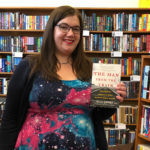
photo by: Dylan Lysen
Local author Rachel McCarthy James stands in The Raven Book Store with the paperback version of her book "The Man From The Train."
Having a famous father can have its perks — like having him ask you to help research and write a book that attempts to solve some early-20th-century murders.
Rachel McCarthy James, the Lawrence native and daughter of Bill James, the man who forever changed the way people think about baseball with his writing on sabermetrics, recently co-authored her first book, “The Man From The Train,” with him.
In the book, Bill and Rachel use mountains of research from newspapers, arrest records and many other documents to uncover the truth behind a string of murders between 1898 and 1912 by a serial killer who used an ax for his crimes and the train as his getaway.
The book was a finalist for the 2018 Edgar Award for Best Fact Crime and a Kansas Notable Book.
The paperback edition of the book was released Oct. 9, and the authors will appear at 7 p.m. Tuesday at the Raven Book Store for a release party, book signing and Q&A event.
Outside of her work with her father, Rachel has published in literary magazines and online publications such as McSweeney’s, Broadly, and The New Inquiry. While she has published fiction, most of her recent work has been freelance journalism and nonfiction writing.
Rachel spoke with the Journal-World this week to shed light on her experience researching and writing the book and what it’s like being the daughter of Bill James.
The following interview has been edited for length.
LJW: You’re a Lawrence native and a graduate of Free State High School, but you went to college out of state to Hollins University in Virginia. When did you return to Lawrence and why?
Rachel McCarthy James: In December 2012, my parents were trying to get me back. So I came back to be with family. My husband (Jason Graham) is from Roanoke, Virginia, and we came out here to do something different. He grew up in Roanoke and never lived anywhere else, so we figured it would be good to live somewhere else for awhile.
LJW: What’s it like growing up the daughter of Bill James?
RMJ: I always had an awareness of his career as a writer. He’s always seen me as a writer since I was a little kid. He has a story he likes to tell about how he was at a gathering with his agent and a few other people in New York and someone asked about me and he said, “Oh, I think she’s a writer.” That kind of set my path going forward.
LJW: Are you a baseball fan yourself?
RMJ: I’ve never been a big fan of baseball, but his work with the Boston Red Sox has been really exciting (Note: Although based in Lawrence, Bill James serves as senior adviser on baseball operations for the Red Sox). We were fans of the Kansas City Royals until he started working for the Red Sox (in 2002). It’s been a good experience.
LJW: Along with the book, your recent work seems to be freelance journalism and nonfiction. Have you written anything else?
RMJ: I have done fiction and I’m working on a couple of novels, like I think a lot of writers are. I haven’t published any fiction recently, and it will be awhile until I get back into that.
LJW: You co-wrote this book with your father. How did you get involved in the project?
RMJ: When Dad hired me to write this, it was about the same time I moved back to Lawrence. He didn’t plan to hire me as a co-author but as a research assistant. He gave me a test to see if I had the research skills to do it.
He sent me the first chapter of the book about the Meadows (a family of victims who are featured in the book). He asked me to read it carefully and asked if I could come up with any other crimes that I thought might look like it. It didn’t take long. The Villisca murders (a famous family murder in Iowa) come up. The parallels were pretty apparent right away.
He hired me as a research assistant and he asked me to start searching between 1907-1908, and I didn’t find that much. But I wanted to keep the job because I just moved cross country and needed a job. So I kept digging and kept pushing, and that’s when I started to look earlier in that decade and find a lot of crimes. Within a couple of months I found the first crime (of the serial killer) and that gave the book a shape and a narrative. From that point on we thought of it as “our book.”
LJW: How did you split the writing?
RMJ: It’s his organization and his construction. I would say it’s 80 percent his words. The book reveals who the killer is in the first murder and that’s in my words. That’s written by me and my voice. Most of the rest of it is in my dad’s voice.
I would find these cases and write 500- to 1,000-word descriptions of them and send them to him. He would take that and write it into the chapter with his vision of the book. That’s his words but a lot of times I’ll read a paragraph and I’ll think, “I remember writing about that paragraph about West Virginia and the trees and fall.”
LJW: In the book, you solve a string of murders in the early 20th century leading back to one man, a serial killer traveling by train.
RMJ: We present a solution. Some people are not convinced, and I understand that. It’s fair for people to be skeptical because it’s a lot of crimes. We’re not equally sure on all of them. There are some that we feel very confident about, but there are some that I think we don’t have enough information about them.
This does identify a lot of these crimes, and I do believe we identify who did them, but it’s the first book about this whole series of crimes. I don’t think it will be the last. This guy killed a lot of people, and it’s a lot of material for other writers and researchers to dig into.
LJW: How did it feel to come to the realization of who you believe the murderer is?
RMJ: Research can be a really exciting experience, and this is tempered by the fact that these are horrible crimes. While that tempers it, it is exciting to suddenly see this pattern clearly and you know it and can’t tell anybody else, which is frustrating and exciting at the same time. While I was researching this book I was always worried somebody would make this connection before me.
LJW: Was working on this book a bonding opportunity for you and your father?
RMJ: It’s definitely a different turn for our relationship. I left home when I was 18, and when I moved back we started this. It’s a big shift in our relationship — first of all, him seeing me as an adult. It’s really made us a lot closer in some ways. In some ways we’re more like coworkers, which can be tense. But overall it’s been a really smooth process. We didn’t have any huge fights like I thought we might when I took on this project.
We had a similar vision for this project, and I never thought he wasn’t listening to me. If I said something, I knew he would take me seriously, even if he didn’t necessarily agree with me. Overall, it was really good.
LJW: Will you work with your father again?
RMJ: Probably not (laughs). It’s nice to just have my dad be my dad and not my coworker.
LJW: Does this book open more writing avenues for you?
RMJ: Absolutely. I’m really grateful I had this opportunity. It’s a great first step into the writing world.
Arts and Entertainment
Theatre Lawrence’s ‘LIZZIE’ puts a Riot Grrrl edge on infamous ax murders

Go, See, Do: Maple Leaf Festival, concerts and a haunting tour
KU professors, middle school band director, radio personality among this year’s Phoenix Award honorees: ‘It’s a cool mix’
Duane ‘Keffe D’ Davis gets 40 years to life for orchestrating Tupac murder
RJ Mitte, ‘Breaking Bad’ actor and disability rights champion, dies at 34