Commissioners weigh infrastructure limits as Douglas County begins discussing rules for data centers and energy storage developments
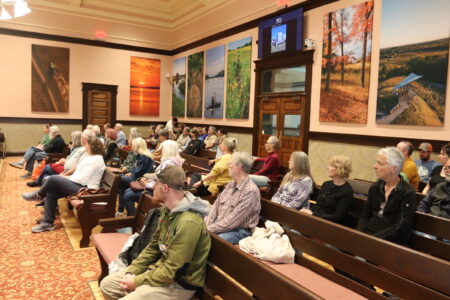
photo by: Josie Heimsoth/Journal-World
Many community members gathered for the Douglas County Commission meeting on Wednesday, May 6, 2026 to hear about the county's findings on data centers and similar developments.
As Douglas County leaders held their first discussion on regulations for data centers and similar developments, several questioned whether the county’s infrastructure could even support them at all.
As the Journal-World reported, this July will mark two years since county commissioners initiated a text amendment to its zoning and land use regulations to explore rules for data centers, digital asset retrieval systems and battery energy storage systems. Currently, none of those land uses are clearly defined in Douglas County’s zoning code, creating uncertainty around how they should be reviewed or permitted.
County staff came to commissioners on Wednesday to present findings of their research thus far, and even provided some recommendations for how commissioners could move forward, as the Journal-World reported. Dozens of county residents were also in attendance.
Staff recommended data center and crypto currency mining facilities be allowed in industrial-zoned areas and battery storage in districts where other utility-scale uses are allowed, if they also receive a conditional use permit from the County Commission. However, commissioners raised concerns about the demands on local infrastructure and whether it was enough to even sustain a data center or crypto mine.
Commissioner Karen Willey said she really struggled to see how the unincorporated areas of Douglas County could even accommodate large-scale data center and digital asset retrieval operations, as these developments have major water and electricity demands that seem tough to meet in the county’s rural areas.
Willey said the county’s rural infrastructure systems already appear to be stretched thin, particularly in rural water districts. County Planner Karl Bauer also said that from his conversations with some of these districts, there would need to be significant infrastructure upgrades to meet water demands for data centers.
Commissioner Patrick Kelly added that he didn’t consider data centers to be an appropriate land use in these areas, because of the questionable infrastructure.
“I don’t know how to create code for something that’s not possible,” Kelly said, adding that the county should try to better understand the role utilities would play in determining resource needs for these projects.
Commissioners and staff spent part of the meeting trying to sort out the differences between outright banning certain uses – like data centers and digital asset retrieval systems – and simply not listing them as permitted uses in the county zoning code. While some uses can be designated as “non-permitted”, meaning they are not allowed under the zoning code, an outright ban can become legally complicated.
“Legal could potentially provide some insight around what would a ban look like,” Commissioner Erica Anderson said. “Is it even allowable?”
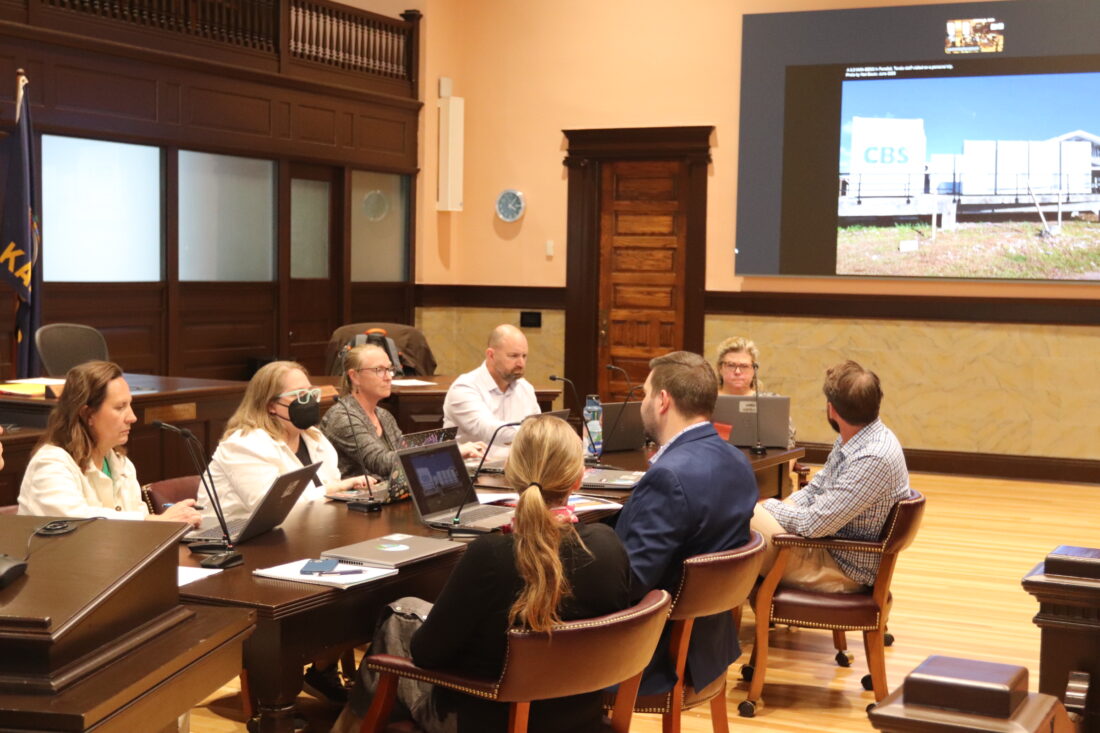
photo by: Josie Heimsoth/Journal-World
Douglas County commissioners are pictured on Wednesday, May 6, 2026.
Commissioners directed staff to gather additional legal guidance before moving further on the discussion with data centers and cryptocurrency mining.
Moving forward, commissioners decided to separate future discussions on battery energy storage systems from data centers and digital asset retrieval systems. Staff will begin working on battery energy storage regulations first and delay more detailed conversations about data centers and digital asset retrieval until after the county’s ongoing zoning diagnostic review is completed.
For battery energy storage, many commissioners voiced support for limited regulations for these developments. Kelly said he could see the use as appropriate alongside utility-scale energy production. Commissioners also said it might be easier to discuss battery energy storage first because there are some regulations already in place for these developments with solar.
Many of the residents that attended the County Commission’s work session stuck around for the business meeting to provide public comments. Commenters expressed concerns on the environmental impact and local control of data centers, with some asking for the county to implement a moratorium on these developments until regulations are approved.
“Where does the community begin to benefit? The infrastructure costs are not always contained within the project itself,” one of the commenters said. “Not only are we talking about grid systems and things like that, but also decommissioning costs, which we have to have a longer term perspective.”
The county doesn’t have a moratorium in place, but a “de facto pause.” This acts similarly to a moratorium, and planning staff previously told the Journal-World that they will not consider applications for any of these developments until there are regulations.
IN OTHER BUSINESS, COMMISSIONERS:
• Heard a preview of the proposed 2027 budget from county staff along with some anticipated challenges for the upcoming budget cycle. In the last five years, Douglas County’s assessed property values have had large increases, with an average increase of 8.1%. However, the most recent projections show growth of about 4% for the 2026 tax year – the lowest rate since 2021.
Another challenge facing the county in the upcoming budget cycle is revenue sources and expenditures for the behavioral health fund, which funds behavioral health services primarily through a quarter-cent sales tax passed in 2018. More recently, growth in the fund has leveled off. Forecasts for 2026 and 2027 show only modest changes in revenue for the fund, and operating costs for the Treatment & Recovery Center take up a large chunk of those funds, as the Journal-World reported.
The budget priorities for next year include sustaining core services and rising operational costs; investing in the Douglas County workforce; continuing support for health and human services; and early planning for significant upcoming capital needs.
• Voiced support to a new funding formula for Lawrence-Douglas County Fire Medical. As the Journal-World reported, the proposed new formula results in a split between the costs of LDCFM, with 59.7% from the City of Lawrence and 40.3% from the county. The new formula is expected to take more factors into account than just the department’s staffing split – such as population stats, the locations of incidents the department responds to, and the total number of runs that units go on.
• Approved a comprehensive plan amendment to Plan 2040 for general cleanup and updating, including updating language to reflect changes in the 2024 Land Development Code and the 2019 Douglas County Zoning Regulations. Staff will also be adding 2020 Census demographic data as well as correcting broken links and errors.
• Purchased a 2026 Spartan fire engine and associated equipment for Consolidated Fire District No. 1 with a cost not to exceed $850,000.
• Executed a memorandum of understanding with the city for the 2023 and 2024 Edward Byrne Memorial Justice Grants funding awards to the Lawrence Police Department and Douglas County Sheriff’s Office. The two entities jointly applied for the grants to fund expensive technological projects, and they equally split the funds awarded. The 2023 Edward Byrne Memorial Justice Grant award is $39,791 and the 2024 award was $35,863.
Other News
Douglas County commissioners discuss tracking results of awarded funding to community partners

Baldwin High already has won $25K and is competing for $1M through national sports program

On sister city visit, delegates from Hiratsuka, Japan, see Lawrence’s friendship firsthand
U.S. Sen. Roger Marshall faces Democratic, Libertarian challengers in general election

Incumbent Douglas County commissioner and newcomer challenger face off for District 5 seat