Tax base begins to grow more slowly in Douglas County, setting the stage for the county’s 2027 budget decisions
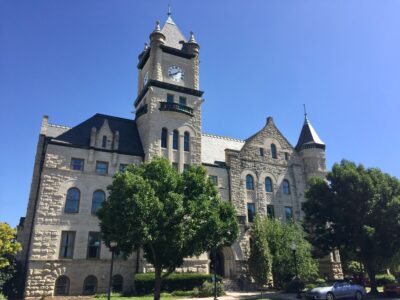
photo by: Journal-World
The west side of the Douglas County Courthouse, 1100 Massachusetts St.
Even though Douglas County’s tax base is continuing to grow in 2027, county staff estimate it will be at a noticeably slower pace than in recent years.
Douglas County’s assessed property values have significantly increased over the past decade, averaging an increase of 6.8%. In the last five years, that average is even more significant with an increase of 8.1%. However, the most recent projections show growth of about 4% for the 2026 tax year – the lowest rate since 2021.
On Wednesday, county commissioners will be briefed on assessed property values and some of the other upcoming challenges for the 2027 budget, taking a look at the county’s overall revenue outlook and spending pressures heading into next year’s budget process. According to a memo in the agenda, the budget priorities for next year include sustaining core services and rising operational costs; investing in the Douglas County workforce; continuing support for health and human services; and early planning for significant upcoming capital needs.
With the county’s total amount of new taxable value coming into the system increasing more slowly than in recent years, for property owners, that doesn’t necessarily mean a smaller tax bill.
Even with slower growth, individual property tax bills can still go up. That’s because a tax bill is not determined only by overall growth in the tax base, but also by budget decisions and tax rates. If county costs increase faster than revenue growth, the county may need to maintain or raise the mill levy – or property tax rate – to cover the difference. So a slower-growing tax base doesn’t automatically translate into lower taxes for homeowners.
But there’s no saying how this could impact taxpayers yet until the proposed 2027 budget is crafted with the mill levy, and commissioners will ultimately decide whether to increase, decrease or keep the rate flat this summer.
Another challenge facing the county in the upcoming budget cycle is revenue sources and expenditures for the behavioral health fund, which funds behavioral health services primarily through a quarter-cent sales tax passed in 2018. A significant portion of these funds has gone towards operations at the county’s Treatment & Recovery Center.
The fund saw strong early growth after it was implemented, rising from partial collections in 2019 to about $6.6 million to $6.7 million annually in recent years starting in 2023. More recently, that growth has leveled off. Forecasts for 2026 and 2027 show only modest changes in revenue for the fund.
Meanwhile, demand on the fund is continuing to increase. Its annual operating costs exceed $11 million due to full operation of the Treatment & Recovery Center and behavioral health programming. Since sales tax revenues alone are not able to cover these costs, the county has been relying on property tax support since 2024 to fill the gap.
Other major revenue sources in the county are also showing a pattern of stabilization after several years of more volatile growth. The county’s 1% general sales tax has increased over the past decade but has largely leveled off since about 2025, with only some growth expected going forward. Investment income has also shifted. After a sharp increase beginning in 2023 — when earnings nearly doubled from about $4.6 million to over $9 million — projections for 2026 and 2027 show returns leveling off at roughly $6.9 to $7 million annually.
County departments and community partners have also submitted 44 supplemental budget requests so far for the 2027 budget cycle, totaling in $6.9 million in additional funding needs beyond baseline budgets. These requests cover a range of services and programs, and some may be eligible for funding from the behavioral health sales tax fund.
The 2027 budget hearings are currently scheduled for July 6-15 with budget deliberations from July 16-24. The public hearing for the 2027 budget is scheduled for Aug. 26.
IN OTHER BUSINESS, COMMISSIONERS WILL:
• Provide feedback to a new funding formula for Lawrence-Douglas County Fire Medical. As the Journal-World reported, the proposed new formula would result in a split between the costs of LDCFM, with 59.7% from the City of Lawrence and 40.3% from the county. The new formula is expected to take more factors into account than just the department’s staffing split – such as population stats, the locations of incidents the department responds to, the total number of runs that units go on.
• Consider a comprehensive plan amendment to Plan 2040 for general cleanup and updating, including updating language to reflect changes in the 2024 Land Development Code and the 2019 Douglas County Zoning Regulations. Staff are also proposing to add 2020 Census demographic data as well as correcting broken links and errors.
• Consider purchasing a 2026 Spartan fire engine and associated equipment for Consolidated Fire District No. 1 with a cost not to exceed $850,000.
• Consider executing a engineering services agreement with BG Consultants Inc. for inspection services with a maximum cost of $97,780. These services are for a bridge replacement project carrying North 1400 Road over a tributary to Captain Creek east of Eudora. Construction is scheduled to begin on May 15.
• Consider executing a memorandum of understanding with the city for the 2023 and 2024 Edward Byrne Memorial Justice Grants funding awards to the Lawrence Police Department and Douglas County Sheriff’s Office. The two entities jointly applied for the grants to fund expensive technological projects, and they equally split the funds awarded. The 2023 Edward Byrne Memorial Justice Grant award is $39,791 and the 2024 award was $35,863.
The County Commission will have a work session beginning at 4 p.m. to discuss data center, digital asset retrieval and battery energy storage systems on Wednesday in the Douglas County Commission meeting room at 1100 Massachusetts St. The business meeting will follow at 5:30 p.m. The meeting will also be available via Zoom.
Other News
Douglas County commissioners discuss tracking results of awarded funding to community partners

Baldwin High already has won $25K and is competing for $1M through national sports program

On sister city visit, delegates from Hiratsuka, Japan, see Lawrence’s friendship firsthand
U.S. Sen. Roger Marshall faces Democratic, Libertarian challengers in general election

Incumbent Douglas County commissioner and newcomer challenger face off for District 5 seat