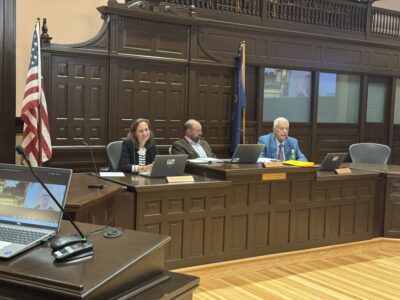
Douglas County commissioners approved funding towards 22 local heritage conservation projects
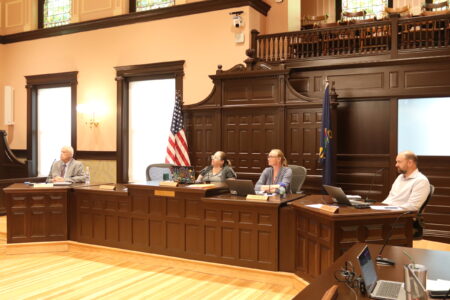
photo by: Josie Heimsoth/Journal-World
Douglas County commissioners met on Wednesday, April 15, 2026.
Douglas County commissioners allocated funding to 22 local heritage conservation projects on Wednesday spanning Indigenous history, ecological restoration and community arts.
This year, there were 42 applications for 2026 Natural and Cultural Heritage Grants with the requested funding exceeding $1,050,000 – the largest number of applications received in the program’s history and highest total funding request.
In 2026, a total of $250,000 was made available for grants. Of the total funding, $40,000 was available exclusively for seed grants, which include requests of $5,000 and below. The remaining $210,000 was available for target grants – requests above $5,000 and up to $60,000.
The County Commission approved funding for 22 projects, including 11 seed grant and 11 target grant proposals:
• Douglas County Historical Society received $35,000 to create interactive museum exhibits at the Watkins Museum highlighting Indigenous histories and perspectives in Lawrence and Douglas County.
• Haskell Indian Nations University received $35,000 to host a 100th anniversary powwow and buffalo feed honoring the Haskell Stadium and Arch with cultural programming and community events.
• Native Lands Restoration Collaborative received $30,000 to restore native plant habitats along Burroughs Creek while offering educational programs and cultural activities tied to land stewardship.
• University of Kansas Museum Studies received $26,600 to preserve, digitize, and expand public access to thousands of artifacts in the Haskell Cultural Center and Museum’s collection.
• Outdoors Unscripted received $20,000 to fund artist-led programs and public events that connect residents to local ecosystems through storytelling, art, and outdoor experiences.
• Kapwa Leadership received $19,200 to commission Native artists to create public murals in Lawrence while mentoring interns and hosting community learning events.
• Kansas Biological Survey received $13,000 to research freshwater mussels in the Wakarusa River and develop exhibits and educational materials about their ecological importance.
• United Cemetery Association received $12,200 to professionally clean and restore historic grave markers at Appanoose Cemetery dating back to the late 1800s.
• Lawrence Model Railroad Club received $10,000 to build a model railroad display and educational programming illustrating the role of railroads in Douglas County’s development.
• Botanical Belonging received $5,000 to establish native plant gardens in local schools and provide prairie ecology education for students and the community.
• Fisch Bowl received $4,000 to create free downtown studio spaces for Indigenous artists who will engage the public through their work and cultural sharing.
• Lawrence Arts Center received $5,000 to produce and distribute a children’s book about the history of a Mexican American community in East Lawrence.
• Prairie City Cemetery Association received $5,000 to repair and preserve nearly 100 historic tombstones while researching and sharing the cemetery’s history.
• Kaw Valley Prescribed Burn Association received $4,500 to purchase equipment for conducting controlled burns that improve native habitats and reduce invasive species.
• Harvestry by Hand received $4,000 to host community workshops teaching traditional wool processing and weaving using locally sourced materials.
• Lawrence Public Library received $4,000 to provide educational programs, workshops, and resources focused on native plants, land stewardship, and natural arts.
• Sparks on the Creek received $4,000 to expand a community firefly festival along Burroughs Creek with art, music, and nature-based programming.
• Great Blue Heron received $3,000 to create and improve public access points for canoeing and kayaking along Rock Creek.
• Douglas County Extension Master Gardeners received $3,000 to build accessible gravel pathways and signage for a native and medicinal plant demonstration garden.
• Bert Nash Community Mental Health Center received $2,725 to host a community festival centered on cultural connection and mental health awareness during Minority Mental Health Month.
• Operation Wildlife received $2,500 to distribute educational yard signs encouraging residents to protect local wildlife, especially from threats like outdoor cats.
• Lumberyard Arts Center received $2,275 to host programs and exhibits that connect residents to conserved landscapes through art, history, and community engagement.
Commissioners expressed an interest in further exploring ways to improve collaboration and refine the grant program in order to ensure its effectiveness. Kaitlyn Ammerlaan, the heritage conservation coordinator, said that while the program accepts applications from any organizations, there was a large number of for-profit organizations.
“I think we might take a look at revising that,” Ammerlaan said. “I know it’s open intentionally to capture a wide variety of different organizations that might be interested in applying, but I think there might be some considerations.”
IN OTHER BUSINESS, COMMISSIONERS:
• Heard a semi-annual update on the work in the behavioral health component of the 2024-2029 Community Health Improvement Plan, or CHIP – the five-year strategic roadmap for health and wellbeing in Douglas County. The goal of this area is to create a more integrated behavioral health system that supports individuals across their lifespan.
As the Journal-World reported, during the presentation, staff reviewed the progress on data, implementation challenges and opportunities for improvement in three key focus areas: implementing Zero Suicide, optimizing the behavioral health crisis response system and integrating lived experience.
• Received a report about the findings from an annual review of Plan 2040, the comprehensive, long-range planning document for Lawrence and unincorporated Douglas County that guides land use, development and policy decisions through the year 2040. The review is a routine, state-required process in which the Planning Commission evaluates whether the plan remains current and effective.
The annual report said that Plan 2040 continues to serve as an accurate framework for guiding decisions on long-term planning and growth in Lawrence and Douglas County.
In 2025, three amendments to the comprehensive plan were considered, with two fully adopted and one still pending. The amendments adopted involved one changing about five acres near Bob Billings Parkway and K-10 from public/institutional use to a mix of medium-density residential and neighborhood commercial, and another redesignated a small area in the Oread neighborhood from commercial to high-density residential to support an affordable housing project. A third amendment, still pending final approval, proposes updates to the future land use map for the New Boston Crossing area in the southern development plan.
• Heard an update from Lawrence-Douglas County Public Health, outlining current operations, financials and how the organization is expanding and strengthening core health services. LDCPH has begun providing nursing care at the juvenile detention center and is planning to relaunch family planning services in July 2026.
LDCPH is also pursuing funding to expand community-based primary care, particularly for underserved populations through partnerships and street outreach programs. In addition, WIC services are being expanded through targeted outreach in smaller communities like Eudora and Baldwin City, while family support programs are seeking to launch a universal home visiting initiative to provide early support to families beginning in mid-2026.
• Held a work session with K-State Extension – Douglas County to discuss the organization’s programs, partnerships and impact. Its work spans areas like agriculture and natural resources, youth development through 4-H, community health, food systems and economic development. Extension works alongside community partners to achieve the goals of the anti-poverty and food security workgroups in the Community Health Improvement Plan.
• Approved the 2026 2026 Vegetation Management Plan, which directs daily operations including roadside mowing, park maintenance, revegetation practices, herbicide use and noxious weed control in the county. The plan was first adopted in 2022 and it has a two-year cycle. The last plan was last approved in 2024, and commissioners directed staff to add the plan for consideration on Wednesday’s agenda at the last business meeting for review and public input.
• Approved a grant application from Douglas County Criminal Justice Services for $91,900 in funding from the Kansas Department of Corrections to ensure youth have access to mental health and substance use assessments and services.
Other News

U.S. Army says cleanup at Sunflower Army Ammunition Plant is ‘slowing down’; PFAS investigation at site still needs funding
‘One of a kind’: Sale at the Lawrence Arts Center will find new homes for late musician’s unique custom guitars

Go, See, Do: KU homecoming, Halloween happenings and other events
Student-run coffee shop opens at Community Connections at Pinckney, teacher receives surprise $1,000 award
‘This is for all of us’: Midco Prairie, an oasis of native plants in downtown Lawrence, opens to the public