Solving Douglas County’s homelessness crisis will take more community buy-in and more data, stakeholders say
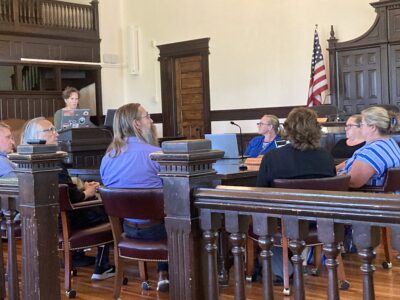
photo by: Matt Resnick | Journal-World
Jill Jolicouer delivers a presentation addressing homelessness and affordable housing during a Douglas County Commission work session, June 28, 2023.
If Douglas County wants to end its homelessness crisis, it won’t just take millions of dollars in housing — it will also require more buy-in from the community and more efforts to document the scope of the problem.
That’s what county staffers and other social service stakeholders told the County Commission on Wednesday during a progress update about “A Place for Everyone,” the nascent plan that aims to virtually end homelessness in Douglas County by 2028. Among other things, the county’s plan would involve constructing more than $35 million in supportive housing to help people go from homelessness to being permanently housed.
But just as important as the money, Assistant County Administrator Jill Jolicoeur said Wednesday, was making sure county residents understood the need for the plan and were on board with it. The county has already made progress in this area with listening sessions in April and May that gathered input from more than 200 people, she said, but that doesn’t mean the outreach effort is over.
“We heard (in the listening sessions) that there is more community education that is needed to increase community buy-in and willingness to implement the plan and invest in solutions,” Jolicoeur told the commission.
Jolicoeur said the county needs to do a better job of articulating the problem, and that means better data to document key characteristics of those in dire need of housing. That includes some groups who don’t fit the precise definition of homeless and are more difficult to document, such as “folks who are sleeping in their cars,” she said.
“We need to do a better job of telling their story,” Jolicoeur said.
The sessions also revealed a variety of safety and security concerns that affect the homeless in Douglas County. Some of these were needs that weren’t always being met for the homeless population, including access to food, toilets and hygiene facilities — which Jolicoeur said “was probably the most urgent and alarming thing” to many of the stakeholders looking at the public feedback. But acts of violence against the homeless were also a worry, Jolicoeur said. She specifically mentioned “sexual violence and coercion for female-identified community members” and said that women are a disproportionately large share of the county’s homeless population.
“So we’ve got to do a better job of understanding what’s happening in our community,” she said. “The safety issues that we heard over and over again (during the listening sessions), we’ve got to pay attention to.”
That’s easier said than done, because Jolicoeur said the agencies that work with the homeless are stretched thin right now.
“And our folks that are currently experiencing homelessness know that those agencies are at capacity and that it’s difficult to meet their needs right now,” she said.
It’s not just about a lack of resources, though. Jolicoeur also mentioned a lack of community support for some solutions to the problem. In particular, she mentioned a power imbalance between poorer community members and more affluent ones who might not want transitional or emergency housing near them. She said that “we need to figure out a way to address that power imbalance and create spaces where we can make progress.”
As of right now, the county’s homelessness plan is still taking shape. Jolicoeur said it currently calls for 135 supportive housing units to be constructed and occupied — at an estimated cost of $35.2 million.
But the input from the feedback sessions will be a valuable resource for making the plan more concrete, according to Bob Tryanski, the county’s director of behavioral health projects. He said the public input sessions gave the county “new boxes of curiosity to look at.”
“When we’re doing needs assessments and coming up with strategic plans — we start with the idea of what we know. What don’t we know? What do we still need to know?” he said. “I think we have a little bit of a blueprint of where we want to explore, but I think there is a lot of work still to be done to come up with costs that we know are solid.”
One thing that’s certain is that the issue of homelessness isn’t going away anytime soon, and Commissioner Shannon Reid acknowledged that it sparks strong feelings, both in Lawrence and around the country. But she also stressed that the intensity of the issue shouldn’t be allowed to undermine the county’s response to it.
“… [T]hat comes with increased reactions,” she said. “But there is a difference between reacting and responding.”
• • •
Also during the meeting, the commission agreed to hold a regular evening meeting on July 5 in addition to the county’s budget discussions that day.
A budget work session is slated for 9 a.m. to noon on July 5, and County Administrator Sarah Plinsky suggested canceling the evening meeting that day because of the work session.
“I mean, it’s up to the commission. I’m just trying to save you a trip back into the courthouse,” Plinsky said.
Commissioner Patrick Kelly objected, saying he wanted the regular meeting to give public commenters a chance to speak. The other commissioners agreed to keep the evening meeting on the schedule.
“I just want to make sure the public has an opportunity to speak with us if they want to,” Kelly said.
County Government
Douglas County commissioners to consider employee health care plan changes as costs expected to increase
‘Can’t think of a building more worth it’: More than $2M of renovations complete at Douglas County’s historic courthouse
Property tax protest bill would let a few dozen voters block tax increases in some parts of Douglas County

County invites public to ‘Discovery Day’ for a family-friendly, activity-filled chance to learn about services
Rural growth is outpacing infrastructure capacity in Douglas County, stakeholders warn