Douglas County leaders want the full funding picture on Lawrence Chamber’s minority business loan program
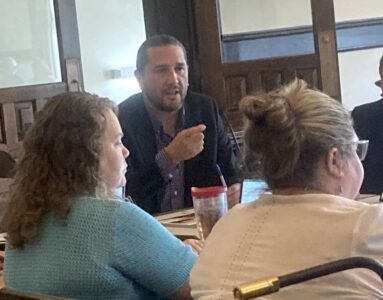
photo by: Matt Resnick | Journal-World
Joshua Falleaf, director of economic development for the Lawrence Chamber of Commerce, seeks bring the Chamber's revolving loan program into sharper focus for Douglas County Commissioners on July 6, during day two of budget hearings.
Lawrence’s chamber of commerce wants more than $100,000 from Douglas County to support a loan program for minority business owners — but county leaders are wondering exactly what percentage of the program they’re being asked to bankroll.
On Thursday, the second day of Douglas County’s budget hearings, the County Commission discussed the Chamber’s supplemental funding request for 2024, including $105,000 for the new revolving loan fund. According to the Chamber’s request, it would lend money to entrepreneurs from underrepresented groups to help them get their businesses off the ground.
The Chamber said it’s in the planning stages of launching the program — but that if the county didn’t approve the extra funding, it would “reduce our ability to impact our ongoing support of minority businesses.”
But by how much?
That was one of the biggest questions the County Commission had for the Chamber on Thursday. The Chamber’s request said it had already received $105,000 for the program from the City of Lawrence, and that it also would be using some “private dollars from our Rising Together capital campaign.” After hearing a list of potential donors from Chamber officials, Commissioner Karen Willey pressed for more details, asking for a full list of funding sources to “see where the county falls within that.”
“I would just like to see the overall structure of who you’re expecting to ask that from and what percentage is anticipated from city and county sources,” she said, requesting that the info be delivered to commissioners by Monday.
Steve Kelly, the Chamber’s vice president of economic development, said that because the Chamber had not received firm commitments from all of its potential pledges, “nailing down an exact amount may be a little bit difficult.”
The Chamber’s request didn’t include information about the organization’s overall financial picture, and Commissioner Patrick Kelly said that was a problem, because it didn’t show how healthy the organization would be if the county didn’t provide the extra funding.
“Because I’m trying to get a sense of how much (is) reliant upon the county for operations, and this doesn’t give me that picture,” he said.
In her response, Chamber President and CEO Bonnie Lowe told the commission that “It’s an apples to oranges comparison” when “looking at the Chamber’s profit-loss versus other not-for-profits.”
“If that’s your goal — looking at those numbers — we can provide that,” she said. She told the commission that the Chamber’s budget was roughly $1.6 million, that its net revenue each year outside of local government appropriations is in the “five-figure” range, and that it has strong reserves.
“So if you’re looking for sustainability and strength with the organization, we can show that,” Lowe said.
While it wasn’t clear what percentage of the program’s cost the county was being asked to cover, it was clear that the Chamber’s request wouldn’t be a one-time ask. Steve Kelly told the commission that the plan was to make an annual funding request for the same $105,000 amount for the next several years until the fund got to a point where it could sustain itself. The eventual goal was originally to get $1 million into the fund, he said, but the chamber subsequently decided a goal of $500,000 was more reasonable.
Lowe confirmed to the Journal-World that the maximum loan amount business owners could get from the program would be $15,000. Commissioners also heard some details on Thursday about how the loans would be serviced. Joshua Falleaf, the Chamber’s director of economic development, said Truity Credit Union would the be Chamber’s financial partner for servicing the loans.
Commissioner Shannon Reid asked whether there was a cost associated with that: “Is it per loan; is it a flat fee per year? Do they have a maximum number of loans?”
Falleaf told her Truity wasn’t going to assess any fees for its services.
“It was part of their service as a credit union and investment in the community to do this loan servicing,” Falleaf said.
The supplemental funding request from the Chamber and the Economic Development Corporation of Lawrence and Douglas County also asked for $30,000 for “operational support.” The request said that in 2019, the Chamber’s annual funding from the county was cut by $25,000, and the request was to restore that amount and add $5,000 more to account for inflation. The request said the money would help the Chamber and the EDC “keep pace with inflation pressures” as they work to prepare for the arrival of the $4 billion Panasonic battery plant in nearby De Soto.
All the supplemental funding the Chamber and EDC are seeking would be in addition to the $205,000 allocation for the Chamber that’s already included in County Administrator Sarah Plinsky’s recommended budget proposal.
• • •
Commissioners didn’t make any final budget decisions at Thursday’s meeting, but did hear from several other departments and agencies, including Public Works, the Heritage Conservation Council and county administrative units such as information technology and zoning and codes staff.
• Douglas County Public Works director Chad Voigt said his department needed more money to keep pace with increasing costs of materials.
Voigt’s department has proposed a budget of $9.72 million for 2024, which was approximately $297,000 higher than what it sought for 2023. In his comments to the commission, he singled out asphalt as a prime example of a material that has experienced a cost increase.
From 2018 to 2022, Voigt said, the department budgeted $550,000 a year for asphalt. However, since 2022, he said the cost of asphalt has risen 42%, but his department only asked for 29% more in funding for it. When the price of asphalt skyrocketed, he said his department responded by “doing 20% less work” on certain projects.
“We’re not asking to fully fund the cost increase we’re seeing,” Voigt said. “We’re asking to fund what we think is a reasonable amount to keep the work going at the level we think it should.”
He also said that “if we can’t buy asphalt, there is plenty of other work (our) folks can go work on,” further elaborating that the work does not need to be contracted out due to the county’s recent purchase of a paver.
In Voigt’s opinion, it’s been a banner year for the department — he said that it had received “good bids and is getting a lot of work done.”
“We’re having a huge year — doing $11.5 million in bid-contracted work in this calendar year,” he said. “So almost a million a month in construction.”
• The Douglas County Fair Board submitted a supplemental budget request of $5,000, citing the need for a professional vehicle parking service. Without the additional funding, the annual county fair might no longer be free to attend, according to the budget proposal.
The estimated price to hire a professional parking service is $3,000 to $5,000, with that request also setting aside $1,000 to $2,000 for additional security personnel during evening hours to supplement the security provided by the Douglas County Sheriff’s Office.
• A number of requests were made by land management entities. Freedom’s Frontier National Heritage Area submitted a budget proposal for $9,379; Clinton Lake Historical Society asked for $27,821; Douglas County Historical Society, $235,539; Eudora Historical Society, $14,605; and Lecompton Historical Society, $68,740. Commissioners asked officials representing these entities to further assess their needs, including multiple supplemental requests for part-time positions.
The county’s budget hearings will resume at 9 a.m. Friday at the Douglas County Courthouse, 1100 Massachusetts St.
— Editor’s note: This story has been edited to clarify that the Douglas County Fair Board requested funding for a professional vehicle parking service.
County Government

Hamm plans to sell landfill, recycling facility to nationwide company; Lawrence city leaders asked to consent
County commission gets first look at proposed school truancy program through criminal justice department

Douglas County begins review to identify strengths and weaknesses of zoning and land use regulations

City staff to gather feedback from Commission on whether to repeal clean energy ordinance, citing ‘unrealistic’ goals and timeline

Douglas County commissioners hire consultant to conduct review of Treatment & Recovery Center’s operations and finances