Mass. Street construction expected to start in August; it will result in fewer lanes for cars, protected lanes for bikes
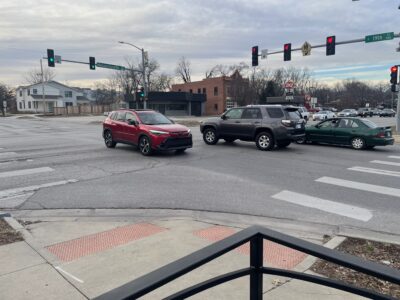
photo by: Sylas May/Journal-World
The intersection of 19th and Massachusetts streets on Wednesday, Feb. 18, 2026. The traffic light at this intersection will be replaced in a future project.
More biking, more safety features and less drag racing: That’s what city staff is hoping for in a project later this year that will shrink Massachusetts Street from four lanes to three.
The $6.6 million construction project, which is still in the design phase, is slated to start in August and will reconfigure Massachusetts from 14th Street to 23rd Street. Mass. is currently two lanes in each direction, but the new design will have one lane in each direction and a shared center turning lane, along with physically protected bike lanes on either side of the road.
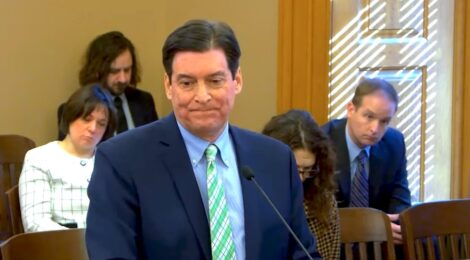
At Tuesday night’s Lawrence City Commission meeting, Aaron Parker, the senior project engineer, said staff had heard stories from the community about dangerous driving on that section of Mass. – “people drag racing down the road, speeding.”
“I’ve driven the road and people are speeding past me on the right,” Parker said. “People are rushing to the next red light, and they’re creating an unsafe corridor for all the road users.”
This stretch of Massachusetts has been identified by the Kansas Department of Transportation as a high-risk area, he said. It’s part of a “High Injury Network” of areas where serious crashes are more likely to happen.
In a report to the commission, city staff wrote that the dedicated center turn lane was one of the safety features of the design. It’s intended to reduce rear-end crashes that can happen in the current configuration when a driver is stopped in one of the inside lanes and waiting to turn.
“I certainly appreciate us wanting to slow down traffic where it needs to be,” City Commissioner Kristine Polian said. But she was also concerned about whether it would be detrimental to traffic flow. “We’ve got a lot of seniors who do use their cars.”
Parker said he wasn’t worried: “A three-lane road section is designed to handle up to 25,000 vehicles per day, and Mass. currently sees less than 10,000 and in 20 years is expected to see around 13,000 vehicles per day.”
The other big safety feature is the bike lanes, and Parker said the feedback from the community early in the design process was clear: There should be a physical buffer and not just lines painted on the road.
“We want to see physically protected bike lanes,” Parker said, summarizing the feedback.
Bike lanes with a physical barrier do present some new challenges, such as snow removal and solid waste collection, as staff’s report to the commission notes. The report said the city has designed the bike lanes in such a way that residents can still put their trash behind the curb, and the Parks, Recreation and Culture department will be responsible for clearing snow from the bike lanes using a skid steer with a snow blower attachment.
The city doesn’t have as many options for bike infrastructure on Mass. as it does in other parts of town. That’s because, as Mayor Brad Finkeldei noted, the city wouldn’t be able to build a wide, shared-use bike and pedestrian path alongside the street without removing most of the old street trees.
“The neighborhood did not want a bike path,” he said. “It would change the whole look and feel of the street.”
While there won’t be a bike path like that, there will be improvements to sidewalks, including work to fill in sidewalk gaps. The traffic signal at 19th and Massachusetts streets will also be replaced, and the report said there were plans for raised bus stops and new mid-block pedestrian crossings as well.
Vice Mayor Mike Courtney said he was excited about the idea of HAWK-style pedestrian crossings. HAWK, short for “High intensity Activated crossWalK,” is a type of crossing that has a signal kind of like a traffic light. When a pedestrian pushes the button, the signal flashes yellow for a few seconds, then displays two solid red lights. Drivers then have to stop, and the pedestrians can cross.
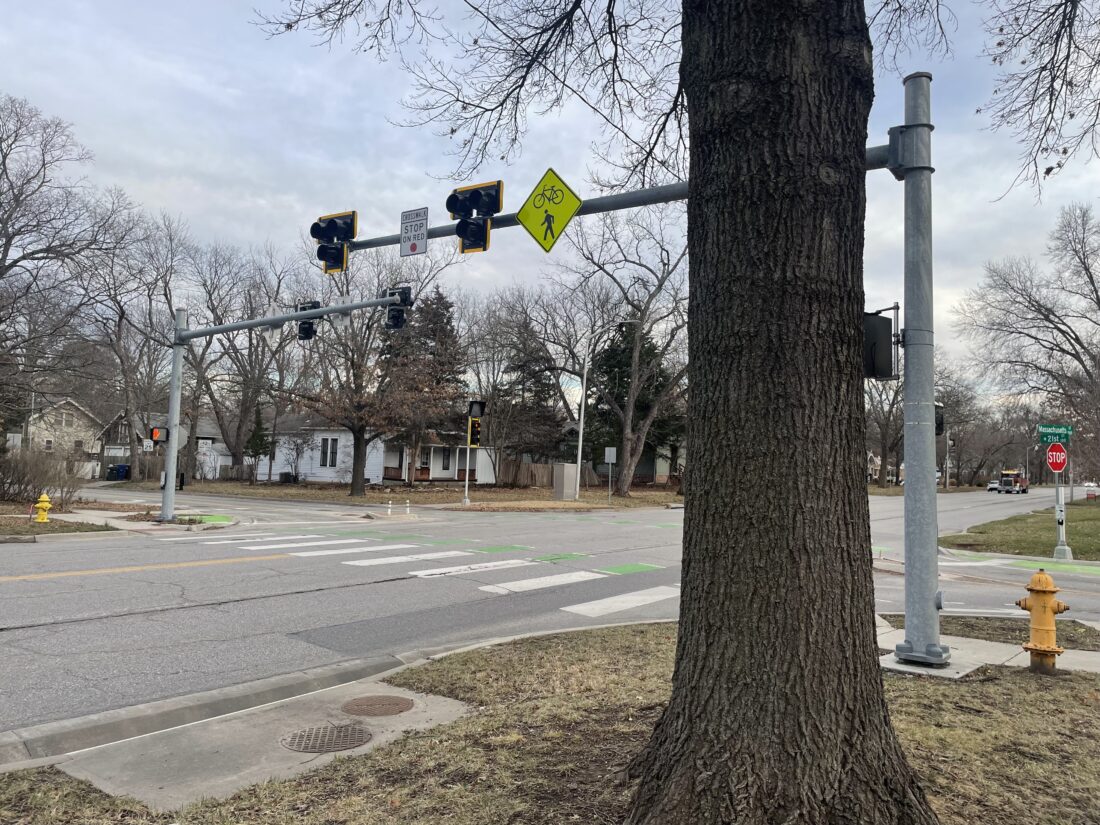
photo by: Sylas May/Journal-World
A pedestrian crossing at 21st and Massachusetts streets with a HAWK signal is pictured on Wednesday, Feb. 18, 2026.
A HAWK signal is already in use on Mass. Street, at 21st and Mass., and farther north there is a mid-block pedestrian crossing with a more conventional traffic light in South Park.
While some stormwater work will be included in the project, don’t expect a full closure of the street like on Ninth Street. Michael Leos, a city spokesman, told the Journal-World that two-way traffic and access to homes and businesses would be maintained throughout construction.
The project’s cost has increased by about $1 million since the City Commission first approved the contract with the design firm, Trekk Design Group, in December 2024. Leos said that was partly due to the increased scope of the project, including the concrete bike lanes, stormwater improvements and traffic signal replacement, and partly due to rising material costs.
However, much of the project will be paid for by grants. Leos said the city had secured $3.95 million in grant funding for the work.
Those who want to learn more about the Massachusetts Street project or give their input can attend an open house next month. Leos said it would be from 5 to 6:30 p.m. on March 31 in Liberty Memorial Central Middle School’s library.
City Government
Mass. Street construction expected to start in August; it will result in fewer lanes for cars, protected lanes for bikes
Lawrence City Commission approves layout drawing for airport; next is an FAA review
City leaders give final approval to incentives for historic Reuter Organ building redevelopment
Closure along Ninth Street near downtown Lawrence extended to Mississippi Street for stormwater project
Seniors are the ‘biggest surprise’ in first month of Lawrence rec center fees; also, a debate on free senior swim