Sustainability board discusses what anti-idling rules might look like – and whether it’s making progress on policy ideas
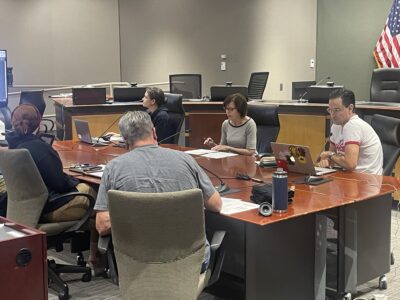
photo by: Sylas May/Journal-World
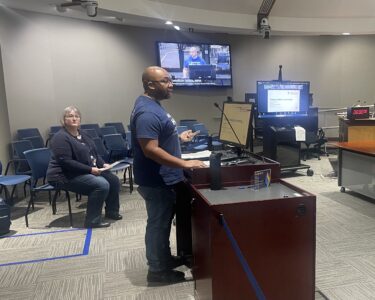
Lawrence's Environmental Sustainability Advisory Board meets on Thursday, Aug. 27, 2026.
What to do about idling cars that aren’t going anywhere? And, what to do about policy ideas that aren’t going anywhere?
These were two of the big questions that Lawrence’s Environmental Sustainability Advisory Board faced on Thursday night, as it discussed how the city should measure its progress toward its environmental goals – and whether the board itself was making progress quickly enough.
The board met to discuss its recommendations for “key performance indicators,” or KPIs, for the city’s new strategic plan. KPIs are measurements the city uses to track its progress toward the goals the plan sets – for example, Sustainability Director Kathy Richardson said, a KPI for greenhouse gas emissions would be the amount of reductions the city achieved.
One of the goals that the board discussed in the most detail was for vehicle idling, and they talked not just about measurement, but about how a potential anti-idling ordinance might look in the future. As the Journal-World has reported, board chair Nancy Muma has suggested a city ordinance that would restrict idling in vehicles for extended periods of time, especially near schools.
“How do you quantify that?” board member Patrick Ross asked Muma on Thursday. “How do you quantify the reduction?”
Muma suggested going to schools during pickup and drop-off times, and counting the cars there.
“All you’ve got to do is to go before each school and count how many cars,” Muma said. “Oh my God, they go for blocks, and I know this because they go in front of my house every day, and my house is four blocks away from the school.”
“Let’s get rid of drive-thrus, too,” board member Joe Fearn said. “I’m serious; they drive me crazy.”
As far as enforcement went, Muma said that any idling ban “would be community-friendly” and focused on education, rather than just punishment.
“There would be some consequences, but when it’s being rolled out, there would be mechanisms to educate people,” Muma said. “… The first couple times you get caught idling, it’s OK, but the third time, you know…”
Beyond just idling, the board discussed metrics for transportation, green energy and native plants, among other things. Muma said that some of the metrics that had been proposed would be “really difficult to track,” such as the number of bicycle trips taken in the city.
Multiple times, Ross brought up the idea of using artificial intelligence and already-existing cameras in public spaces to track things. He said he was just “teasing the idea,” but brought up things like counting bike trips, watching for idling vehicles, even making sure that children walking home from school got home safely.
“I’m making a joke, but we have a system that the cops are using to track license plates that people don’t like, but we could use it for beneficial things,” Ross said. “And this is sort of how China operates.”
“Let’s go with real intelligence, not artificial!” Fearn told him one time when he brought up AI.
Board member Chloe Chaffin said that it was important to keep things grounded in the practical, and to consider the human impact of whatever the board recommended. “I do want to see idling decrease, and I do want to see realistic enforcement,” she said, but she also didn’t want to create a situation where “cities can over-rely on small fines and fees for the average person.”
“I also don’t want it to be something where, you know, the single mom who’s exhausted from working three jobs in the pickup line (at school) – I think it’s like we should do some education around that, rather than being like, ‘Well, the AI sent a ticket to your house.'”
“… I know you’re mostly being facetious,” she told Ross, “but I would be remiss if I didn’t at least throw that out there, that sustainability is also the cultural and neighborly aspect.”
The board didn’t vote on any of the ideas it discussed on Thursday, and it got through discussion on about half the list of KPIs.
Ross expressed some frustration with the lack of progress – he noted that the board had been working on brainstorming ideas for potential policies and for the strategic plan for months, but that it needed to do a better job of advancing its ideas to the City Commission level where they might be implemented.
“Every month that we meet is an opportunity to officially vote on something and pass it to the commission,” Ross said when the board stopped its discussion of the KPIs for the night. “So every time that we don’t meet, or every time that we meet and we only meet for an hour, it’s less -”
“Less impact we have on the commission, is what you’re suggesting,” Muma filled in.
City Government
Lawrence City Commission to weigh whether Costco should be included in STAR bond district
As they approve bikes plan, Lawrence city leaders ask about data collection, Kentucky and Tennessee streets
Lawrence city leaders want to toughen tobacco licensing rules ‘sooner than later’
Algerian government invites Mayor Brad Finkeldei, Lawrence delegation for a visit
Construction on Wakarusa Drive to resume; city manager says KDOT’s secretary has apologized for delay