Lawrence’s residency policy raises state concerns, causes city to miss federal homelessness grant
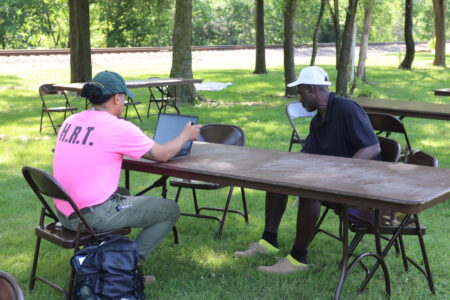
photo by: Josie Heimsoth/Journal-World
The Homeless Response Team held a lunch for people experiencing homelessness at Sandra Shaw Community Health Park on Wednesday, May 14, 2025.
The city’s residency policy is now at the center of Lawrence’s push to regain federal homelessness funding after their application was denied over concerns the rules could “exclude eligible individuals and families” out of services.
The Kansas Housing Resources Corporation, KHRC, administers the federal Emergency Solutions Grant program, which provides funding to communities and nonprofit groups to help people who are facing homelessness. The federal grant originates in the U.S. Department of Housing and Urban Development.
In a July letter to the city – shared with the Journal-World earlier this week – the KHRC said that “the grant review committee did not recommend the City of Lawrence receive an award from our 2026 ESG grant funds.”
Emily Sharp, the spokesperson for the KHRC, told the Journal-World via email that the grant review committee had “several concerns” with the city’s application.
“First, Lawrence has been slow to expend its 2025 funds, with only 21% of its annual allocation spent so far,” Sharp said in the email. “Second, the city’s residency requirement for accessing housing resources could limit delivery of services, which conflicts with federal program guidelines.”
The residency requirements the KHRC is referring to is the city’s policy for serving unhoused individuals from other communities, and it was updated as recently as May 2025. The policy states that in order to manage and prioritize the limited resources available for homeless services within Lawrence, its services are intended to prioritize Douglas County residents.
People who are not residents of Lawrence or Douglas County can receive limited, short-term assistance designed to help them return to their community of origin or another place where they have confirmed support. After an initial assessment, eligible nonresidents can receive emergency shelter, meals and basic services for up to three business days. During that three-day period, the individual must work with a designated helping agency to develop a return plan.
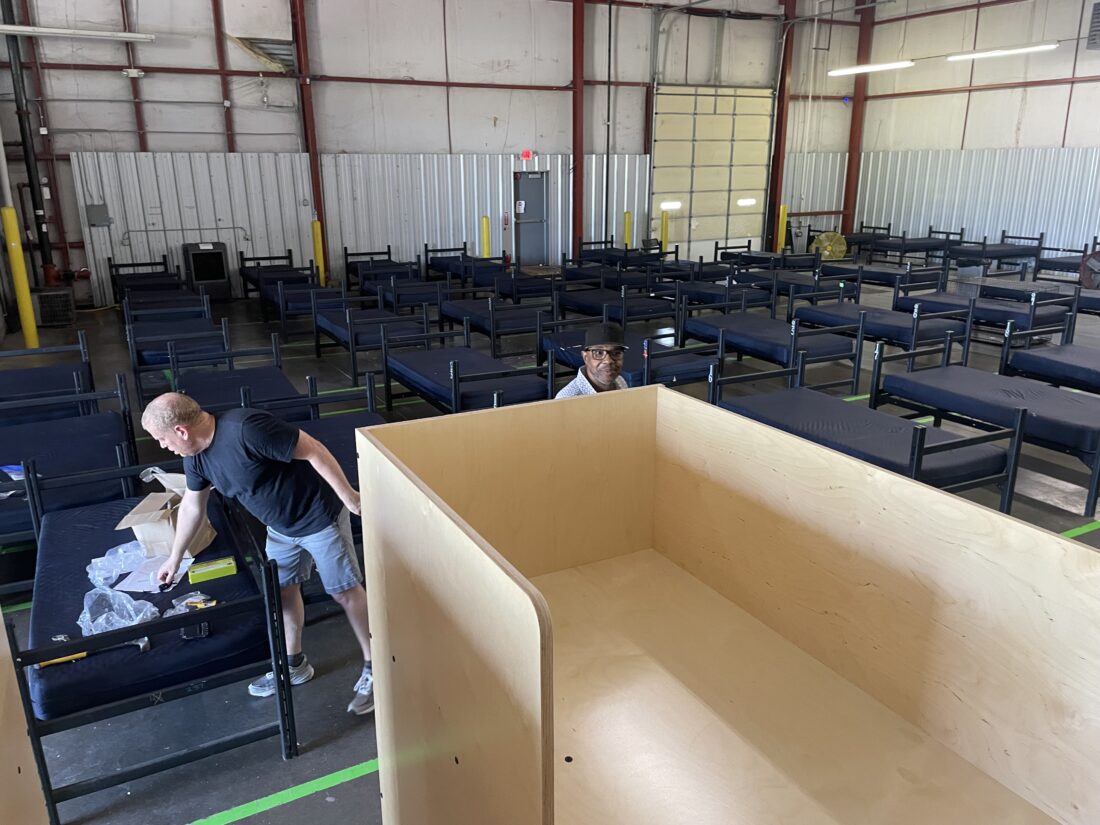
photo by: Sylas May/Journal-World
Rows of metal shelter beds at the Lawrence Community Shelter are shown from the top of a pod of Step Up beds on Monday, June 15, 2026.
However, Misty Bosch-Hastings, the city’s director of the Homeless Solutions Division, told the Journal-World that the framework was changed – once again – in April after “challenges regarding its application continued to arise among partner agencies.”
“The framework became a highly contentious issue within the homeless services system,” Bosch-Hastings said, but she did not elaborate further and cited the denial letter from the KHRC.
The City of Lawrence has applied to receive the grant funding from the KHRC each year since 1989, according to a memo uploaded to the City Commission’s agenda. The program funding is used to support a community’s homeless population in the following categories: emergency shelter operations, rapid re-housing, homeless prevention and street outreach.
Lawrence’s application – which was approved by the City Commission on May 5 – requested $210,000 for three community agencies: $100,000 for the Douglas County Housing Stabilization Coalition, $60,000 for the Lawrence Community Shelter and $50,000 for the Willow Domestic Violence Center.
When the Journal-World asked the KHRC which framework its concerns referred to, the organization pointed to the policy in place before the April changes. That raises the question of whether the concerns have been addressed by the city’s new, more detailed framework.
The city’s residency framework
April’s updates explicitly apply to city-funded homeless services, which are services funded by the city as well as services administered through the Homeless Solutions Division. Bosch-Hastings said these changes were meant to establish a more “detailed version”.
The basic principle is the same: people who become homeless while residing in Douglas County are eligible for all city-funded homeless services, while non-residents can receive temporary assistance to connect them with another community.
The previous policy establishes a specific three-business-day period during which nonresidents can receive emergency shelter, meals and basic services while developing a plan to leave the area.
The April policy does not establish that fixed three-day period. Instead, it says nonresidents may receive time-limited assistance, including basic needs such as shelter and meals, with the duration determined by the Homeless Response Team based on the circumstances.
The April policy is also more specific about what does not establish residency. It says that working in Douglas County, coming to the county to receive services, staying at a hospital or jail, participating in treatment or recovery programs, receiving services from local agencies, staying at the Lawrence Community Shelter, staying in a hotel or motel, living in an encampment or having friends or family in Douglas County do not, by themselves, establish residency.
“While the City cannot meet every need within the community, this approach ensures that available resources are used responsibly and that all individuals are provided with clear expectations and a defined pathway for assistance,” the framework said.
With the city’s previous and shorter framework, Sharp cited multiple conflicts with federal program guidelines. Under the Violence Against Women Act, she said, survivors experiencing domestic violence are entitled to receive federally funded housing resources and services.
When compared to the city’s policy from 2025, Sharp said a survivor from a rural area outside the county could be denied shelter access and resources in Lawrence, even if returning to their previous community could be unsafe and/or their home community does not have the resources to serve them.
Lost funding to partner agencies
Sharp told the Journal-World that Emergency Solutions Grant program funding is limited and the process is competitive. In this year’s funding cycle, the KHRC received applications requesting a total of $4.2 million with only $1.5 million in available resources.
Meanwhile, state data has demonstrated that there’s been a large need for homelessness services in Douglas County.
According to the Kansas Statewide Homeless Coalition’s 2025 point-in-time count report, the county’s homelessness population made up 32.9% of the total number of individuals experiencing homelessness throughout the state during a single day in winter – not including Sedgwick, Shawnee, Johnson and Wyandotte counties.
“We have the highest population, and to say that you’re going to cut it off because of that, where (we) have the most unhoused, doesn’t make any sense,” Lawrence Community Shelter Executive Director James Chiselom said, referring to the KHRC not awarding funding for 2026.
The bulk of requested funding was going to go toward rental and utility assistance administered through the Douglas County Housing Stabilization Coalition. For the Willow Domestic Violence Center, $50,000 would have been allocated towards shelter operations for the 24-hour a day domestic violence shelter.
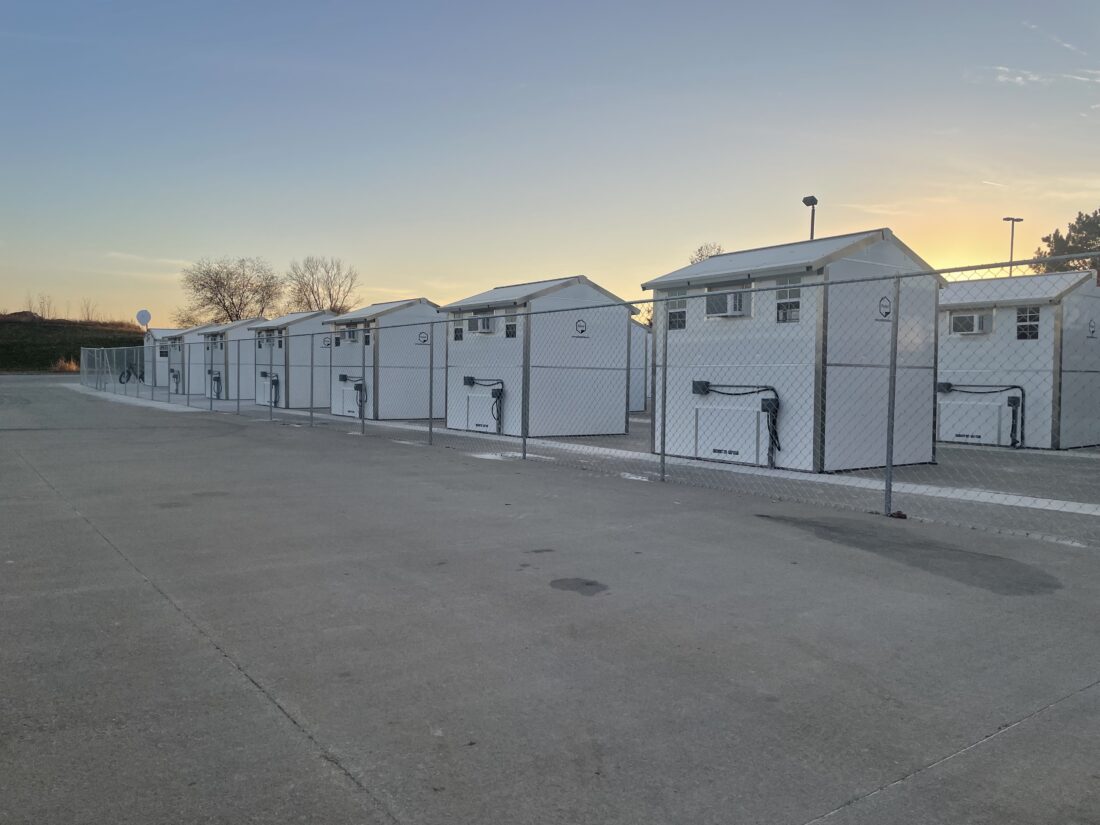
photo by: Sylas May/Journal-World
The Pallet 24 cabins are pictured behind the Lawrence Community Shelter, 3655 E. 25th St., on Tuesday, Nov. 18, 2025.
Meanwhile, the $60,000 to LCS would have gone towards rapid re-housing efforts to reduce the length of stay at the shelter and increase successful exits to permanent housing. Chiselom said in the past, this funding has gone toward helping shelter residents pay off bills and other expenses.
Chiselom said the funding makes a significant difference for many people. However, given the demand of these services in the community, he said the $50,000 the organization previously received from the KHRC is nowhere near enough to meet the need.
“And then to say, ‘We’re not going to give you any money for anybody because of a prioritization policy,’ there’s more than enough people here to just serve Douglas County and use way more than $50,000,” Chiselom said. “That’s just what doesn’t make any sense to me.”
What happens now?
After being notified about not receiving funding this year, the city wrote a letter back to the KHRC on Aug. 7 sharing their disappointment in the organization’s decision.
“That decision will have a direct bearing on the City’s partner agencies that have been able to leverage those monies to fund various valuable programs that assist those in our community in need, regardless of where they are from,” the letter said. “The City feels that its application represented a strong commitment to work on issues of homelessness and losing that funding and the partnership with KHRC is one that will adversely affect the City’s partner agencies that provide much needed services to those in need.”
The letter said the city will continue to monitor the program regulations and intends to apply for 2027 funding to continue the relationship between the city and KHRC.
The city said its local preference policy applies only to homeless programs funded entirely by city tax dollars and does not apply to funds the city receives through the KHRC’s Emergency Solutions Grant program. The city requested an opportunity to clarify this distinction with the committee.
“The City fully understands the regulations of ESG and strictly adheres to them,” the letter said. “In this instance, unfortunately, no opportunity was given to the City to have those conversations with the committee or to address any of its concerns.”
Sharp said KHRC staff have communicated previously with city officials about their concerns with the existing policy. “Even if the policy applies only to activities not supported by ESG funds, the overall effect would restrict access to federal programs and limit delivery of services.”
While the decision did not award funds for this year, Sharp told the Journal-World it does not rescind any current funding. The city has a deadline of Sept. 30 to spend the remaining 2025 funds. There was no information in the documentation explaining the speed with which the 2025 funds have been spent so far.
“(O)ur staff have been in contact with city officials regarding this decision and are currently coordinating a meeting to discuss any remaining concerns and ensure plans are in place to use remaining 2025 funding by the program deadline,” Sharp said via email.
City Government
Lawrence’s first bike lanes with physical barriers are installed on Ninth Street
Opinion: Don’t give up on trying to use Costco to take tens of millions of dollars from the state of Kansas
Abandoned housing pilot program, data center rules, funding clawback for Bert Nash project on City Commission’s agenda

KU professors, middle school band director, radio personality among this year’s Phoenix Award honorees: ‘It’s a cool mix’
Housing Stabilization Collaborative’s request for city trust fund aid won’t be considered because it was filed late