As Lawrence grows, Mayor Brad Finkeldei looks ‘forward with expectations’
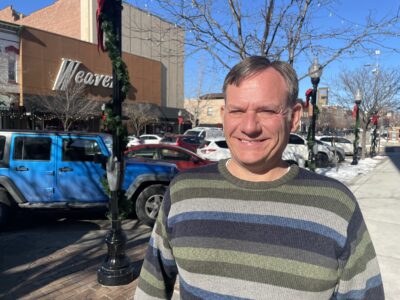
photo by: Sylas May/Journal-World
Mayor Brad Finkeldei is pictured Thursday, Dec. 4, 2025, on Massachusetts Street.
When Mayor Brad Finkeldei looks at Lawrence these days, he sees all kinds of growth – growth that has been a long time coming.
He sees the University of Kansas partnering with the city on two big projects at once, The Crossing on West Campus and the Gateway project around the stadium. He sees long-vacant parts of downtown drawing new interest from developers. And of course, on the west side, he sees Costco coming into the Mercato shopping center, and utility lines going under K-10 that will serve the city’s first houses to the west of it.
“I would say we’re kind of in the execution phase of growth,” Finkeldei said.
This sudden explosion isn’t by accident, he said. It’s the payoff for years of work by the city government. Since the last time he was mayor, the city has rolled out big changes to its code, and it will soon be doing more strategic planning for the next five years – under a different city manager, too.
When Finkeldei was elected mayor this past week by his fellow commissioners, he spoke about many of the ways the city is poised to grow in the next few years. A couple of days later, he sat down with the Journal-World to talk more about the potential he sees, and the low-profile work at City Hall that laid the foundations.
From gloom to boom
Lawrence looked very different when Finkeldei first served as mayor in 2020.
“The last time, we were in the middle of COVID,” he said. “It was a whole different time. The way we ran meetings was different, the issues were different… COVID so dominated everything we did.”
It also made it difficult to plan for the city’s future. Aside from the unpredictability of sales tax revenue during this time, development slowed down, Finkeldei said, which hindered the growth of Lawrence’s commercial and industrial tax base.
The COVID years were full of “things you couldn’t control,” he said. “What projects were coming in, you didn’t know how the money is going to flow in, you didn’t know how things were going to change … so many things were on hold.”
But that didn’t mean the city wasn’t planning. First, it updated its five-year strategic plan under City Manager Craig Owens, who was hired a few months before Finkeldei was first elected to the City Commission in 2019.
“(Owens) came on board, spent his first six or seven months learning the city, talking to people, and then we started the process of the new strategic plan, which I was part of,” Finkeldei said.
Then, in 2022, a steering committee started meeting to revamp the city’s Land Development Code, which had not been updated since 2006. The code governs what kinds of projects developers can do, and the city wanted to make it less confusing for them and easier to build dense housing developments.
The new code went into effect in April of this year, and some developers had been waiting for it to do projects that took advantage of that flexibility and density, Finkeldei said.
“I’ll give you an example,” he said, and described a housing project near the Kansas Turnpike.
“We annexed land next to the turnpike,” he said. “They had a plat under the old code, and under the old code everything was very structured, and you could only build single-family next to single-family, and you could not vary any of the setbacks or the lot lines.”
This project, he said, had a lot of cul-de-sacs in it, and therefore many bigger corner lots with a lot of unutilized space.
With the new code, however, “you can now put a duplex on that corner lot that you couldn’t do before,” Finkeldei said.
“Under the new code, there will be a significantly higher number of units that can be built than under the old code, and so the developer had been waiting for that code to come about. Now he can put forward his new plan.”
And it wouldn’t just allow duplexes – it would allow smaller homes, or even modular homes, which new Vice Mayor Mike Courtney frequently spoke about in his campaign this year. That, in turn, can make for more affordable housing stock, Finkeldei said: “Drive the price down by having more lots, having more units.”
“I think you’re just now starting to see those projects coming,” Finkeldei said.
The same goes for multifamily projects with more density. Already the first project has been proposed under the new code’s “very high density” R5 zoning, which is a new addition and allows developments that would have been impossible before.
That project is being proposed by developer Doug Compton and would build a student apartment complex with more than 300 bedrooms across several properties in the Oread neighborhood: 1430 and 1432 Louisiana St. and 1423 and 1433 Ohio St.
“You’ve seen some of the recent filings under the code, where they can build more units deep, the parking requirements are different,” Finkeldei said. “And people have been waiting for that so they can build denser projects with more flexibility. And so that’s why I think you’re starting to see a lot more activity.”
Crossing over
One of Finkeldei’s first acts as mayor this time around was to highlight some building permit statistics. As the Journal-World reported, after the vote at Tuesday’s City Commission meeting, he listed 2025’s total permit valuations through late November for commercial and multifamily residential projects. Both were more than double the amount they’d been in any of the previous four years.
The other building permit valuations he shared, however, were for smaller residential projects like single-family homes, and he noted that these ones didn’t have an eye-popping stat. In fact, this year’s valuation was smaller than any of the previous four years, down about $3 million from 2024.
But Finkeldei told the Journal-World that people shouldn’t be pessimistic about single-family home growth in Lawrence, because it shows up differently and happens at a different pace than multi-family and commercial development.
“Unlike the other two categories, residential building permits are delayed,” he said.
Because single-family developments are split into so many lots, they don’t show up as a big jump like an apartment complex. For example, he said, if someone gets a building permit for a $22 million apartment complex, “it’s $22 million on day one.” But if the city annexes land where dozens of single-family homes are planned, those permits will trickle in over a period of several years.
“So when you’re looking at building permit values, it’s going to trail,” Finkeldei said.
Especially in the case of developments west of the South Lawrence Trafficway, there have been years of lag time between annexation and signs of progress. Crossing the SLT has been on leaders’ minds for years, Finkeldei said.
“We’ve been talking a long time about growing to the west of K-10,” Finkeldei told the Journal-World. “But in the next five years, we will actually be doing that.”
At Tuesday’s commission meeting, Finkeldei noted that Lawrence’s first housing developments west of the SLT could be going up in 2026 or 2027. He said utilities were currently being installed for a project by local developer Steve Schwada that would be just across K-10 from Costco. The plans for that development were filed in 2021.
“We zoned that, we annexed that, it’s ready for residential development,” Finkeldei said Tuesday. “But he’s been waiting for water and sewer to get under the SLT. And that’s now being built as we speak.”
The city will soon be considering annexing more land on the west side of town. Just this past week, the Journal-World reported that Wichita developer Phil Bundy would be purchasing 800 acres of property west of the K-10 and Bob Billings Parkway interchange, which he hopes to have annexed into the city; 700 acres of it would be used for single-family homes. And on Tuesday, the commission received a request to annex 63 acres along Queens Road/East 1000 Road, just north of North 1700 Road.
The question of how Lawrence should grow – through annexation or infill – has been much discussed in Lawrence, and that has to do with another plan that was approved in August 2019. That plan is the city-county comprehensive plan, called Plan 2040, and one of its goals is to prioritize development within the city’s boundaries.
Finkeldei said he thinks most Lawrence residents would prefer a balance between annexation and infill.
“I would say that most people believe that we need both,” he said. And both have pros and cons.
For infill, the upside is that the infrastructure is already there. “There’s no question that if you can take an empty lot in town and build something on it, where you don’t have to build a new sewer and you don’t have to build a new road; that is more property tax, more residents, without any expense,” Finkeldei said. “Generally speaking, people think that’s a good idea.”
The flip side is that those infill properties don’t just have water, sewer and roads; they have neighbors, too, and neighbors sometimes have complaints.
“When they live next to that empty lot, they often have a different opinion,” Finkeldei said.
With annexation, it’s a very different set of benefits and drawbacks.
“The thing with annexation is you are adding a lot of expense – roads, pump stations, fire departments, things to service brand new developments,” Finkeldei said. “So the cost-benefit analysis isn’t necessarily as good from a pure tax standpoint on annexed land. However, the bigger question we have now is affordability, and having more supply, no matter what the type of housing, infill or annexation, is going to help that affordability issue.”
Sometimes, builders in Lawrence have blamed the city’s housing struggles – rising prices and lower numbers of home starts – on a shortage of developable lots, and Finkeldei echoed that concern.
“Historically, we have had the problem that we haven’t had enough buildable lots,” he said. “Annexation is the first step, but then someone has to put in the roads and put in the infrastructure, all before the very first building permit is pulled to build the house.”
Already the city is working on those infrastructure pieces, not just in the water and sewer crossing under the SLT, but in the plans for a new Lawrence-Douglas County Fire Medical station, Station 6. Finkeldei said funding the station and working out the details with the county would be “a major undertaking,” but that a new station on the west side was inevitable.
“Especially as we look out west, I don’t think there’s any question: We need a fire station. We need the service area,” he said.
New leader, new plan
As all of this change is happening, the city’s leadership is changing, too. City Manager Craig Owens has said that he’ll be leaving in the spring, and Finkeldei and his fellow commissioners will soon start their search for his replacement.
This will actually be the first city manager search that Finkeldei has taken part in. He was elected in November 2019, and Owens was hired in July 2019.
“Craig Owens was hired five months or four months before I was elected,” Finkeldei said. “He hadn’t been on the job for very long, but he had been hired.”
As Finkeldei noted, Owens spent those first months testing the waters and figuring out the priorities for the five-year strategic plan. And it’s the strategic plan, Finkeldei said, that’s partly behind the timing of Owens’ departure.
“One of the reasons Owens decided to step away at this time was because we’re about to embark on the next five-year strategic plan,” Finkeldei said. “… We spent the last five-plus years executing on (the previous) strategic plan, and it’s now come to its five-year end, and now we’re about to embark on a new five-year plan.”
“Understandably, you want the city manager who’s going to join us on creating that plan to be the one to execute it over the next five years,” he said.
When asked what he’s looking for in a city manager, Finkeldei said it would be someone with a knack for that kind of planning.
“I’m looking for a city manager who can come in, help assess where we’re at, help us join with the community and create that next five-year strategic plan that we can work together to implement,” he said.
Soon, the process will get in motion. On the City Commission’s agenda for next week are proposals from three search firms, Finkeldei said, and the commission could choose one as soon as Tuesday.
“They all, I believe, have 12- to 14-week timelines, generally,” he said. “So if we decide on Tuesday night to hire one of them, or we decide on a process about hiring one of them, I think it’s generally three to four months after we hire a search firm that we could reasonably expect a city manager.”
Owens has said he’s planning to stay with the city through May 2026, and Finkeldei doesn’t anticipate the need for an interim city manager to be named if everything stays on schedule.
“Should we choose not to engage a consulting firm, that could change,” Finkeldei said. “But no, that’s not the intent at this time.”
The other big change is with the commission itself, because two of its seats changed hands this past week. In place of Lisa Larsen, who served for 10 years, and Bart Littlejohn, who served one four-year term, are newcomers Courtney and Kristine Polian.
Finkeldei noted the parallels between the commission right now and when he took office in 2019.
“You know, when I joined the commission, I joined with Courtney Shipley, and both of us were new and joined three longer-serving commissioners,” he said. “And they certainly helped me trying to understand the issues.”
Finkeldei thinks that commissioners tend to become “experts” on certain topics, whether because of their personal interests or their professional experience. He’s described himself as a numbers guy, and he’s excited about the new team and their strengths.
“Our two new commissioners have great experience – Polian with her background in finance and in working for cities, and Mike in AI and technology,” he said.
“We need to be able to leverage that going forward, and I look forward to getting to know them and working them into the team.”
Forward, with expectations
Growth is about more than just a city’s geographic footprint. It’s also about things being filled in, areas being revitalized and relationships being built.
Take KU, Finkeldei said. He thinks KU and the city are closer partners than ever, thanks to the mixed-use Crossing project on Iowa Street, where a new Dillons grocery store recently opened, and the Gateway project near the stadium.
These are projects that don’t just benefit the university, but also the city’s financial and housing goals. The Crossing is envisioned to one day have a mix of private offices, apartments, condos and retail development, and the Gateway will have an approximately 150-room hotel and about 400 units of student housing, in addition to the convention center in the stadium’s north end.
“If you think about the Crossing project, and about the Gateway project, for the first time in the history of the city, KU is using their property to address housing needs and tax base,” Finkeldei said.” That is a major step forward for the future of the city.”
So too is the activity in the city’s industrial areas, which Finkeldei says Lawrence will soon need more of.
“We’ve been filling up our industrial land,” he said. “We’re not going to have very many lots left, and we have to be looking at the next industrial park.”
Then there’s the North Lawrence corridor study, which will look at the future of not only that neighborhood, but also the unincorporated areas north of town and Lawrence Regional Airport. The airport and the nearby access to I-70 will be especially important for the future of that area, Finkeldei believes.
And, on the other end of town, the turnpike will be important too as the SLT construction project moves up to the Lecompton interchange.
But some of the changes Finkeldei is most excited about are in downtown Lawrence, within walking distance of his office at the Stevens & Brand law firm.
He sees “long-empty lots, long-closed businesses being developed.” One of the sites that he mentioned on Tuesday is the former Journal-World printing plant building, where the Q39 barbecue restaurant is nearing completion and where a tech company is looking to locate its offices.
“My office has been in downtown Lawrence for 27 years,” he said. “And the amount of activity in downtown Lawrence – mainly along New Hampshire – but, you know, the amount of activity, of people wanting to build and put new things in downtown Lawrence, is really impressive to me.”
He thinks that downtown is on the verge of a transformation. “I think people will look back years from now and talk about Massachusetts and New Hampshire in ways that we don’t talk about today,” he said.
And he thinks he and his fellow commissioners will look forward today, with a confidence that they didn’t have the last time he held the mayor’s gavel.
“This time around,” he said, “I think we can look forward with expectations.”
City Government
City leaders consent to sale of Hamm Landfill to nationwide waste disposal company
Lawrence city leaders take a step forward on incentives for 121-unit affordable housing project

Hamm plans to sell landfill, recycling facility to nationwide company; Lawrence city leaders asked to consent
City Commission to consider tax incentives for 121-unit affordable housing project in west Lawrence

Why the City of Lawrence is doing a new housing affordability study – and what COVID has to do with it