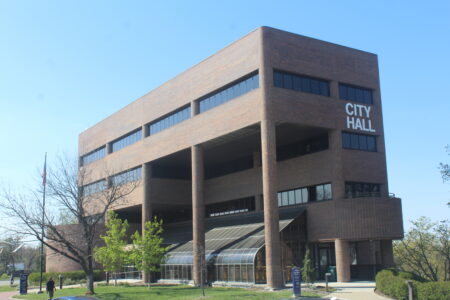
If City Hall seems a little bare, it’s because the trees are gone

photo by: Kim Callahan/Journal-World
The stump of a pin oak is pictured outside Lawrence City Hall Thursday, Jan. 5, 2023. The tree had an iron deficiency that led to its decay, necessitating its removal.
If you happened to sense that the area around Lawrence City Hall seems different lately, it’s probably because four large trees on East Sixth Street have recently been cut down, leaving the plaza area and lawn looking unusually naked, even for winter.
The largest of the trees, a pin oak that soared to the roofline of the four-story government building, is probably the most noticeable absence. The tree, which Horticulture and Forestry Manager Tyler Fike estimated to be about 50 to 60 years old and which pre-dated the construction of City Hall, had to be removed after efforts to treat its iron deficiency proved ineffective and the tree fell into decay, Fike said.
Another hardwood tree, an ash tree just west of the pin oak on City Hall’s lawn, was removed because, Fike said, it had also fallen into a state of decay — this one due to emerald ash borer, an invasive beetle that, as the Journal-World has previously reported, has destroyed hundreds of Lawrence’s more than 10,000 ash trees, necessitating their removal.
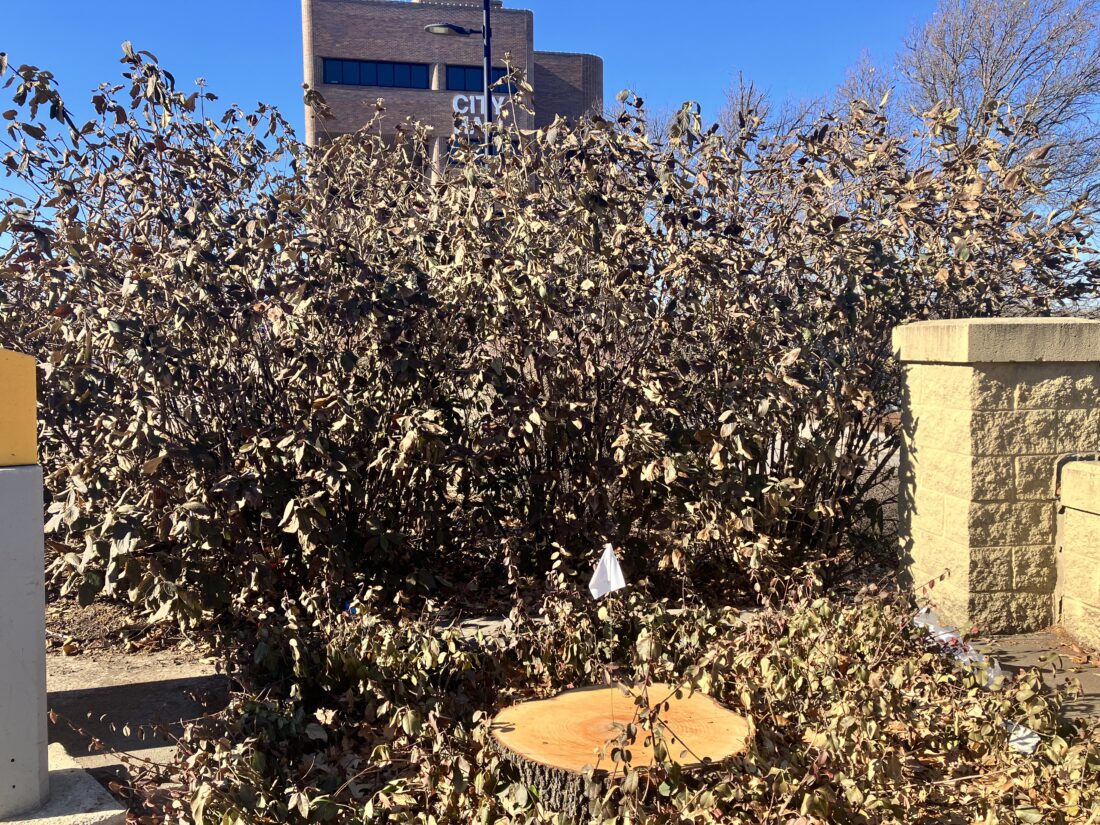
photo by: Kim Callahan/Journal-World
The stump of a large Bradford pear tree is pictured outside Lawrence City Hall Thursday, Jan. 5, 2023.
The other two of the four cut-down trees, shading the benches in the plaza area where East Sixth curves into New Hampshire Street, were Bradford pear trees that were about 40 feet tall with a 40-foot spread, Fike said. Those trees, once valued for their ornamental, if smelly, white blooms, have come to be regarded as an invasive species that threatens native flora.
Fike said the pear trees had become particularly messy and weren’t worth keeping as the city eyes eventually replacing all the Bradford pears with trees that are friendlier to native plants and wildlife.
Fike told the Journal-World last spring that the city had at one time planted a few hundred Bradford pears and that those trees, once thought to be unable to reproduce, had spread across the city — a problem that cities across the U.S. are now facing.
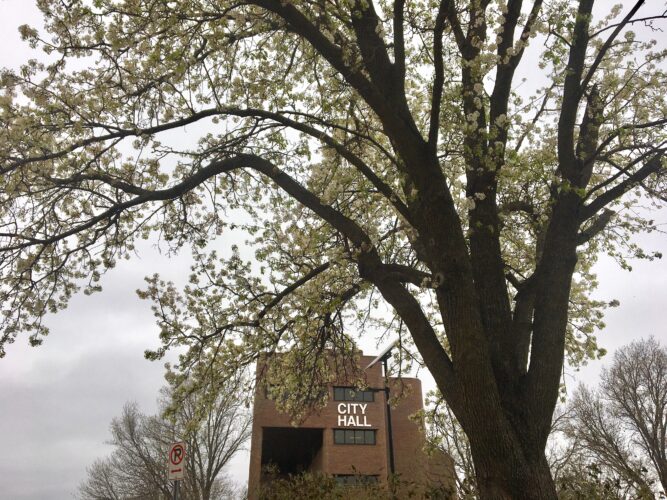
photo by: Kim Callahan/Journal-World
One of the Bradford pear trees near City Hall, pictured in April 2022, before it was cut down last month. The ornamental trees are now considered invasive and harmful to native flora.
As Fike told the Journal-World recently, there’s no particular plan yet to systematically rid the city of the pear trees, but his department doesn’t try to save them and will cut them down if they are brought to the city’s attention as nuisances.
The ash trees, on the other hand, are a pressing problem because as they die from the beetle infestation they “get brittle and fall apart rapidly,” posing public safety issues. Fike said that about 3,000 of the ash trees in Lawrence are on city property and the city has more systematically been tackling that problem since the emerald ash borer was detected in Lawrence in 2015.

photo by: Shutterstock Photo
Emerald ash borer
As for ash trees on private property, Fike advised property owners to have an “ash plan” in place, because if the tree becomes too brittle an arborist will not be able to climb it to cut it down — necessitating a removal by crane, which Fike said could be “very expensive.”
The four stumps near City Hall will be removed, he said, and new trees will be planted in their place in coming weeks.
City Government
Lawrence Loop trail may go along busy downtown street; city wants to steer clear of Riverfront for development reasons
Opinion: Lawrence’s data center moratorium is wrong in one way, but right in the most important

Current and former elected officials celebrate Lawrence’s new Municipal Services and Operations campus
‘We have to move forward’: On 3-2 vote, Lawrence City Commission approves budget with 1.4-mill hike
Manufacturer opens new production facility, adds 30 jobs in Lawrence industrial park