City Commission candidates discuss arts’ importance in Lawrence at forum, but some are cautious on funding sources
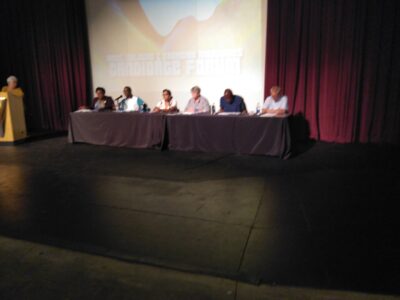
photo by: Elvyn Jones
Lawrence City Commission candidates, from left, Amber Sellers, Milton Scott, Ma'Ko'Quah Jones, Lisa Larsen, Bart Littlejohn and Stuart Boley prepare to answer questions at a forum Saturday, Oct. 2, 2021.
Candidates for the Lawrence City Commission agreed at a forum Saturday that the local arts and culture community supported the goals of the city’s strategic plan.
But some of them were hesitant to specify how arts programs should be funded.
The forum was sponsored by a group of community organizations and businesses that are supportive of the arts and culture industry and took place at the Lawrence Arts Center. All six candidates took part: incumbents Lisa Larsen and Stuart Boley and challengers Ma’Ko’Quah Jones, Bart Littlejohn, Amber Sellers and Milton Scott.
Forum moderator Deanell Tacha, a former Arts Center board member, asked the candidates how arts and culture supported the strategic plan’s goals. The plan aims for a number of broad outcomes, including strong neighborhoods, safety and security, economic success, connectedness and giving Lawrence an unmistakable identity.
Sellers said arts and culture were “not value added, but in the DNA of Lawrence.”
“I see our strategic plan not as a ceiling but as a baseline,” she said. “I see this as a starting point to recognize the value our art and culture community provides for us.”
She suggested the city should review its funding mechanisms and that funding for arts and culture could be identified in that process. One of the funding sources she singled out was the city’s transient guest tax, which is a special sales tax that is charged on hotel rooms in Lawrence in addition to standard sales taxes. She said that would be an appropriate funding source because the arts draw tourism to the community.
When Tacha asked about possible funding sources other than the transient guest tax, Sellers said that would require more study so as not to reduce funding for other critical programs.
The transient guest tax also appealed to Scott as a source of funding for the arts. But he added that the city had to be creative and consider other sources, as well. He said that might include sources from the business community, as well as making arts a part of other programs that the city is already funding. For the latter, he suggested incorporating more art into local youth programming, and he specifically said arts programing could be offered at the Douglas County Juvenile Detention Center.
“I think that’s what I bring to the table of looking at it in unique ways to not only enhance the community but how we can utilize resources we haven’t tapped into,” he said.
Jones said that in her experience, the arts often double as social programs. She highlighted her experiences as a single mother and said that her children have participated in community theater and choir activities, and that they’ve also benefited from arts-based social service agency Van Go.
She also linked arts funding to her broader campaign theme of environmental sustainability. The city could free up money for the arts by adopting environmentally friendly policies that would save money on water, electricity and other expenses, she said.
“Where are we wasting energy?” she asked. “Where are we wasting water? Where are we wasting resources we can learn to cut back on so we can learn to conserve and save those dollars for the people of Lawrence?”
Littlejohn said the arts were central to Lawrence and that they helped build strong neighborhoods, brought people together and benefited the economy. But he said the city needed to develop a plan for arts funding with measurable objectives. He suggested using plans from Boulder, Colo., and Omaha, Neb., as models.
“The have plans that they can go back and revise to make sure they have measurables and goals,” he said. “I want to make sure we don’t just say we are going to fund it and let it die. We need to help it grow and help it prosper.”
Incumbents Boley and Larsen both said the city had already made considerable contributions to the arts by building the Lawrence Arts Center’s current facility and providing for its interior and exterior maintenance. Boley said that meant the Arts Center didn’t have to ask private-sector donors for funds to cover building expenses — instead, it could focus solely on asking them to support its programming.
Boley declined to identify any future funding sources for the arts. He said that it would be the city manager’s job to make such recommendations in the annual budget.
Larsen said the city has a cultural arts plan that was developed in 2015 and that calls for using the arts to foster a strong, diverse and connected community.
“When I read that and I looked at our strategic plan, that statement alone covers at least three of our outcomes,” she said. “I am a strong believer in meeting our outcomes, and that is how we are going to drive our budget going forward.”
City Government
Report recommends routing Lawrence Loop down Seventh and New Hampshire; city told consultants not to consider going through Riverfront

Opinion: Lawrence’s data center moratorium is wrong in one way, but right in the most important
Current and former elected officials celebrate Lawrence’s new Municipal Services and Operations campus
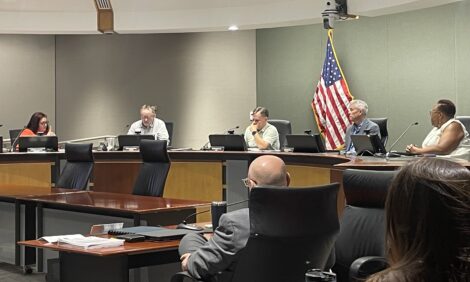
‘We have to move forward’: On 3-2 vote, Lawrence City Commission approves budget with 1.4-mill hike
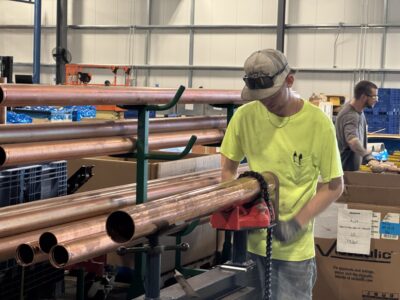
Manufacturer opens new production facility, adds 30 jobs in Lawrence industrial park