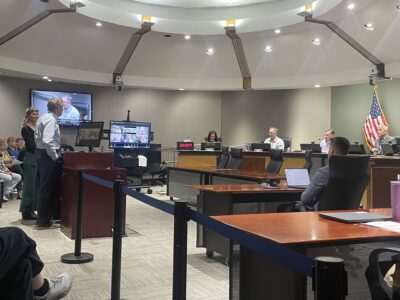
After 7 decades, should Lawrence change its style of government? Commissioners say it’s worth considering

photo by: Mike Yoder
Lawrence City Hall, 6 E. Sixth St., is pictured Thursday, July 7, 2016.
It has been 70 years since the city decided on its current government structure, and Lawrence city leaders say it’s time to reconsider whether it’s still the best fit.
Commissioner Jennifer Ananda, who just finished a yearlong term as mayor, recently suggested that Lawrence consider whether it would benefit the city to have a directly elected full-time mayor. Her fellow city commissioners agreed that the topic was due for reconsideration, and the city now plans to study the issue. Ananda told the Journal-World that the topic was often raised and discussed casually, and now she thinks it’s time for a serious discussion.
“I think we need to reassess what we do, and just make sure we are doing what’s most relevant and most helpful in the work that we do, because it has been so long since we have assessed this at all,” Ananda said.
Lawrence has a council-manager form of government, which employs an elected council — referred to as a commission in Lawrence — and an appointed professional city manager. The current commission-manager form of government was put in place in February 1952, according to information that city spokesman Porter Arneill provided to the Journal-World. Newspaper archives indicate that the matter was put to vote and approved by Lawrence residents in 1950. Previous to that, the city had a mayor and a board of 12 council members, a structure put in place in 1858 after the territorial legislature passed a charter for the city.
•••
Under the current structure, the commission makes policy and final budget decisions while the city manager is in charge of day-to-day administrative duties and proposes a recommended budget to the commission. The commission’s five members are elected at large, as opposed to by district. Commissioners elect the mayor to a one-year term, and by tradition they elect whoever received the most votes in the most recent election, though there have been exceptions. The mayor presides over commission meetings and has ceremonial duties, but has no additional powers and, like other commissioners, is part time.
The council-manager form of government is the most common form of government and is most popular in cities with populations over 10,000, according to the National League of Cities. The second most common form of government is the mayor-council, in which the mayor is elected separately from the council, is often full time and has significant administrative and budgetary authority. However, depending on the city, the mayor could have weak or strong powers and some cities still appoint a professional city manager. The mayor-council form of government is found mostly in older, larger cities, or in very small cities.
However, according to the NLC website, the forms of government are less distinct than they once were, and it is common for cities to incorporate features from more than one form. NLC says the most common mixing occurs across the two most prevalent forms, the council-manager and the mayor-council, and the most common change is the addition of a professional chief administrator or city manager.
Ananda, who finished her term on Dec. 1, said that being mayor during the pandemic highlighted some of the issues with the current structure. Ananda, like current mayor Brad Finkeldei and several other mayors before them, maintains a professional career in addition to her role on the City Commission. Ananda said she doesn’t necessarily think the mayor should have more power, but that a full-time mayor that served a longer term could improve communication between city government, city staff and the residents of Lawrence. She said especially during the pandemic, there seemed to be a need for a spokesperson or voice for the community, and that that the position could also provide more consistency.
“I think that having that consistent term would allow the person in that position to think very long term, strategically,” Ananda said.
•••
Another reason Ananda cited for reexamining Lawrence’s form of government is the city’s population, which is now estimated to be around 100,000 residents.Lawrence recently has increased its population about 10% every 10 years and is one of a handful of Kansas cities with a consistently growing population, as the Journal-World has reported.
Four out of five of the state’s largest cities — Wichita, Overland Park, Olathe and Topeka — all use the mayor-council-manager form of government, according to the Kansas League of Municipalities. The exception is Kansas City, which has a consolidated city-county government. Lawrence, the state’s sixth largest city, is one of 37 cities listed as a commission-manager form of government, making it the city with the largest population currently using that form. Other cities with a commission-manager system include Abilene, Coffeyville, Dodge City, Emporia, Eudora and Manhattan.
Commissioner Lisa Larsen has been interested in assessing the city’s form of government since she joined the commission. Larsen, who was appointed to fill a vacant seat on the commission in 2015, included the topic in her application materials at the time. She asked whether the current system was adequate and whether the city should consider moving to a strong-mayor system and/or adopting a precinct system allowing for direct representation of geographic areas.
Larsen also told the Journal-World that she has heard from community members who are interested in having an elected mayor and that she continues to be interested in other potential changes. She emphasized that any changes would be decided by the community and that she supports a full examination of the options and potential ramifications.
“Before we make that move, we’ve got to have a very serious discussion about what are the pros and what are the cons and try to look at all the unintended consequences,” Larsen said. “What I’d want, to me, is not as important as ensuring that we present all facets of the possible outcomes.”
She said that would include how an elected mayor would change the way the commission and city staff operate and how district boundaries would be set and how that would affect representation of the city’s different neighborhoods and areas. Larsen said that as part of the broader discussion, she would also like to understand when and why the city decided on its current form of government and what changes have been made or discussed before now.
Like Larsen, Ananda said she wasn’t advocating for one form of government or another; she thinks it should be a decision informed by research and made by residents.
“I’m really excited at the prospect of having this discussion, regardless of how it turns out,” Ananda said. “I don’t have a dog in this fight. It really is about what’s best for the city of Lawrence.”
All of the commissioners have agreed that the possibility of an elected mayor and the commission’s structure should be examined, and the commission will discuss forming a committee for that purpose at a future meeting.
City Government
Opinion: Local government made a small mistake. Taxpayers shouldn’t be on the hook to fix it

As club cancels ‘Beetlejuice’ screening at Oak Hill, city says there are no specific rules about events at cemeteries

Opinion: An $80 million Hail Mary that combines Costco and Lawrence’s love of trails
Lawrence Police Department receives KDOT’s top traffic safety award for second straight year
Lawrence City Commission approves extra layers of oversight for data centers, asks for patience on further regulations