Boundary Advisory Committee determines initial list of possible schools to accept Broken Arrow and Pinckney students
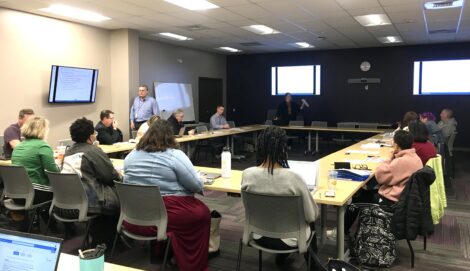
The Boundary Advisory Committee meets on March 1, 2023.
Story updated at 10 p.m. Wednesday, March 1:
A committee working to redraw district boundaries related to the potential closures of Broken Arrow and Pinckney elementaries has determined where those students could potentially go should the board move forward with closures.
The Boundary Advisory Committee met Wednesday evening, on the heels of the Lawrence school board’s decision to consider closing the two elementary schools. Using a show of hands, committee members voted to consider the following schools to receive Broken Arrow students: Langston Hughes, Sunflower, Schwegler, Cordley and Prairie Park. They voted to consider the following schools for Pinckney students: Deerfield, Sunset Hill, Hillcrest, Cordley and New York. Both of these lists may be narrowed down later due to other considerations.
Before the vote, Robert Schwarz, of consulting firm RSP & Associates, said that the committee would need to consider multiple schools that could accept the students from both Broken Arrow and Pinckney, since there was not capacity for any one school to absorb each school’s student population.
“We know if we move them to one of the buildings, all of them, they’re not going to fit, right?” Schwarz said. “We can’t move everyone from Broken Arrow to Prairie (Park) or Schwegler. That’s not going to happen without another change, so this isn’t where do we completely move them, but where do we consider.”
The lists are meant to encompass all viable options, and could potentially be narrowed down if the committee decides certain factors should rule a school out. District spokesperson Julie Boyle also said that the lists would be reviewed by district administration, which could also result in changes before the notices of public hearings for the potential school closures are published.
For Pinckney students, the committee discussed the possibility of including Woodlawn, in North Lawrence, as an option, but after some discussion decided it was not a viable option due to transportation considerations. The Lawrence school board voted against closing Woodlawn due to concerns about students potentially walking across the Kansas River bridge. Board member G.R. Gordon-Ross, who serves on the committee along with school board Past President Erica Hill, said the same concerns would apply.
“I don’t think you can boundary Pinckney into Woodlawn because you’re going to end up with the exact same situation,” Gordon-Ross said. “That they could walk, they could miss the bus and walk, people can’t drive them there.”
When considering viability, there was some discussion about not including New York as a possible option for Pinckney students because it is in the midst of transitioning to a Montessori magnet school open to all students in Douglas County. Because of that transition, New York could only accept students next year who were second grade and older. Ultimately, the committee agreed not to rule out that possibility and leave the topic open for discussion. Hill said she didn’t think the committee should rule out New York so early in the process.
“It needs to be broad, and then we can talk about the nuances and then narrow it down,” Hill said. “But we need to get the broad buckets.”
For Broken Arrow students, there was also discussion about keeping options wide because of rural students who currently attend Broken Arrow. Ginna Wallace, a planner with RSP, said placement and transportation for students in the unincorporated rural areas south of Kansas Highway 10 would need to be considered should the school be closed.
At the opening of the meeting, Larry Englebrick, the district’s chief operations officer and a committee member, laid out various considerations for the committee when determining new school boundaries. Those included socioeconomic status of student populations; the number of students receiving special education services per building; the impact on multigrade classrooms; the availability of before- and after-school care through Boys & Girls Club; the impact on supplemental federal funding for high-poverty schools (title funding); class size; and walkability. Englebrick said the district’s designated schools for students who are learning English were also a consideration, but the district is not considering making changes to the current locations of those centers.
Englebrick noted the committee serves in an advisory capacity to the school board, which will make the final decisions. He also said that RSP, which has expertise in the area of school boundary changes, would be assisting in the process of analyzing relevant data and proposing boundary lines. The board hired RSP at a cost of $120,000 to complete an enrollment analysis and to facilitate school closure discussions.
The committee has two more meetings to further discuss potential boundary changes, and will consider data collected by RSP regarding student population density, transportation, current class sizes, enrollment projections, the distribution of students who qualify for free meals and student demographics. Schwarz said as the committee discusses further details, it might decide to narrow down the lists of potential receiving schools.
“There may be an item that’s on our initial list, but in the details of the data, we’re going to say as a group that just doesn’t work,” Schwarz said.
Emerson Hoffzales, who represents the district’s teachers union on the committee, said the committee should also bear in mind the recent closure of Kennedy Elementary school. Hoffzales noted Kennedy students were moved to Cordley, Prairie Park and New York schools, and that the committee should consider how that closure impacted resources and students.
“Just that notion of being mindful of resources that are being used in those spaces and not to overextend,” Hoffzales said. “I think just being mindful of the past historical things that have happened too when moving forward.”
On Monday, the Lawrence school board voted to hold public hearings on potential closures at Broken Arrow and Pinckney elementaries, a necessary step should the board ultimately decide to close either school ahead of next school year. The board also voted to repurpose Liberty Memorial Central Middle School as a magnet school with a to-be-determined special curricular focus, but to delay that transition until the 2024-2025 school year, meaning those boundaries will not need to be redrawn ahead of next school year.
The public hearing notice for closing schools must specify what school would be closed as well as what school those students would attend after the closure. A draft school closure timeline calls for Boundary Advisory Committee meetings to take place during the first few weeks in March, followed by an update to the board on “transition progress” on March 27. The committee is scheduled to meet again on March 8 and 22 at the district’s Facilities & Operations Campus, 711 E. 23rd St., Building A.
A date for the public hearings for each school closure and a final vote from the school board are not yet determined. Public hearings will only be held for the elementary schools, as LMCMS would be repurposed.
K-12 Education
Report projects enrollment at Lawrence schools to decrease over next five years; board members approve enrollment analysis contract
Lawrence school district celebrates opening of new Family Engagement Center
Student-run coffee shop opens at Community Connections at Pinckney, teacher receives surprise $1,000 award
Perry-Lecompton voters to weigh new joint recreation system funded by property tax levy
KU professors, middle school band director, radio personality among this year’s Phoenix Award honorees: ‘It’s a cool mix’