‘What does that next phase look like for Lawrence?’ Big questions arise with requests to add hundreds of acres to city

photo by: Lawrence-Douglas County Planning Office
A map shows a 143.41-acre annexation request located in the southeast corner of the South Lawrence Trafficway and U.S. 59.
After seeing minimal expansions of its boundaries in recent years, the City of Lawrence could be poised to increase by as much as 300 acres in the next year. However, as those requests come up, so will questions about where and how the city grows.
The city received four applications to annex land in 2022, totaling 295.05 acres altogether. Three of those applications were filed in the last half of the year. For comparison, there have been only six annexations into the city since 2015. Planning and Development Director Jeff Crick said the rise in annexation requests in recent months could represent the beginning of a return to the more sustained levels of growth that the city saw prior to the 2008 recession.
“I think it is picking up,” Crick said, noting that from 2015 onward the city saw either zero or one applications completed per year, with the exception of 2016 when there were two. “It seems like it’s returning back into a trend that we would normally see, which was somewhere between two to six completed per year potentially.”
From 2005 to 2009 there were 20 annexations, or an average of four per year. From 2010 to 2014 there were 23 annexations, or an average of about 4.5 applications per year. From 2015 to 2020, there were four annexations total, or an average of less than one per year.
Three of the annexation requests have been received in the past six months, meaning they were submitted after Gov. Laura Kelly announced that Panasonic would build a $4 billion battery plant in nearby De Soto. The plant is currently under construction and expected to begin producing batteries in early 2025. It’s anticipated the plant will employ 4,000 people and be a catalyst for the whole region due to the suppliers and other local businesses needed, which are expected to create up to 4,000 additional jobs. Cities throughout the area are anticipating population growth as a result of the plant. But the plant is not the only factor at play in Lawrence.
Crick said that in his conversations with applicants, the Panasonic plant has been mentioned as a factor, as have the city’s low housing supply and the finalization of the funding and a construction timeline for the expansion of the South Lawrence Trafficway — the project’s website states the final design is moving forward and construction is anticipated to begin in 2024.
“There is now a known commodity for what the South Lawrence Trafficway will look like,” Crick said. “… People have recognized that one. But it is kind of all three of those (factors) potentially at the same time.”
Mayor Lisa Larsen said that looking at the annexation trends, the city could indeed be on a return to a more typical level of growth. In addition to the possible factors previously noted, namely the need for housing, the Panasonic plant, and the SLT — which she said she thought was a huge factor — Larsen said that the city has also allocated money in its Capital Improvement Plan to expand the city west of the SLT and toward the southeast. She said that funding represents a commitment from the city to expand.
“If you look at our CIP, the city has dedicated quite a bit of funding to infrastructure for expansion,” Larsen said. “And I would consider that known quantities, that maybe haven’t been settled in the past like they have been just in the last year or so, and so that could be spurring some of that interest for annexation.”
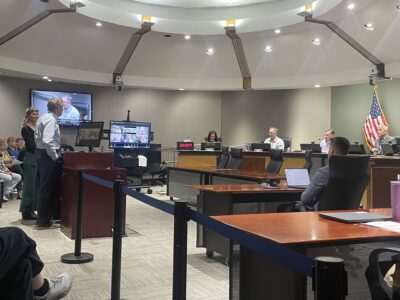
However, not every annexation is a done deal. Two of the annexations have already been approved — a 61-acre expansion east of 1760 East 1100 Road, and a 5.64-acre annexation east of O’Connell Road and East 26th Terrace — but the two larger annexations are still under review, and the largest one has already provoked weighty discussions. The city’s planning staff recommended both of the two pending annexation requests, which are for 143.41 acres located in the southeast corner of the South Lawrence Trafficway and U.S. 59 and 85 acres located east of Highway 10 and south of North 1750 Road. However after a lengthy discussion this past week, the Lawrence-Douglas County Metropolitan Planning Commission voted 4-3 not to recommend the 143-acre annexation.
Representing one side of the vote was Jim Carpenter, who expressed concern about the proximity of floodways to parts of the development, and the potential for floodways to grow as more development occurs upstream from the Wakarusa River. Carpenter said that a mixed vote didn’t mean the project wouldn’t go forward, but it gave information to the City Commission, which will ultimately have to make the decision based on all the information and factors.
“All the arguments will be made there,” Carpenter said. “My bigger point is I think we need a better plan before we consider annexing this land.”
On the other side, there was emphasis on the city’s need for more land, the inevitability of expanding past the SLT, the pressure the Panasonic plant will add to the area, as well as a belief that the policies and review processes the city has in place, which include storm water studies, will address the issues of concern.
“Our need for developable land is real and present,” Planning Commission Vice Chair Gary Rexroad said. “It shows up in housing costs, that based on what’s happening east of us is likely going to grow worse quickly. We’re surrounded by floodplain as a community. We’re going to come up against these questions in almost every direction that we think about expansion, and being able to manage that is going to be something that we’re going to need to deal with.”
Crick said a date was not set for when the annexation request would go to the City Commission, but that it would likely be in the coming weeks. When it comes to what more annexations could mean for the growth of city, Crick said it will start with determining where the city should expand.
“It’s really going to be a conversation about what does that next phase look like for Lawrence,” Crick said. “Over time as it has annexed and changed, (the boundary) moved from Kasold to Wakarusa to the SLT. So that’s a possibility that it keeps moving beyond that, but there could also be conversations or interest in moving different directions, depending upon the market and where people would like to live.”
Crick said that local leaders will need to consider various factors, including housing and other community needs, as well as the need to expand infrastructure and city services past the city’s current boundaries.
“So I think in the future, I think it’s going to be those conversations about what does the market and the community really want to see,” he said. “Lawrence can really go in a great number of directions, but getting the infrastructure to all those (areas) is really going to be the question, because annexing is one thing, but then you also have to think of the city services that you have to provide, and that’s where the Capital Improvement Plan and some of those tough decisions come in.”
In addition to a need for more housing, Larsen also emphasized that the city has an equal need for additional commercial and industrial properties, and that those needs should be at the forefront as well. She said expanding the city’s commercial and industrial tax base would also help take pressure off of residents. Larsen said she does not yet have a position on the upcoming annexation requests, but that she would be considering all the factors at play, as well as weighing the recommendations of staff and planning commissioners and talking with the various parties. She said those factors would be considered in the context of Plan 2040, the city’s comprehensive plan that lays out areas for immediate growth and emphasizes density, affordable housing and sustainability.
“I look at Plan 2040, and how do all of those factors fit into that,” Larsen said.
City Government
Opinion: Local government made a small mistake. Taxpayers shouldn’t be on the hook to fix it

As club cancels ‘Beetlejuice’ screening at Oak Hill, city says there are no specific rules about events at cemeteries
Opinion: An $80 million Hail Mary that combines Costco and Lawrence’s love of trails
Lawrence Police Department receives KDOT’s top traffic safety award for second straight year
Lawrence City Commission approves extra layers of oversight for data centers, asks for patience on further regulations