In response to achievement gaps, Lawrence school board gets update on district’s equity, restorative discipline efforts
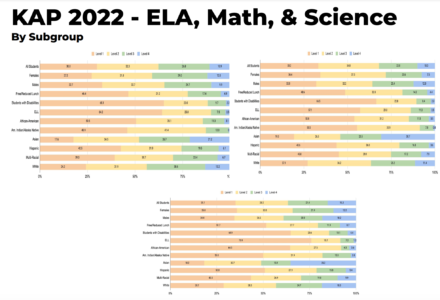
photo by: USD 497
A Lawrence school district presentation slide shows the state assessment scores of various student subgroups in English Language Arts (ELA), math and science. Level 3 and 4 are considered proficient and Level 2 is considered at grade level.
In the face of persistently lower assessment scores for many students of color, Lawrence school board leaders heard an update on the district’s efforts to address academic disparities, implement restorative justice practices and otherwise support historically marginalized students.
The board received the report about the district’s equity efforts as part of its meeting Monday. The report included academic assessment and discipline data broken down by race as well as information about district efforts to address disparities and support historically marginalized students. Monday’s report was a quarterly update, but Cynthia Johnson, the district’s executive director of inclusion, engagement, and belonging, began the presentation by bringing up state assessment data from last school year that indicated clear disparities.
“The reason that I keep it at the forefront (is) because our goal is to ensure that our data, as it relates to our marginalized populations, does not look like it does right now,” Johnson said.
When the board received that report in July, it asked for concrete action to address disparities in achievement, and Monday’s report was a quarterly update related to the district’s equity goals. The July report showed Native American, Hispanic, multi-racial and low-income students scored lower than others. Monday’s report included student data regarding interim assessments, attendance, chronic absenteeism, behavior/discipline reports, and restorative justice practices during the first quarter of the 2022-2023 school year. The district began using interim assessments this school year to help predict students’ future performance on the state assessments taken later in the year and inform decisions regarding classroom instruction, according to a district news release.
Past President Erica Hill said she hoped no one would look at the data and think the gaps in test scores were due to the abilities of students, and she emphasized instead the need to address differences in opportunity. She said that begins with access to preschool and continues to opportunities for students to explore career interests and connect with mentors.
“It’s really about opportunities, how students learn, what opportunities they have access to,” Hill said.
School Board Vice President Paula Vann, who is Native American, pointed out that in some state assessment areas no Native American students scored in the highest level, and that the data showed that the district is ignoring this particular group and needs to be more intentional with its efforts.
Apart from interim assessment performance, the report indicated that disparities exist in other areas that impact academics, such as attendance, chronic absenteeism and behavior/discipline reports. Johnson said to close gaps in access, opportunity and achievement, each school follows a framework of seven questions:
1. What does the data show about how we are educating marginalized populations?
2. Who are the marginalized students in your school (by name, race, grade, parent/guardian)?
3. What does the data show about the achievement of each marginalized student?
4. What does the data show about the attendance rate of each marginalized student?
5. What does the data show about the behavior of each marginalized student?
6. What instructional changes are necessary to improve the learning of each marginalized student?
7. What supports are necessary to promote healthy development and excitement about learning to move our marginalized students?
Johnson said that each of those questions should prompt an action from school staff, and that it was not just about looking at the overall data, but instead addressing the needs of individual students. The report states that school principals, equity teams and building leadership teams are responding to the questions and making the necessary changes and adjustments within each school. Staff at the middle and high school levels and equity team members also used training they received through the Courageous Conversations About Race program to analyze barriers to changing student outcomes. Other efforts discussed Monday included after-school tutoring provided by Native American Student Services, mental health supports at each school and a pilot program to evaluate three social and emotional learning curricula.
Johnson also provided an update about the district’s restorative discipline efforts. As the Journal-World reported earlier this year, restorative practices, which focus on directly addressing the harm caused and mending relationships, have been put in place at the district’s middle and high schools, and staff training for elementary schools began this school year.
Out of 1,018 behavior reports during the first quarter, which represent reports related to 492 students, restorative practices were used in 612 cases, or about 60% of the time, according to the report. Of those 612 cases, 38.2% did not include the use of in-school or out-of-school suspension.
Johnson said five of the district’s 13 elementary schools — Broken Arrow, Cordley, Prairie Park, Pinckney and Schwegler — received the first of three training sessions regarding restorative practices over the summer. She said that once all sessions are complete in the spring, six to 10 staff members at each of those schools would be trained and would work with other staff on the program.
K-12 Education
Report projects enrollment at Lawrence schools to decrease over next five years; board members approve enrollment analysis contract
Lawrence school district celebrates opening of new Family Engagement Center
Student-run coffee shop opens at Community Connections at Pinckney, teacher receives surprise $1,000 award
Perry-Lecompton voters to weigh new joint recreation system funded by property tax levy
KU professors, middle school band director, radio personality among this year’s Phoenix Award honorees: ‘It’s a cool mix’