Lawrence school board member advocates for recommendation to remove Native American mascots, branding from Kansas schools
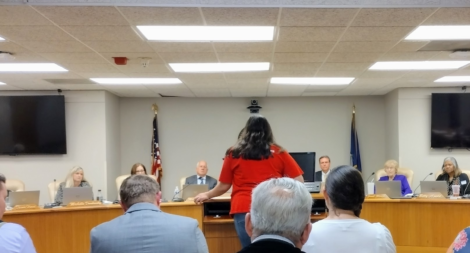
photo by: Carole Cadue-Blackwood contributed
Lawrence High School graduate and Haskell Indian Nations University freshman Georgia Blackwood, a member of the Kickapoo Tribe, provides testimony to the Kansas State Board of Education and Commissioner of Education Randy Watson on Oct. 11, 2022.
To see an example of the impact Native American mascots have on students, Lawrence school board member Carole Cadue-Blackwood said people should look at sporting events, where whoops and gestures make a mockery of Native culture and communicate harmful messages. And in Kansas, she said, those messages are starting in public schools.
“It’s socially acceptable, because it’s their mascot, it’s in the school culture,” Cadue-Blackwood said. “And it’s not OK. They turn around and say, ‘Well, we’re just trying to honor you.’ Well, there’s no honor in that.”
Cadue-Blackwood is among those advocating for the Kansas State Board of Education to recommend the elimination of Native American school mascots and branding. She and her daughter Georgia Blackwood, members of the Kickapoo Tribe in Kansas, were among several people who provided testimony this week in support of a recommendation to eliminate the use of Native American-themed mascots and branding in Kansas public schools. The Kansas Advisory Council for Indigenous Education Working Group proposed the mascot reform policy to the Kansas State Board of Education and the Kansas Board of Regents and presented the recommendation to the board of education on Wednesday.
In her testimony, Cadue-Blackwood wrote that Native American mascots and imagery increase negative stereotyping of Native Americans, which is psychologically detrimental to Native American students and reinforces those negative messages for other students. Cadue-Blackwood, who is also involved in the Not in Our Honor group that opposes the Kansas City Chiefs and other Native American branding in sports, did a review in 2020 and found there were 54 schools in Kansas using Native American mascots and 26 districts that used such mascots. Among them were Indians, warriors, braves, redmen and chieftains. The list includes districts that Lawrence Public Schools could potentially compete against, such as Manhattan High School, which continues to use Indians in its branding and imagery.
Blackwood, who graduated from Lawrence High School and is now a freshman at Haskell Indian Nations University, wrote in her testimony about the disrespect she felt when encountering Native American mascots and imagery both as an athlete and a student. Blackwood said it made her feel like her culture was a joke to non-Native Americans, and their taunting depictions made her feel that those students had preconceived notions about her.
“Along with that, I feel that the defense and support of these blatantly racist depictions let me know that my opinions aren’t valid and that what I have to say is not being taken into consideration,” Blackwood wrote. “I didn’t feel respected as an athlete, I didn’t feel respected as a student, and I didn’t feel respected as a human.”
The recommendation from the council spoke to those issues as well, stating in part that American Indian mascots and branding practices are part of the educational atmosphere in Kansas schools, and students, teachers, administrators, and community members learn from them in problematic ways.
“These practices teach narrow-minded stereotypes that represent American Indians as exotic, warlike people who are stuck-in-the-past, making it difficult for people to understand how American Indians exist in contemporary ways,” the recommendation states.
The recommendation goes on to say that research shows Native American mascots are harmful to American Indian students’ self-esteem, and that they also limit the way that they might see their future possibilities — even when the imagery is intended to honor them. The recommendation also cites the American Psychological Association, which states that such practices undermine educational experiences of all students and create an unwelcome and hostile learning environment for Native Americans.
In reference to sporting events specifically, the recommendation states that Native American-themed mascots prompt students to dress in fake stereotypical Indian clothes, to make fake Indian noises and chants, and write jokes about “sending them back on the trail of tears” and “scalping the Indians” on pep rally banners. In addition, the recommendation states that these branding practices prompt non-American Indians to claim Native cultural symbols in unwelcome ways.
The recommendation asks the Kansas State Board of Education and the Kansas Board of Regents to affirm the council’s statement and ask public schools in the state that have Native American-themed mascots and branding to develop plans to retire those practices within the next three to five years. Other recommended actions include organizing assistance and exploring funding options to help schools transition away from those mascots and branding.
Cadue-Blackwood said costs should not represent a barrier for change. In 2017, Cadue-Blackwood led a campaign that resulted in the name of South Middle School being changed to honor Olympian Billy Mills, Oglala Lakota (Sioux), who attended Haskell Institute and the University of Kansas. She said that the cost to do so was nominal, as stationery, uniforms and other branded materials can be phased out over a period of time. She also noted some sportswear brands even work with schools to help them rebrand.
Ultimately, Cadue-Blackwood said the real cost of maintaining those mascots falls on Native American students, who can be made to feel ashamed of their heritage and culture when it is mocked or made light of in school settings. She said what is needed instead is accurate and comprehensive Indigenous curriculum — an effort Cadue-Blackwood has also advocated for and that is now underway in the Lawrence district.
“It’s been shown that when students see themselves portrayed positively in the academic realm that confidence will improve, self-esteem will improve,” Cadue-Blackwood said.
The Kansas State Board of Education will consider the recommendation as part of its meeting in November. The recommendation cannot compel schools or districts to discontinue use of such mascots but would stand as an official policy recommendation that should guide districts in those decisions.
K-12 Education
Report projects enrollment at Lawrence schools to decrease over next five years; board members approve enrollment analysis contract

Lawrence school district celebrates opening of new Family Engagement Center
Student-run coffee shop opens at Community Connections at Pinckney, teacher receives surprise $1,000 award
Perry-Lecompton voters to weigh new joint recreation system funded by property tax levy
KU professors, middle school band director, radio personality among this year’s Phoenix Award honorees: ‘It’s a cool mix’