Lawrence district begins discussion of legislative priorities in anticipation of debate at state level

photo by: USD 497 screenshot
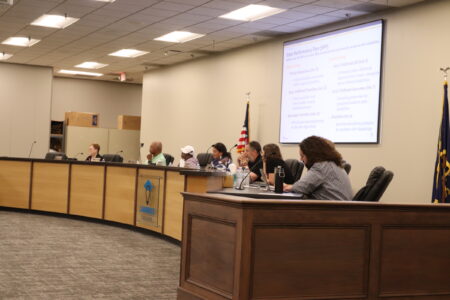
Lawrence schools Superintendent Anthony Lewis and School Board President Shannon Kimball discuss the district's legislative priorities as part of the board's meeting Oct. 10, 2022.
Lawrence school board leaders have begun discussing potential additions to their legislative priorities earlier than usual with the goal of being more prepared to represent the district’s needs going into the upcoming legislative session.
As part of the board’s meeting Monday, Lawrence schools Superintendent Anthony Lewis presented administrative recommendations related to the school board’s annual legislative priorities statement, including a recommendation that the district’s statement reference its equity policy. Lewis said public education has been under attack from organized efforts, and that those efforts threaten the district’s commitment to the success of all students.
“This work becomes difficult when there is overreach, particularly when it’s from some individuals that have never stepped foot in our classrooms that are putting bills (forward) that, in my opinion, become barriers to the work,” Lewis said.
Lewis read the following excerpt from the district’s equity statement: “Current and past federal, state, and local failures to act urgently in the pursuit of educational equity contribute to reduced access to academic opportunities, and to disparities in graduation outcomes and disciplinary actions for students from historically marginalized communities.”
The other two topics district administration recommended the legislative priorities address are two components of the Kansas Senate substitute for House Bill 2567. The first had to do with section 12, which lays out documentation and publication requirements for district needs assessment and state assessment results. Lewis said the district believes the needs assessment, particularly the financial components, should be a function of the state board of education and not state legislators.
The district also recommends that the priorities address section 27, which requires parent notification and consent for any nonacademic test, questionnaire, survey or examination. That section also requires districts to first attempt to notify a parent before administering a suicide risk assessment when a district employee becomes aware a student may be at risk and to share all the assessment information with the parent.
Board member Kelly Jones, a social worker, said she saw both sides of the issue regarding suicide risk assessments and that it warranted further consideration and discussion. Jones also suggested that the priorities could further emphasize existing statements about gun safety laws and full funding for special education by making them standalone sections. District administrators did not propose specific language related to any of their recommendations, and Lewis said Monday’s input would inform a draft that would be brought back for further discussion as part of the board’s meeting on Oct. 24.
Recent proposals at the state level have included the so-called Parental Bill of Rights, proposed restrictions on transgender athletes, and vouchers to funnel money away from public schools. Both Lewis and Board President Shannon Kimball expressed concern for potential legislation regarding public schools in the upcoming legislative session, which begins in January. Lewis said by beginning the conversation earlier, it would give the district and potentially staff or community members the chance to engage earlier with issues at the state level. Regarding the district’s position that the state should fully fund special education, Kimball said the district should be prepared with data and information. She also said the base state funding per pupil needed to increase for teachers and staff to be adequately paid.
The board also reviewed the draft legislative priorities for the Kansas Association of School Boards. Those priorities express support for locally elected school boards, adequate state funding, and the expansion of early childhood education, and express opposition to diverting public funds away from public schools through vouchers or other programs, among other priorities.
K-12 Education
Report projects enrollment at Lawrence schools to decrease over next five years; board members approve enrollment analysis contract

Lawrence school district celebrates opening of new Family Engagement Center

Student-run coffee shop opens at Community Connections at Pinckney, teacher receives surprise $1,000 award

Perry-Lecompton voters to weigh new joint recreation system funded by property tax levy

KU professors, middle school band director, radio personality among this year’s Phoenix Award honorees: ‘It’s a cool mix’