City leaders hear update on reforms to municipal court; some suggest additional changes

photo by: Rochelle Valverde
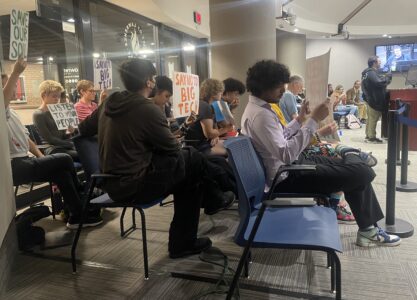
Supervising City Prosecutor Elizabeth Hafoka answers a question from Vice Mayor Lisa Larsen as part of the Lawrence City Commission's meeting on May 10, 2022, at City Hall, 6 E. Sixth St.
Lawrence Municipal Court staff says the city has been implementing reforms to how the court operates, and that additional changes will continue to be discussed.
As part of its meeting Tuesday, the Lawrence City Commission received a presentation from staff in the city attorney’s office about Municipal Court operations. City Attorney Toni Wheeler opened the presentation by saying the court has undertaken many “progressive reforms” already under the leadership of Municipal Court Judge Scott Miller and expects more dialogue and changes to come.
“We are very much aware that the criminal justice system, law enforcement agencies and courts across the country and locally are under scrutiny and reforms are underway,” Wheeler said. “We think that is a good thing and we believe it’s very worthy of our time and attention.”
The presentation included trends regarding cash bonds posted, the number of people being held in the jail on municipal offenses, and traffic citation costs, among other data points. Court data indicates that the amount of money the city has collected for cash bonds has decreased significantly in recent years, the average number of people serving time in jail on a daily basis for municipal offenses has declined, and that traffic citation costs in Lawrence are lower than several nearby communities.
Municipal Court Manager Vicki Stanwix said that several years ago, Miller revised the court’s bond schedule to allow defendants to be released on their own recognizance after an initial arrest for a misdemeanor offense, meaning they could sign a written promise to appear in court and not have to pay any bond. Stanwix said the court believes the change in policy has resulted in the declines in cash bonds seen in recent years.
“We believe that this decline is a direct effect of the court’s bond schedule,” Stanwix said.
The amount of money collected in cash bonds has been generally decreasing since 2014, according to the presentation. In 2014, the city collected more than $600,000 in cash bonds, an amount that declined steadily to about $200,000 in 2019; about $100,000 in 2020; and slightly over $100,000 in 2021.
In 2021, the average daily population at the Douglas County Jail was 141 people, about nine of whom were being held on municipal court violations, or about 6.5%. By comparison, in 2016, the average daily jail population at the Douglas County Jail was nearly 239 people, about 21 of whom were being held on municipal court violations, or about 9%.
For comparison, the presentation provided information about the total cost of running a red light in 13 courts in the Lawrence area and elsewhere in Kansas. Lawrence’s cost for a red-light violation is $143, compared to $183 at Douglas County District Court, $176.50 in Wichita, $176 in Topeka, $173 in Manhattan, and $173 in Eudora.
In addition to fines, the city charges a fingerprinting fee, a supervised probation fee and court costs. Stanwix said other courts have additional fees, and the city recently got rid of a fee for issuing a warrant. She said the city charges $63 for court costs — part of that goes to the state and part goes to the city’s general fund. She said fines and fees made up 0.44% of the city’s revenue in 2021, and it was projected that amount would be even less in 2022.
“We believe that the purpose of Municipal Court is to hold people accountable for law violations, not to generate revenue for the city,” Stanwix said.
Community service allows defendants to credit $10 per hour worked toward their fines, an amount that had recently been increased.
Vice Mayor Lisa Larsen said she was impressed by all the methods to decrease fines and provide pay-off options, but she also wanted to know whether a restorative justice program had been considered for the municipal court system, noting that Douglas County was getting ready to implement such a program. After confirming that the county charges the city $101 per day to hold someone in the jail, Larsen calculated that holding about nine people per day would cost the city about $330,000 per year.
Supervising City Prosecutor Elizabeth Hafoka she’d not heard any discussion about a restorative justice program in Municipal Court, but that the court had recently had a meeting with the county about restorative justice and would be open to that idea.
“I think that Lawrence Municipal Court would be interested in doing that and using that model if that could be created, and that we would certainly be open to that,” Hafoka said.
Larsen also asked about a previously discussed idea to get rid of some municipal offenses, referring to an effort put forward in 2020 by then-mayor Jennifer Ananda and later reviewed by the city’s anti-poverty work group. Stanwix said if the commission wishes for that to come back before it for consideration, that could be done.
Commissioner Brad Finkeldei asked about whether the compensation for community service could be increased to a living wage. Hafoka said the municipal judge had recently increased it to the current rate of $10 per hour and could potentially decide to increase it further, or the City Commission could also pass an ordinance to establish a new rate.
City Government
Evacuation drill planned Tuesday at Lawrence City Hall

Bond issue for water and sewer projects, bike plan, Wakarusa Drive update on Lawrence City Commission’s agenda

Opinion: Environmentally conscious Lawrence is not focused on the biggest problem with electric vehicles

Locust Street apartments, Holcom housing development among this year’s applicants for $700K in Affordable Housing Trust Fund money

Business owners hurting from Wakarusa Drive closure say they’re getting no answers, no signs, no accountability