Native American school board members question response to commissioner’s ‘Indians raiding’ comment, ask state board for concrete actions
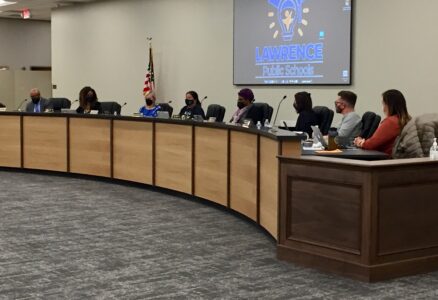
photo by: Rochelle Valverde
Carole Cadue-Blackwood speaks about Education Commissioner Randy Watson’s comments about Native Americans at the school board's meeting Feb. 28, 2022.
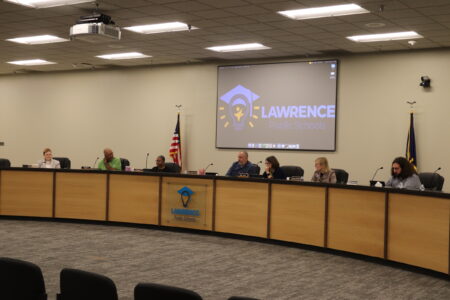
Some Lawrence school board members — including the board’s two Native American members — pushed back against the Kansas State Board of Education’s decision to reject the resignation of Education Commissioner Randy Watson after he made comments about “Indians raiding.”
During the Lawrence school board’s meeting Monday evening, three board members questioned the decision and asked for concrete action to be taken. Watson announced last week that he would resign, but the state board subsequently rejected his resignation and instead suspended him for 30 days without pay, citing a desire for restorative justice.
Lawrence board member Carole Cadue-Blackwood, a member of the Kickapoo Tribe, said that restorative justice does not exist in a vacuum and that she was still waiting on an apology from Watson.
“We have two Native American elected officials right here — we’re highly educated women,” Cadue-Blackwood said. “… I’m frustrated, I’m hurt, I’m saddened.”
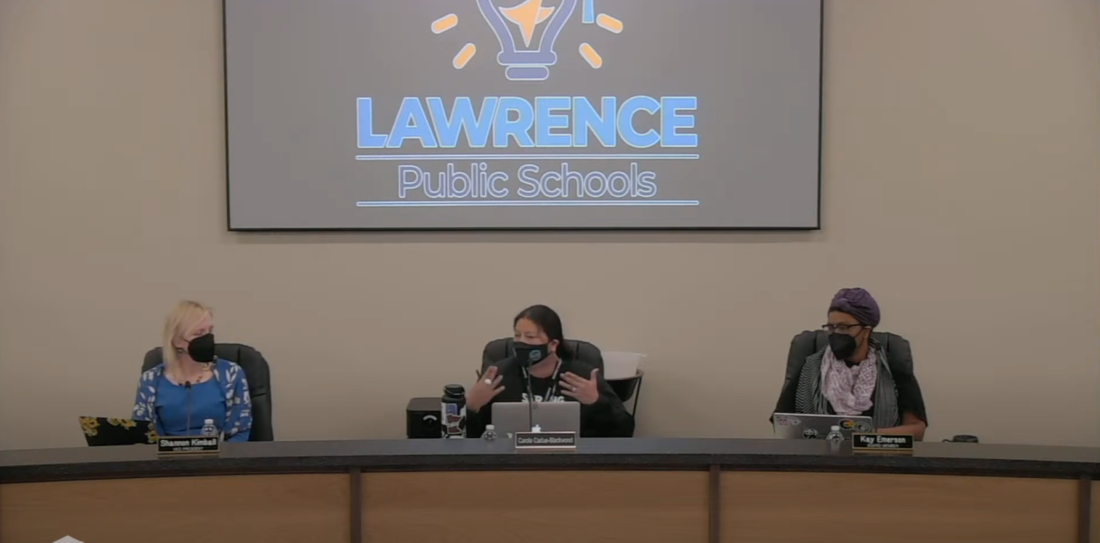
photo by: USD 497
Carole Cadue-Blackwood speaks about Education Commissioner Randy Watson’s comments about Native Americans at the school board’s meeting Feb. 28, 2022.
Watson recently made the remark during a conference on virtual education, according to The Associated Press. Watson made an extended metaphor that compared responding to the coronavirus pandemic to dealing with both a tornado and a hurricane. He joked about how cousins from California used to visit him in Kansas during the summer when he was a kid and were “petrified” of tornadoes, and that in response he would say, “Don’t worry about that, but you got to worry about the Indians raiding the town at any time.”
Ann Mah, who represents District 4 on the Kansas State Board of Education, was at the board’s meeting Monday to provide a regular update, and spoke about the situation. Mah said Watson recounted a “hurtful stereotype” from his childhood and it was wrong of him to do that. She said in doing so, he hurt the very children he’s been trying to help for the last 40 years.
However, Mah said in making its decision the state board looked at several things, including Watson’s work history, pattern of behavior and whether he had shown remorse and made amends. Mah said the board found decades of stellar work, no pattern of similar behavior, and that Watson had been reaching out to people to apologize. She said the board decided that one mistake shouldn’t end his career, and that the board discussed using restorative practices instead.
“I really believe in it, and strongly believe that healing is more important than punishment,” Mah said. “And when Dr. Watson returns we will figure out what that looks like for him.”
Mah said the state board has had a number of people in the Native American community offer to help the board through the process of bringing together Watson, the victims and the community. She promised that process would be “extensive.”
School board member Paula Smith, a tribal member of the Sisseton-Wahpeton Oyate, said that Watson did apologize to her, but that she told him she could not accept his apology because his remark was hurtful and impacted students and other tribal members.
“Tribes have been apologized (to) for decades, so I think there needs to be some concrete actions behind Dr. Watson’s comment,” Smith said.
Smith said she spoke to Watson about several things she’d like to see, including his creation of an action plan for self-learning, a commitment for the state board to review the report of Gov. Laura Kelly’s Commission on Racial Equity and Justice, and for the state board to commit to removing the use of Native American mascots and related imagery in public education settings.
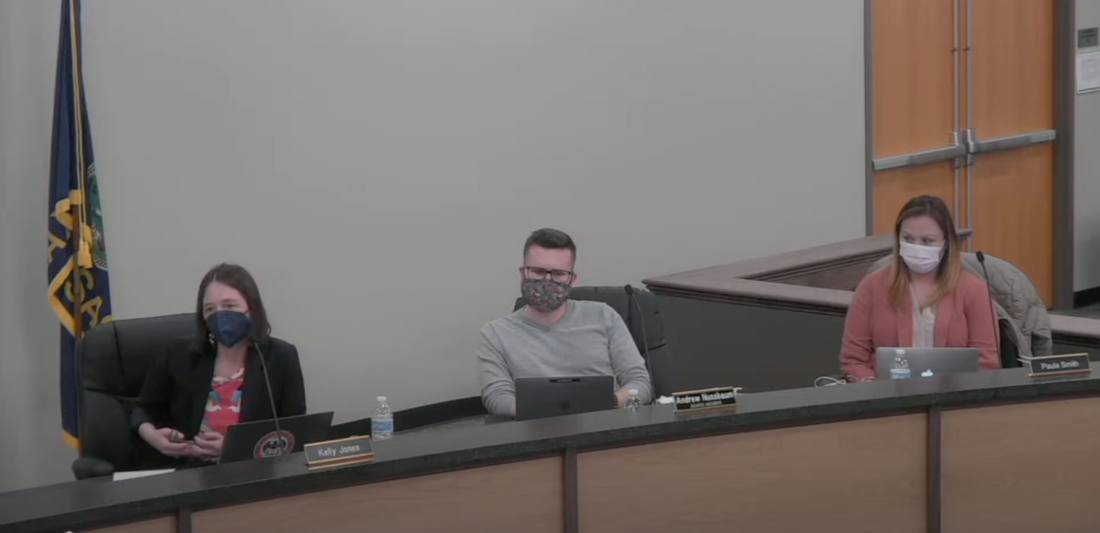
photo by: USD 497
Board members Kelly Jones, Andrew Nussbaum and Paula Smith are pictured at the board’s meeting on Feb. 28, 2022.
Cadue-Blackwood said she is an active member of Kansas Association for Native American Education, which had also crafted suggestions for the Kansas State Department of Education and Watson. She added she appreciated Mah being at the meeting and that she felt for Watson, “because he has been disenfranchised of a good quality public education.”
Cadue-Blackwood said people are unaware of the state’s full history, and she’d like to see Native American history embedded in the state curriculum.
“Because I’ve lobbied for several Native American bills, and I can tell you that every time I go there, I have to start from the beginning, from scratch,” Cadue-Blackwood said. “And people are often amazed that I’m a sixth-generation Kansan.”
School board member Kelly Jones said she found the state board’s action “deeply troubling,” especially given that Gov. Kelly called for Watson to resign. Jones questioned the board’s commitment to equity given its unanimous vote to reject Watson’s resignation.
“So it’s hard to understand a commitment to racial equity when that’s the vote,” Jones said.
Jones also said she saw the situation as an opportunity for action, and noted the Kansas Association for Native American Education’s call for curriculum that respects Indigenous peoples and nations.
Mah said she was sorry that the board members did not agree with the state board’s decision, but reiterated that the state board did not think one bad mistake should end Watson’s 40-year career. She said the board felt that firing Watson solved nothing.
“If he’s gone, how does he come back and build bridges?” Mah said. “It doesn’t happen. We need him here facing up to what he did, and I think that’s going to be the best resolution.”
Before the board’s discussion about Watson’s comment, Superintendent Anthony Lewis also made a statement about the issue. Lewis said in part that he was saddened by the comments and that they perpetuated a harmful stereotype about Native Americans. He said Watson called him on Tuesday, and that Lewis believed Watson understood the pain he had caused and that his apology and his commitment to learn and to do better was sincere.
K-12 Education
Lawrence school district identifies $73.9 million in deferred maintenance and facilities needs

Lawrence school board to bring back public comment after 9-month hiatus
Lawrence school district’s four-year graduation rate increases, but gaps persist among student groups
Nine Lawrence-area high school seniors named semifinalists in national scholarship program
BOE censures teacher, parent in alleged corporal punishment case
TOPEKA — The Kansas State Board of Education rejected conclusions of child abuse investigators, a professional ...