Some sidewalk repairs in eastern Lawrence delayed after estimated cost ends up millions more than expected

photo by: Rochelle Valverde
A person walks down the sidewalk on 14th Street on Feb. 3, 2022. The section of sidewalk pictured is part of the city's 2021 sidewalk improvement program.
As the City of Lawrence’s sidewalk improvement program moves farther into older sections of the city, the cost of needed repairs has shot up by millions of dollars, easily exhausting the available funding.
Of the nearly 400 blocks of sidewalk identified for repairs as part of the 2021 program, close to a quarter of the blocks are in such disrepair that instead of repairing just the damaged sections, the city has decided it makes more sense to replace the entire block. As a result, in addition to the $2.2 million the city budgeted for the project, the city now estimates that it would need to spend several million more to make all the necessary repairs.
More specifically, among the 2021 routes, which are almost entirely in eastern Lawrence, 390 blocks of sidewalk were found to be in need of repair, according to Engineering Program Manager Jake Baldwin. Of those, 90 blocks, or 23%, had enough damage that the city has identified them as warranting a full block replacement. The city’s preliminary estimate for completing all the full block replacements is between $6 million and $13 million.
Baldwin said the program only has enough funding to pay for the city’s portion of the localized repairs on the 300 blocks and the replacement of six of the 90 blocks of sidewalk identified for full replacement. Baldwin said the remaining 84 blocks would be added to the city’s list of other potential capital projects that will be considered for funding as part of the city’s annual budget process.
However, that procedure is not necessarily the way the sidewalk repair program was envisioned when it was revamped in 2018 amid ample debate among city commissioners.
The city was initially broken into eight zones to begin enforcing the 1979 ordinance regarding sidewalk repairs, which requires all property owners to pay to repair the sidewalks running along their property. The ordinance had not been fully enforced for decades, and under a new administrative policy created in 2018, certain homeowners — low-income households and those with multiple sidewalks on their property — are eligible to have the city pay for all or part of their repair costs. The city is also financially responsible for damage that is the result of city street trees and city infrastructure, such as manholes.
The first inspection zone under the new policy was in northwest Lawrence, where sidewalks were in relatively good condition, and the following year the inspection area was in southeast Lawrence. The 2021 program mainly comprises sidewalks that are east of Iowa Street and north of 23rd Street, which includes several older neighborhoods. Because of the level of repairs identified in the 2021 inspections, the city previously suspended the deadlines for that program in May so that it could analyze the inspection data and decide how to proceed.
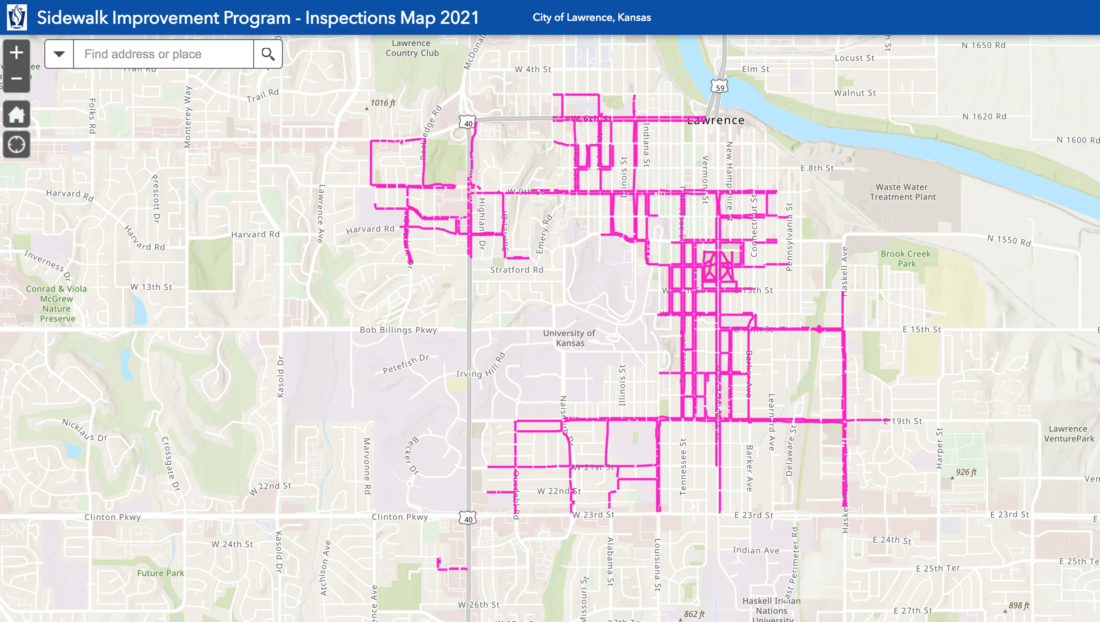
photo by: City of Lawrence
This City of Lawrence map shows the sidewalks included in the city’s 2021 sidewalk improvement program.
The city has since proceeded with the localized repairs, and Baldwin said the city plans to announce soon which blocks it will fully replace. For those six blocks, Baldwin said property owners would not be charged more due to the full replacement, and instead would be billed in the same manner as the other property owners in the inspection area, where charges reflect only the cost for the particular sections needing repairs.
In addition to financial assistance for homeowners who qualify, Baldwin said the city would pay the difference between the property owner’s contribution and the cost to replace the entire block. He explained that the full block replacement also means those repairs will have to follow different criteria. He said replacing the entirety of a sidewalk, in contrast to localized repairs, triggers compliance with the requirements of the Americans with Disabilities Act, which include specific sidewalk widths and ramp slopes.
Baldwin said the city’s contractor began work on the 300 blocks identified for repairs in the fall, and those repairs are slated to be finished in March. He said the replacement of the additional six blocks of sidewalk, once those are identified, would be completed toward the end of the year.
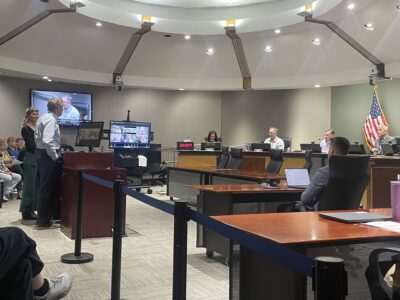
Meanwhile, the budget discussion regarding the currently unfunded replacement of the remaining 84 blocks will not be the only upcoming consideration regarding sidewalk repairs. Mayor Courtney Shipley, whose campaign included the position that the city should take full responsibility for sidewalk repairs, has gotten the city’s sidewalk improvement program on the commission’s agenda after past unsuccessful efforts. In response to comments from Shipley during the commission’s meeting this week, the commission’s two new members, Amber Sellers and Bart Littlejohn, said they were open to discussing the program, and the topic will be placed on a future study session agenda.
Shipley noted that the commission had not reconsidered the program since it adopted its new strategic plan, and she thought that would affect the discussion.
“We haven’t talked about it in that context at all or through that lens, and I think that’s going to make a huge difference in the way we talk about it,” Shipley said.
City Manager Craig Owens said staff could create a presentation providing information about the history of the program, its current format and information comparing the cost of the current program versus a fully funded program. Owens estimated the topic would be put on an agenda in 30 to 60 days.
City Government
Opinion: Local government made a small mistake. Taxpayers shouldn’t be on the hook to fix it

As club cancels ‘Beetlejuice’ screening at Oak Hill, city says there are no specific rules about events at cemeteries
Opinion: An $80 million Hail Mary that combines Costco and Lawrence’s love of trails
Lawrence Police Department receives KDOT’s top traffic safety award for second straight year
Lawrence City Commission approves extra layers of oversight for data centers, asks for patience on further regulations