Lawrence schools see uptick in families qualifying for free school meals, with more than 900 more students eligible
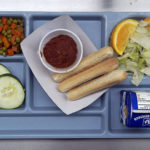
photo by: Nick Krug
This 2005 Journal-World file photo shows lunch at Kennedy Elementary School: Italian Dunkers with Sauce, peas and carrots, sliced cucumbers, salad with sliced oranges and a carton of 2% Milk.
About 3,400 children in the Lawrence school district have family incomes low enough to qualify for free meals this school year, about 900 more children than last year.
Applications continue to be processed, but so far, 911 more students qualified for free meals — meaning their families have very low household income — and 540 more students qualified for the free and reduced-price meal program overall, according to information from the school district. The number of students qualifying for free meals represents a 37% increase over last school year.
District food service administrators say specific contributing factors are difficult to identify based on the data the district has, but that the increase could be attributed in part to it being easier for families to enroll in the free and reduced-price meal program. Families whose children are covered under Medicaid — itself a program for low-income families — are now automatically eligible for the meal program. However, the upward trend of students needing assistance aligns with trends seen both locally and nationally.
The Journal-World recently reported that the local food pantry Just Food, along with 80% of network food banks across the country, have been seeing an increase or sustained demand for food assistance during the past few months. For its part, Just Food recently set a record for the number of people served in one day — for the third time this year. Contributing factors for the increase include rising food costs and inflation in general, the expiration of the child tax credit and the expiration of the universal free school meal program.
The Journal-World asked Director of Nutrition and Wellness Julie Henry if there are indications that any of those factors is playing a role with the district’s increase. Henry said that it is possible, but specific trends regarding income are harder to determine because more students are now qualifying based on their participation in the Medicaid program, which provides health insurance for children in low-income households.
“It is possible that families have also had reduced incomes since the pandemic, but that would be hard to tease out, since many families that used to qualify based on income are now qualifying based on Medicaid,” Henry said.
What the district knows is that it has received a significant number of participants in the free and reduced-price meal program because of Medicaid eligibility. Families whose children qualify for Medicaid are now automatically eligible for the free and reduced-price meal program, without the need for a separate application. Specifically, Henry said that 1,679 students qualified for free meals via their Medicaid eligibility, and 81 students qualified for reduced-price meals. That means about 45% of the students participating in the free and reduced-price meal program so far this school year qualified based on their participation in Medicaid.
Henry said the district continues to process applications daily, but as of this past week, 3,367 students have qualified for free meals and 523 have qualified for reduced-price meals, for a total of 3,890 students in the free and reduced-price meal program so far. Last school year, 2,456 students qualified for free meals and 894 qualified for reduced-price meals, for a total of 3,350 students in the program overall. The 911 additional students who have qualified for free meals so far this school year represent a 37% increase over the number who qualified for free meals last school year.
To qualify for free school meals, families need to make below 130% of federal poverty guidelines, which is $23,803 for a two-person household, $29,939 for a three-person household, and $36,075 for a four-person household. To qualify for reduced-price school meals, families must make below 185% of federal poverty guidelines, which is $33,874 for a two-person household, $42,606 for a three-person household, and $51,338 for a four-person household. An extended income eligibility table is available on the U.S. Department of Agriculture Food and Nutrition Service website, USDA.gov.
The jump in students qualifying for free meals comes as the district’s overall enrollment appears to have stayed relatively flat, though district spokesperson Julie Boyle said the district would have more reliable numbers after Sept. 20, which is the official headcount day. It also comes following the end of a federal pandemic relief program that provided all students free meals without the need to verify income for the past two school years.
Though all students received free meals last school year, Henry said the district is still able to track how many students qualify for free and reduced-price meals the past two years based on data that families provide on the Household Economic Survey.
Henry added that families can still apply for the free and reduced-price meals program for this school year, and families can also submit applications during the school year if financial circumstances change and they become eligible.
The price of school meals varies by age group and meal. The cost of breakfast is $1.80 for elementary students, $1.90 for middle school students and $1.95 for high school students. Reduced-price breakfast is 30 cents. The cost of lunch is $2.80 for elementary students, $3 for middle school students and $3.05 for high school students. Reduced-price lunch is 40 cents.
Families can complete an application for the free and reduced-price meal program on the district’s website, and paper applications are also available in each school office. Applications are available in English and Spanish.
K-12 Education
Report projects enrollment at Lawrence schools to decrease over next five years; board members approve enrollment analysis contract

Lawrence school district celebrates opening of new Family Engagement Center
Student-run coffee shop opens at Community Connections at Pinckney, teacher receives surprise $1,000 award

Perry-Lecompton voters to weigh new joint recreation system funded by property tax levy

KU professors, middle school band director, radio personality among this year’s Phoenix Award honorees: ‘It’s a cool mix’