Douglas County Emergency Management aims for ARPA dollars to boost disaster response and preparedness
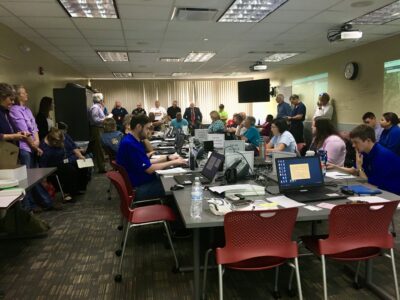
photo by: Courtesy of Douglas County
The Emergency Operations Center in Lawrence is shown during response and recovery efforts for the May 2019 tornado.
Douglas County Emergency Management’s work throughout the COVID-19 pandemic was extensive; the department established the Unified Command team in March 2020 to help with pandemic response and recovery, and it also coordinated the county’s mass testing and vaccination events.
It’s no surprise, then, that when Douglas County leaders wrapped up the process of allocating American Rescue Plan Act funding last month, they granted Emergency Management a significant portion of the roughly $7 million reserved for internal county departments — specifically, $797,881 for a group of seven projects.
“… It’s important to be prepared, especially in light of disasters in the last few years, so I think that you’ll find that our projects were all very practical and needed,” Emergency Management Director Robert Bieniecki told the Journal-World Thursday.
Bieniecki and Deputy Director Jillian Rodrigue walked the Journal-World through the details of those projects from the department’s Emergency Operations Center in the Douglas County Judicial and Law Enforcement Center. It was a fitting setting for a conversation about ARPA funding, since around $168,000 of the department’s aid will go toward upgrading that space.
The center serves as a good example of how Emergency Management’s work extends far beyond the pandemic. When an EF-4 tornado struck Douglas County on May 28, 2019, for example, Rodrigue said that was the first time in more than a decade working with the department that she’d seen the center fully activated and used for something other than training exercises.
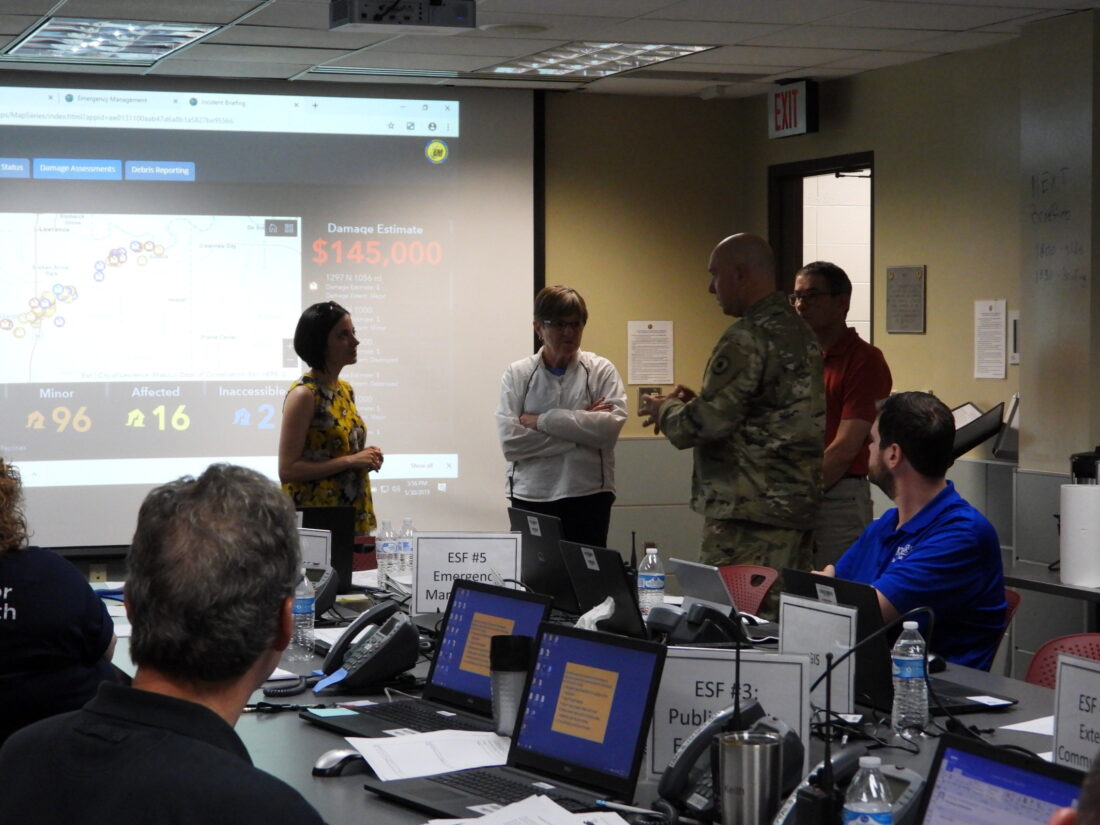
photo by: Courtesy of Douglas County
The Emergency Operations Center is shown during response and recovery efforts for the May 2019 tornado. Kansas Gov. Laura Kelly is at center in white.
“We’ve been very fortunate in Douglas County; we’ve had disasters, but not on that scale,” Rodrigue said. “The room was entirely full, standing room only, and … there’s only so many places to put information and only so much space.”
The massive crowds that congregated in downtown Lawrence during the University of Kansas men’s basketball team’s run to a national championship title earlier this year also prompted the activation of the center.
Events like these bring together personnel from a number of partner agencies such as the Lawrence Police Department and Douglas County Sheriff’s Office, Rodrigue said. Those two offices operate on their own networks for information sharing, but the space doesn’t currently have the capacity to support connecting to them without bringing in outside equipment.
The ARPA upgrades will allow for the department to re-run network lines providing full fiber connectivity, Rodrigue said. That’s along with more audio-visual display equipment around the center, upgrades to some equipment used for responding to severe weather events, and a video conferencing system. The department also wants to install a “Cradlepoint” router through Firstnet, a nationwide wireless broadband network with dedicated service towers just for first responders, to ensure stable internet access.
For the national championship, Bieniecki said IT staff with the Lawrence Police Department was in the center days in advance working to ensure that the technology would be ready. The upgrades made possible by ARPA funding will be especially helpful in accommodating the response to events the department can’t plan ahead for in the same manner.
“If there’s an emergency today and we need to deploy all those resources and have all those people in this room, we would not be ready and we would scramble some to get to that proficiency,” Bieniecki said. “Since this room was developed, technology has advanced so much that we want to catch up, if that makes sense.”
It’s all about efficiency and redundancy, Rodrigue added. Forms of communication are bound to fail, so every emergency management operation has at least one or two backups to ensure the department can still function.
“We look very specifically at what’s the worst that can happen, and can we mitigate that?” Rodrigue said. “Can we lessen the impact by having multiple ways to get information, to get out information?”
To that end, the department actually has an alternate Emergency Operations Center at its disposal. That space is located across Lawrence at Consolidated Fire District 1, Station 111 at 300 W. 31st St. About $331,000 in ARPA funding will go toward purchasing and installing furniture, equipment and service lines in the space so it basically mirrors the main Emergency Operations Center, Rodrigue said.
The third broader-scale project on the department’s list will upgrade primary and secondary communications for the county’s 44 outdoor warning sirens, costing about $200,000 in total. The system operates on a radio signal, Bieniecki said, and the department plans to install three “digipeaters,” newer radio communicators that can repeat the system signal that activates the sirens. As a backup, Bieniecki said a cellular modem utilizing Firstnet would be added to each siren. That would allow the department to activate the sirens from a cellphone in the event radio communications go down, he said.
That’s especially important, Rodrigue added, because the 2019 tornado made it clear that the outdoor warning sirens were still a crucial tool in ensuring that people who are outdoors during a severe weather event know to take cover.
“That was one of the things we heard a lot after the May 28 tornado, that outdoor warning sirens going off was key to a number of people taking shelter during that tornado,” Rodrigue said. “It saved a lot of lives that day, so it’s definitely a piece of equipment that folks are still using.”
The remaining projects are a bit smaller in scale. One of them is purchasing reflective vests and rain coats for Emergency Management staff and volunteers to help ensure they’re identifiable and shielded from the elements.
Another pair of projects seeks to replace the department’s 2014 Chevrolet Tahoe and a Citizen Emergency Response Team trailer, the latter of which is used by one of the department’s volunteer groups to haul equipment and other resources for emergency activations or training events. The trailer is also used as a hub from which to make specialized identification cards for Emergency Management staff and volunteers onsite at disaster scenes, such as the semitrailer fire on the Kansas Turnpike east of Lawrence last month. Rodrigue said those cards help to make it easier for Emergency Management workers to identify themselves to other first responders.
If not for ARPA funding, it would have been impossible to tackle every project on this list in one budget year. In fact, Rodrigue said the department’s budget during an average year — without the added element of an influx of federal aid money — is fairly lean, enough so that it really only can support salaries, contractual maintenance and ongoing upgrades to the county’s emergency siren system that began last year.
It’s a list of projects that will benefit not just a county department but the many partners — first responders, search and rescue teams, and public works, to name just a few — that come together to mitigate the disasters that could affect the community, Rodrigue said.
“It’s all of those agencies coming together,” Rodrigue said. “First responders are a piece of that, and we tend to spend a lot of time with them just because that’s the day-to-day. But when that really big emergency happens — when it’s a bad day for a lot of people, or everyone’s worst day — that’s where all of those other relationships (come into play).”
Other News
RJ Mitte, ‘Breaking Bad’ actor and disability rights champion, dies at 34
Clinton State Park and other state parks will increase overnight camping, vehicle permit fees starting next month
‘No day is like the other here’: Students from Lawrence’s German sister city discover football, new foods and new friends on exchange
GCSAA celebrates 100 years with new plaza and statue honoring its founder and first president

Go, See, Do: Library book sale, candidate forum and more