

Lawrence schools roll out districtwide bicycle PE program
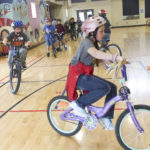
photo by: Joanna Hlavacek
New York Elementary School fifth-grader Claudia Davis, trailed by classmate Dalton Smart, rides laps around her school's gym Wednesday morning during teacher Alex Reyes' PE class. New York is one of several Lawrence elementary schools to implement the district's BLAST (Bicycle Lesson and Safety Training) program this fall.
Everett Webb, a fifth-grader at New York Elementary School, first hopped on a bicycle less than two months ago. You wouldn’t know it by watching him confidently loop around his school’s gym Wednesday morning, as PE teacher Alex Reyes led Webb and 16 of his classmates through a series of exercises designed to test the young cyclists’ braking skills.
“When I started, I was horrible,” Everett says, taking a respite after colliding with another classmate (the kids haven’t mastered braking just yet) on the gym floor. “Now, I can take off and everything.”
It’s a source of pride for Everett, who remembers feeling terrified by the prospect of riding a bike at first, more specifically “crashing and falling off some sort of cliff and breaking my ‘everything bone,'” he says.
On this day, he isn’t daunted when he falls off his bike. Even with a lightly skinned calf, the fifth-grader chooses to hop right back on.
Wednesday’s class marked the second installment of the Lawrence district’s BLAST (Bicycle Lesson and Safety Training) unit at New York, where students are learning cycling basics such as how to properly signal turns and identify road signs. The program, which piloted in four Lawrence schools last year as part of the communitywide “Be Active Safe Routes” initiative, sends a district-owned fleet of 30 bicycles into a different elementary school every few weeks.
The fleet, purchased through a $15,000 grant from the Lawrence-Douglas County Health Department and supplemented with helmets donated by the Lawrence-Douglas County Fire Medical Department, passed through fourth- and fifth-grade PE classes at Quail Run and Woodlawn schools earlier this fall. After Reyes wraps up his third BLAST lesson next week, the bikes will travel to Langston Hughes and Broken Arrow.
Reyes, who enjoys cycling in his spare time, says he’s pleased with the level of progress he has seen so far in his students. Some, he says, “didn’t know which side of the street to ride on” at first.
“Our goal is just to get them to ride their bicycles more than they’re doing now,” Reyes says of the BLAST program. “If they get out there, if they ride their bikes to school five days a week and back home, that’s more exercise that they get during that week than if they didn’t ride their bikes. Hopefully, if they like it enough, it’ll become more of a hobby.”
Surprisingly, he says, about a quarter of his students had never ridden a bicycle before. Some New York families (nearly 75 percent of students there are labeled “economically disadvantaged,” according to the Kansas State Department of Education) may not be able to afford one, he speculates. Others may have held off on teaching their kids how to ride for unrelated reasons, Reyes says.
Either way, young people are not as bicycle-savvy as they once were. At least, that’s been the finding of Denise Johnson, the district’s curriculum coordinator of health and wellness, throughout the implementation of the BLAST program.
Even at Lawrence’s more affluent schools, there are still pockets of students who don’t know how to ride, she says.
“It is absolutely widespread,” says Johnson, who admits she would’ve chalked up the phenomenon to economic reasons at first glance.
“We’re in this time where … everything’s scheduled for them. They go to dance practice and gymnastics practice and then they have basketball practice, and there isn’t really time to spend outdoors and ride your bike and hang out with your friends and run around like what we’ve had” in older generations of kids, she says. “I think that’s part of it.”
With PE teachers leading the charge, Johnson and district leaders hope to encourage students to reach for a bicycle instead of a candy bar in the evenings after school. Reyes is optimistic that his students might develop a similar appreciation for the activity.
In the meantime, the district has applied for another grant, this time through the Health Department-coordinated LiveWell Lawrence coalition. With additional funds, the district would be able to purchase a second fleet of bicycles to circulate through all 14 elementary schools in Lawrence, giving teachers and students more time with the program.
To really feel comfortable on a bike, students need more than “just four or five days,” Johnson says. Still, she’s encouraged by the results she has seen already, as has New York Principal Nancy DeGarmo.
Some kids, DeGarmo says, are even pedaling their own bicycles to school for the lessons.
“Kids are loving it,” she says. “When kids remember to bring something to school, you know they’re loving it.”
City Government
Lawrence City Commission to consider earlier public comment period once a month, new civility standards for commissioners
Garage door manufacturer Amarr seeks help from City of Lawrence to buy its current facility; it could eventually expand with 50 to 75 new jobs
Recent trail closure at Rock Chalk Park reveals city has abandoned cost-sharing agreement with KU
Lawsuit settlement would have City of Lawrence take control of Riverfront building; city and its contractors would pay $2.5 million in total
During new demolition moratorium, University Place hopes to strengthen protections for its older homes