

Doing her part: Baldwin City woman worked in World War II defense plants, trained for women’s flying corps
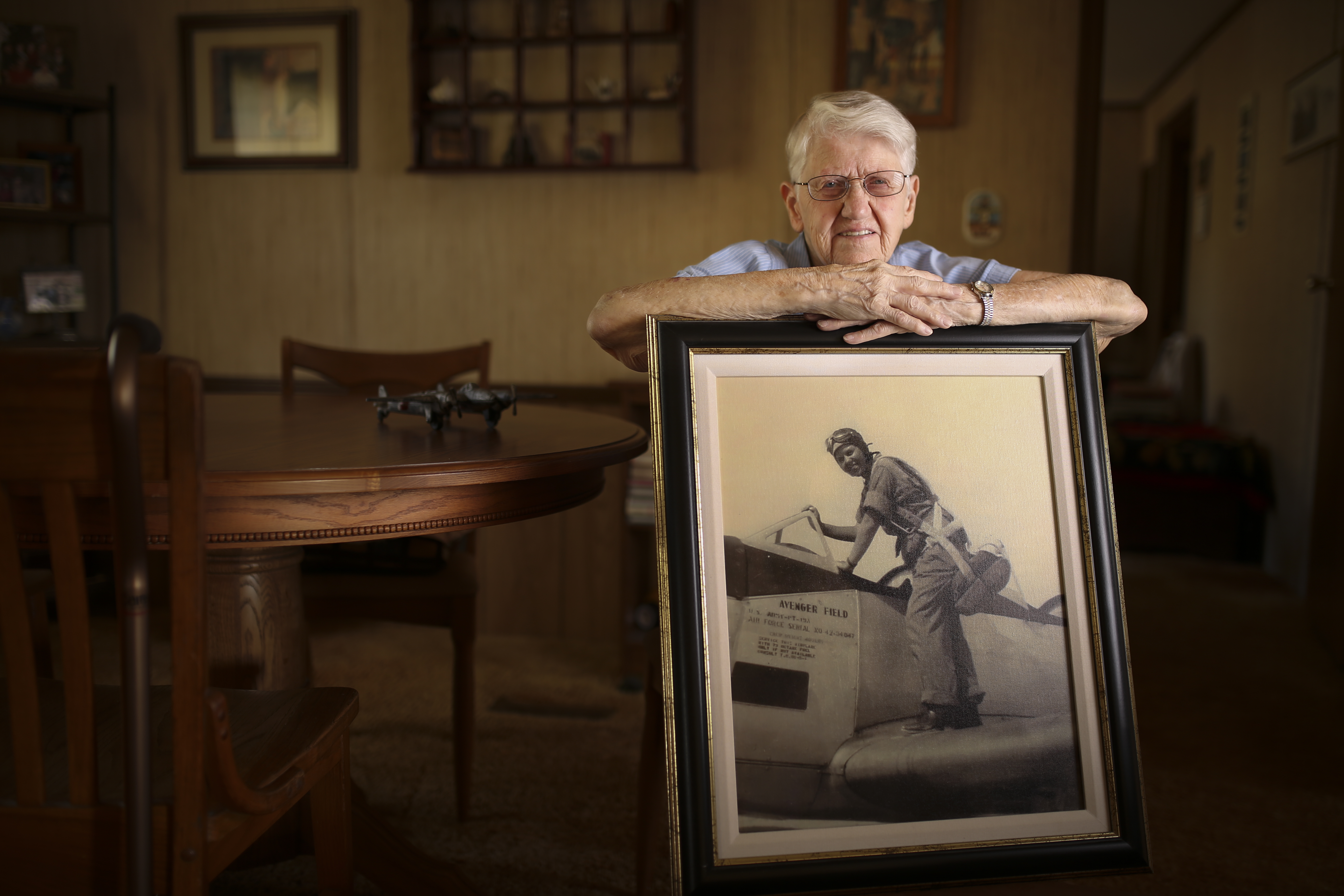
Baldwin City resident Pat Young, 96, is pictured with a nearly 70-year-old photograph of her climbing into a PT-19 Fairchild plane when she was 25. During World War II, Young volunteered for the Women Army Air Corps, but unable to finish the training program, she began building airplane engines in a defense plant.
On a coffee table in Pat Young’s living room is a stack of books on Amelia Earhart.
“I guess you could say she had a big influence on me,” the 96-year-old rural Baldwin City resident said, adding that she wrote a letter to the famed Kansas-born aviator while a student at Argentine High School in Kansas City, Kan.
“We were assigned to write three people about careers,” she said. “I chose her. She was out of town, but I got a letter back from her secretary. I still have it.”
Young graduated from high school in 1938 as the world was spiraling toward a war that would touch nearly every American of her generation. For many men near her age, war meant active duty service in World War II. That took them out of the workforce just as demand mushroomed for labor in America’s defense plants, giving rise to the term Rosie the Riveter as women filled nontraditional factory jobs.
Young did her part to defeat the Axis powers in ways that reveal Earhart’s influence. She worked in aircraft-related defense plants during the war and is a veteran of the Women Airforce Service Pilot program.
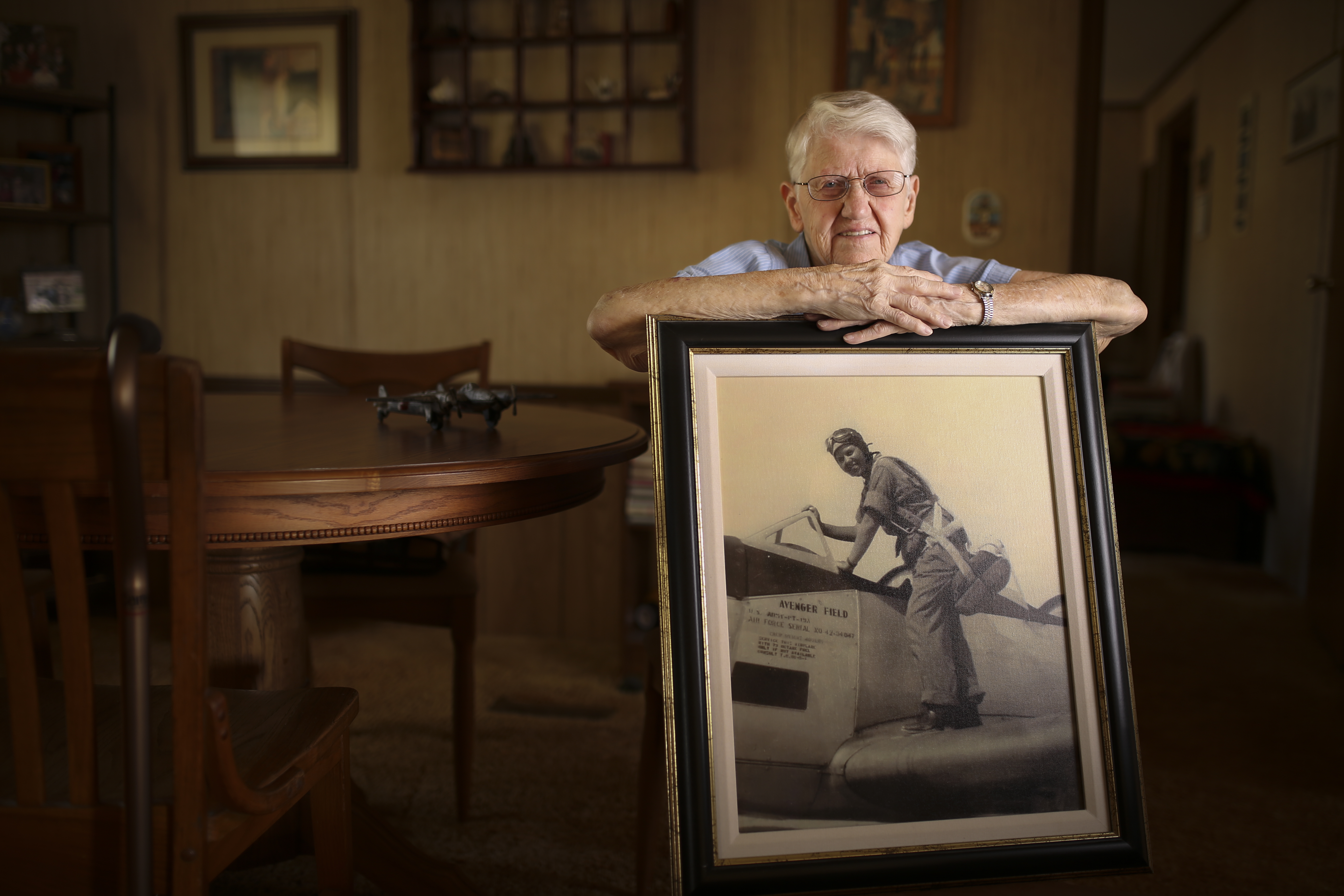
Baldwin City resident Pat Young, 96, is pictured with a nearly 70-year-old photograph of her climbing into a PT-19 Fairchild plane when she was 25. During World War II, Young volunteered for the Women Army Air Corps, but unable to finish the training program, she began building airplane engines in a defense plant.
Young’s first defense job was a 1942 position at Aircraft Accessories Corp. in Kansas City, Kan., assembling radios for airplanes. The job came with a big perk.
“Aircraft Accessories owned a Piper Cub,” Young said. “I took flying lessons through that, which were really, really cheap compared to private flying lessons.”
The lessons were at the old downtown Kansas City, Mo., Municipal Airport, Young said. She made slow progress in part because the early airline pilots who provided her instruction changed with nearly every lesson, she said.
“One day, I had this woman instructor, Verna Burke,” she said. “When we landed, she said, ‘I want to fly with you again next time.’ I flew with her exclusively from then on. She became a big friend.”
As she was training for her pilot’s license, Jacqueline Cochran was engaged in a nationwide recruiting tour for the Women Airforce Service Pilots program she directed since its formation in 1942. To free male pilots for war-related duties, the civil service program recruited women for such tasks as ferrying newly manufactured airplanes to military bases and towing targets used for gunnery practice.
“I interviewed with her (Cochran) when she was in town,” Young said. “A little while later, I got notice to start training at Avenger Field in Sweetwater, Texas. I barely had 35 hours of flying time, solo and with an instructor. The women in the first WASP classes had to have 200 hours, but they cut it back to 35 hours in 1943.”
Her acceptance into the program was noteworthy. Only 1,900 of the 25,000 women who applied for the program were chosen for training. Of those, 1,074 graduated before the program was disbanded in December 1944.
Young said she arrived Aug. 9, 1943, in Sweetwater as one of 99 cadets in the last 1943 WASP class. She was assigned to a barracks with three roommates.
“I enjoyed it,” she said. “I made friends with all kinds of women — professionals, college graduates and people like me. Some had been flying for quite a while.”
WASP training was the same as that given to novice male military pilots at the time, minus schooling in combat maneuvers. WASP cadets also used the same trainers, the Fairchild PT-19 and the Vultee BT13.
Training was broken down to three phases of primary, basic and advanced, Young said. To move on, cadets had to pass increasingly difficult flight tests given by both civilian and military instructors.
Those who failed a flight test were washed out, Young said. Of the 99 who started her class, 50 graduated. Eleven WASP cadets were killed in accidents while training during the WASP’s three-year history and another 27 died while flying after graduation, but washing out was the cadets’ big worry, Young said.
“I was surprised to find out later, all the girls, even the ones who were really good pilots, thought they were going to wash out,” she said.
Young made it through the primary training, but knew she was struggling. Three months into the training, she failed a flight test.
“The instructor said I was too slow,” she said. “He said I flew like I was in the tail of the plane rather than in the cockpit. I was very unsure of myself. I don’t try to cover up anything. I was just too slow.
“It seemed like the end of my life. That was what I really wanted to do at that time.”
Back home, Young got another defense industry job at the Pratt and Whitney airplane engine plant in the Kansas City, Kan., Fairfax Field B-25 bomber production complex. She first disassembled engines for inspections after test runs and was later moved to the rebuild team. During off hours, she earned her pilot’s license. In 1945, Young got another aviation opportunity when she was offered a job as a traffic controller in the tower of a Wichita airport.
“It was on-the-job training,” she said. “Radar was a new thing. It was very simple. The job was nowhere near as complex as what they do today.”
Young stayed with the job for about a year before once again becoming part of a generational phenomena as her relationship with Ed Young became more serious with his discharge from the Army. Young’s daughter Patty Thies, of Washington, Mo., said the romance nearly didn’t get off the ground, citing a letter her mother wrote turning down one of her father’s proposals because “her first love was flying.”
The couple had a family of six Baby Boomers, which left her no time to fly, she said. The Youngs moved in the 1960s to Baldwin City when her husband took a job with Haskell Indian Nations University.
Her children said Young remained interested in flying during their childhood, always looking up to identify planes overhead. Two of her sons joined the Air Force, with son Jerry Young rising to the rank of lieutenant colonel in his 29-year career.
His mother’s flying experience and interest contributed to his interest in aviation, Jerry Young said. He gained further insight into how his mother shaped his character when he accompanied her to a 50-year WASP reunion at Sweetwater.
“There were a lot of us children there who called ourselves Kids of WASPs,” he said. “A local TV station did an interview with the whole focus of our moms were not June Cleavers. The common thread we discovered from our conversations was while growing up we were expected to do things for ourselves. If you came home from school and wanted milk and cookies, you had to get them yourself. Our moms taught us independence — you can do it if you really want to.”
In 1977 after women became eligible to be Air Force pilots, Congress belatedly recognized WASP women with military veteran status. With that, Young received her official military WASP discharge papers. Her son said it was a long overdue recognition for the role they played in the war effort.
“There were a lot of instructors who didn’t want women in a cockpit,” Jerry Young said, “For those women to stand up, leave their homes and families and get in one of those trainers, that took real grit and determination.”
The biggest influence his mother’s experience had on his Air Force career, which included duties as a pilot and flight instructor, was his firm and early advocacy for female pilots in all roles, including combat, Jerry Young said.?
“When females started flying, I was one of the biggest advocates,” he said. “Who cares who flies fighter jets? Why would we pass over them and not put our best pilots up front?”
Aviation continues to fascinate their mother, Thies and Jerry Young said. She is a favorite passenger for the pilots in the Dawn Patrol World War I replica squadron of Liberty, Mo., and is a welcome visitor of A-10 Warthog pilots at Richards-Gebaur Air Reserve Station, Thies said.
“They love her,” she said. “They let her climb right up and look at the controls in the cockpit. We tell them, ‘Don’t tell her where the keys are.’ She would definitely start it up if she knew.”
Young’s response to a Christmas present she received from her children when she was 85 indicates that could be the case.
“I had a few times said doing a parachute jump would be fun, so they went together and paid for a jump with a parachute club out of Manhattan,” Young said. “I was attached to an experienced jumper. When he jumped, we were out of the plane. It was great. I’d do it again.”
Veterans Day activities
Lawrence
Friday
• American Legion, 3408 W. Sixth St.
11 a.m., flag ceremony, rifle salute and short speeches with free coffee, tea and cookies to follow.
• VFW Post 853, 1801 Massachusetts St.
11 a.m., Honor Guard, words from post officers, free lunch for those attending.
5:30 p.m., All-you-can-eat chicken dinner, free to veterans and $10 for others
University of Kansas
Friday
• Lied Center, 1600 Stewart Drive
7:30 p.m., AXIS Dance Company performance includes “to go again,” which shares veterans’ stories of resilience, specifically dealing with wounded veterans and their re-adjustment to civilian society. Tickets available online. KU military-affiliated students with a student ID may receive discount tickets by emailing veterans@ku.edu or calling 785-864-6715
Sunday
• Memorial Stadium, 1101 Maine St.
KU Salute to Service football game vs. Iowa State at KU Memorial Stadium. Five dollars from each ticket purchased at http://www.kuathletics.com/promo entering code SALUTE goes toward the KU Wounded Warrior Scholarship fund.
Sunday
9 a.m.
Fifth annual KU Veterans Day 5K, honoring Vietnam veterans and marking the 30th anniversary of KU’s Vietnam Veteran Memorial dedication. Online registration is closed, but onsite registrations will be available Sunday at Memorial Stadium. All finishers of the race will receive a finisher’s medal, and age group awards will be presented to winners.
Baldwin City
Friday
• 10:45 a.m., Baldwin Elementary School Intermediate Center,100 Bullpup Drive.
The school will have annual veteran recognition day in the school’s gym. The event will include a student choir, recitation of the poem “The White Table” and BESIC Principal Dan Walsmith reading the names of all veterans present. Veterans will receive a free lunch following the ceremony.
Eudora
• Eudora Elementary School, 801 E. 10th St.
Friday
• 7:20 to 8 a.m., doughnuts for dads and veterans.
City Government

Lawrence’s next city manager to be announced Tuesday; his contract has $330K base salary
Lawrence City Commission to consider incentives for Alarm.com; tech company wants to renovate downtown building for its offices

Nominations, call for artists open for Lawrence’s 2026 Phoenix Awards
Lawrence City Commission to consider selling public parking lot in downtown for affordable housing project

Lawrence’s housing study calls for hundreds of new units a year, repairing existing affordable homes