

Kansas governor vetoes American Royal, power plant measures
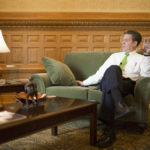
Gov. Sam Brownback answers questions during a year-end, sit-down interview on Dec. 8, 2015, in his office at the Statehouse in Topeka.
Topeka ? Republican Gov. Sam Brownback vetoed two measures Friday that showed the GOP-dominated Legislature’s growing distrust of how his administration has handled two major projects.
One measure was a provision in a budget bill designed to keep the state from authorizing bonds backed by state sales tax revenues for a project to lure the 117-year-old American Royal horse and livestock exhibition to Kansas from Kansas City, Missouri. Critics worried about the state forgoing revenues as it struggles to balance its budget.
The other measure was a separate bill to prevent the state from demolishing the 1950s-era Docking State Office Building near the Statehouse. Legislators passed the bill after their criticism forced Brownback to cancel a $20 million project to tear Docking down and replace its power plant with a new one for the Capitol and other nearby office buildings.
Brownback criticized the American Royal measure as “discrimination” against Wyandotte County, where the development would occur. He said the Docking measure wasn’t necessary once he abandoned the power plant project.
Both measures had bipartisan support, and the Docking bill passed both chambers nearly unanimously. Their backers would need two-thirds majorities in both chambers to override either veto.
“He’s picking some pretty good fights,” said Sen. Jim Denning, an Overland Park Republican who supported both.
The American Royal measure was included in a bill making dozens of adjustments in the state’s $16.1 billion budget for the fiscal year beginning July 1 in hopes of keeping it balanced. The bill also included Brownback’s proposals to close a projected deficit approaching $200 million largely by juggling funds and capturing unanticipated savings in programs.
Brownback signed the bill, but governors have the power to veto individual items in budget legislation. The provision he excised said the state couldn’t approve bonds backed by sales tax revenues for any Wyandotte County project unless lawmakers first tightened up the so-called STAR bonds program.
“I do not believe there is any precedent for this kind of discrimination against one county in connection with economic development programs,” Brownback wrote in his veto message.
With the state’s approval, Wyandotte County issued $450 million in STAR bonds starting in 2001 to create a thriving entertainment and shopping district surrounding a NASCAR track, Kansas Speedway. The bonds will be paid off this year — so the state can keep sales tax revenues generated in the district.
Denning and other lawmakers worried that Brownback’s administration would expand the district to include an American Royal development and tap up to $42 million in existing sales tax revenues generated there for new bonds. A recent Department of Commerce report said the American Royal project could include a hotel, a children’s museum and a 5,000-seat arena for both the exhibition and a minor-league hockey team.
Administration officials said there is no firm plan and disavowed using existing sales tax revenues to back new bonds. In his veto message, Brownback said he will work with lawmakers on tightening up the STAR bonds program.
Denning said with the veto, “We’ve will have to get that done.”
The power plant project drew criticism because the Department of Administration signed an unusual financing agreement in December, weeks after members of a legislative committee expressed misgivings. The state would have financed the project through a 15-year lease-purchase agreement with Bank of America, paying 2.32 percent interest.
The department contends it isn’t cost-effective to keep Docking open because it needs up to $100 million worth of maintenance, though some legislators are skeptical.
In his veto message, Brownback noted that in 2014, legislators authorized Docking’s demolition. The building will be mostly vacant by this summer.
In this year’s bill, legislators tied the project’s cancellation to a refusal by them to provide funds for it — expecting such language to help the state negotiate smaller penalties to be paid to Bank of America and the construction contractor.
State Government
State legislators push back against federal energy regulators ending competitive bids
TOPEKA — Two Kansas legislators asked federal energy regulators to ensure competitive bidding occurs on ...
Senate confirms 1st of 3 Kansas nominees to U.S. District Court
Corporate income tax collections falling sharply in Kansas; Republican, Democratic leaders disagree on what it means
TOPEKA — Corporate income tax collections in Kansas have almost halved since last year, while other sources trend ...
Candidate’s campaign manager created website with documents used to attack rival
TOPEKA — Kansas U.S. Senate candidate Patrick Schmidt’s campaign manager left his digital footprint on ...
GOP secretary of state files to run for governor
