

Lawhorn’s Lawrence: Homeless shelter director a student of recovery
For a while, it was was uncertain which way Brian Blevins, the relatively new director at the Lawrence Community Shelter, was going to turn.
That’s the way it often is for a man whose turn signals don’t work.
“I got my tail lights smashed and my door kicked in so many times,” Blevins says of his previous stint as a security guard at the shelter. “I was trying to control them, and they didn’t like that. Eventually I learned that you don’t control this environment. You influence it. But for quite a while, I was not a good security guard.”
But he was an even worse quitter. Blevins stuck with the job. He knew a thing or two about a life uncertain of which direction it will turn. Blevins has 10-plus years as a recovering alcoholic.
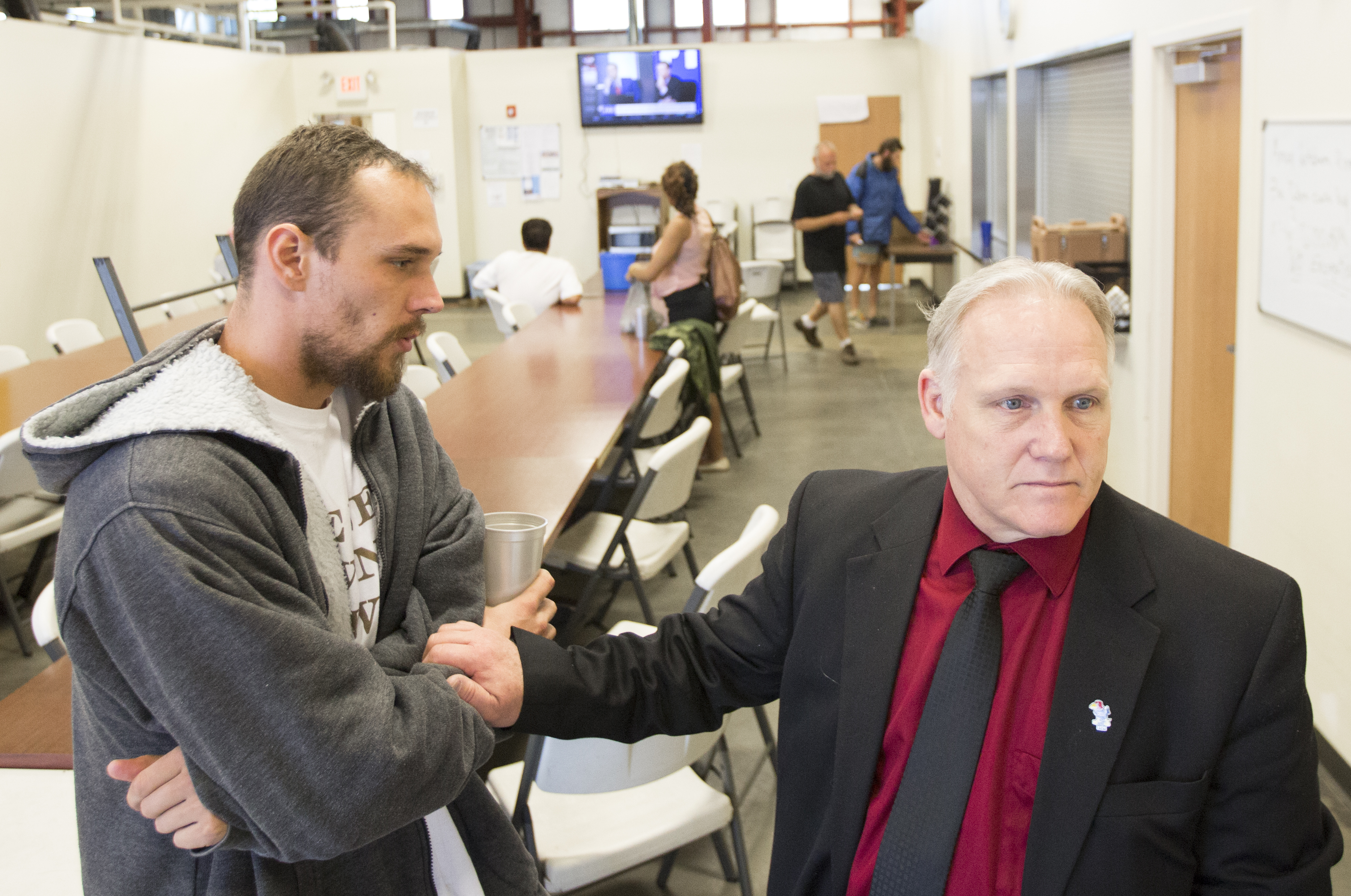
Lawrence Community Shelter Director Brian Blevins gives a pat to shelter guest Mark Swope after a conversation about Swope's reluctance to pursue a temporary housing option, while making his rounds on Friday morning at the shelter. Blevins, who is a recovering alcoholic, believes his personal experiences give him a better perspective on many of the issues surrounding homelessness.
“I went through 14 different treatment centers trying to figure out how to not be who I was being,” Blevins says. “I knew something was broke, but I didn’t know what it was. Then, I met some good people.”
Those people — counselors and friends who were on a successful path to recovery — taught Blevins how to change, and also gave him a new avocation.
“I became a student of recovery,” Blevins says. “Why do people recover? What does it take to get people in a mindset to recover? I wanted to see how to intercede before they get to the tragedies of their life.”
For some, that means a stop at the Lawrence Community Shelter, the 125-bed homeless shelter on the eastern edge of the city. Blevins took over as director of the shelter on Dec. 26. But he’s been a part of the shelter for much longer. He’s been an employee in various capacities since 2007. He was a frequent volunteer before that, serving as part of the construction crew that did the renovation work on the original shelter downtown. The volunteer work fit his skill set well. He was in the home improvement business — the hammer and saw type — before he got a degree in substance-abuse counseling, which has been known to improve a home as well.
As executive director of the shelter, Blevins has found he has to be a student of more than just recovery. A little bit of accounting knowledge comes in handy too, although knowledge of alchemy would be even better.
“The most challenging part of this job is funding,” Blevins says without hesitation. “Trying to keep your mind on funding what we have rather than what we want is a trick, too.”
Blevins says finances for 2015 currently are about $150,000 short. He said the shelter continues to seek additional donations from the public to make the shelter’s approximately $1 million operating budget work, but he said funding requests to the city and the county are likely.
He thinks he’ll have a good case to make, if that time comes. Since he’s taken over, work has begun on converting vacant space in the shelter into a “career center.” The space will include classroom areas and computers donated from Lawrence Memorial Hospital, where shelter guests can learn some key employment skills. The shelter is collaborating with both the Lawrence Public Schools and Kansas University on instructors for the space. Blevins said the onsite training is a shift from a previous philosophy where the shelter tried to send guests to other such programs in town.
“We get a lot better accountability if it happens here rather than us giving them a bus pass,” Blevins says.
Accountability is a bigger concept at the shelter than some people may think. Blevins did not hesitate when asked about the biggest misconception people have of the shelter.
“I think a lot of people have this image of us being tree-hugging dirt worshipers,” Blevins says. “I came into this business as a conservative Republican. I suppose it does get mixed with some liberal ideas too. I think the mixture allows us to help people better. There is a fine line in the sand between enabling someone and helping someone.”
Blevins says the shelter’s employment program is paying dividends, too. He hired a new employment director in January — a young Kansas University economics graduate — who is using new strategies to find work for eligible shelter guests. He has stopped using temporary employment agencies and instead has begun seeking out more permanent positions from the beginning. The shelter also is taking advantage of a federal bonding program that gives employers an incentive to hire convicted felons. If the employee acts improperly and causes damage to a business, the bond kicks in to cover the company’s losses.
Blevins says the average employment rate of eligible shelter guests is now about 70 percent, which is up from about 25 percent previously.
“There are some good jobs in this town,” Blevins says, mentioning several employers, including some who are in the East Hills Business Park right across the highway from the shelter. “Amarr Garage Doors hires quite a few. That is hard work, but they pay a good wage, and they’re willing to take a chance. We love people who will do that.”
But mainly what Blevins loves is recovery. He’s not the type, though, who talks about a lot of steps or other such mechanisms. Remember what he said he found when he finally recovered? Good people.
Making the shelter be a place where you can find good people is a big part of the equation.
“What it boils down to is the environment,” Blevins says. “If you give somebody a good environment to heal in, then you can employ the social service agencies and the other tools to help them get better. But it has to start with the environment.”
Having the additional space of the 125-bed shelter — which replaced the shelter’s cramped downtown quarters in late 2012 — has done wonders for the environment and reduced the stress levels of guests, Blevins says.
But that’s only one part of the environment. The other is not quite as easy to build.
“We definitely have people come in here who clearly don’t care about getting a job or about getting mental health care or about anything else,” Blevins says. “Some people see that person as someone who just doesn’t care. But what I see is somebody who fought tooth and nail against being here, and now they have come to accept nothing can change.
“What I believe wholeheartedly is that there is nobody who comes into this shelter who wants to be here.”
Seeing people leave the shelter on the right terms makes the job rewarding, Blevins says. Getting a note — like a recent one from a former shelter guest who recently finished his college degree and has been in recovery for six years — is rewarding too. Big life stuff happens here.
But in this business there are even minute moments that can leave an outsized impression. Blevins remembers one from his early days as a student of recovery. He was sitting in on a counseling session where role-playing was being used. It involved a patient full of anger toward his father, but for reasons that weren’t accurate or logical. For whatever reason, the role-playing exercise had flipped that switch and helped the patient understand it wasn’t his father’s fault.
Blevins remembers seeing the tension in the man’s face leave. He remembers hearing the tone of his voice change, the posture of his body relax. And it all happened from one minute to the next, right there as the three men sat around the table.
No, it doesn’t happen every time. But if you see it happen once, you’ll never forget it.
“Seeing a miracle happen in someone’s life is the single greatest joy anyone could hope to see,” Blevins says. “I just sat there and watched the hate leave him.”
A true change — and a good reminder that a broken turn signal shouldn’t stop a turnaround.
— Each Sunday, Lawhorn’s Lawrence focuses on the people, places or past of Lawrence and the surrounding area. If you have a story idea, send it to Chad at clawhorn@ljworld.com.
City Government
Lawrence City Commission to consider earlier public comment period once a month, new civility standards for commissioners

Garage door manufacturer Amarr seeks help from City of Lawrence to buy its current facility; it could eventually expand with 50 to 75 new jobs
Recent trail closure at Rock Chalk Park reveals city has abandoned cost-sharing agreement with KU
Lawsuit settlement would have City of Lawrence take control of Riverfront building; city and its contractors would pay $2.5 million in total
During new demolition moratorium, University Place hopes to strengthen protections for its older homes