New board to tackle Medicaid
Kansas Health Policy Authority to oversee health care reform
All across the country, states are looking for ways to rein in their health care costs.
Some, such as Missouri and Tennessee, have cut eligibility. Others, such as Utah and Kentucky, have adopted copays.
Florida is leaning toward privatization. West Virginia wants its Medicaid recipients to sign contracts, agreeing to take their medicines and steer clear of emergency rooms.
Kansas is different. It’s put its eggs in one basket known as the Kansas Health Policy Authority, a nine-member board that after July 1 will assume oversight of the state’s Medicaid programs and its insurance programs for state employees and uninsured children.
Combined, the three programs cover 100,000 people and billions of dollars.
“This is a big deal,” said Andy Allison, the authority’s deputy director. “In a very real sense, Kansas is addressing reform in a more fundamental manner than what you’re seeing in other states.”
Accessibility
Rather than always quibbling over how best to contain costs, the authority, Allison said, will focus on the long-term goal of making health care accessible to the insured as well as the uninsured.
“The approach that Kansas is taking is designed to bring health issues to the fore – not just payment or cost issues,” he said.
No one on the authority, he said, is calling for copays, cuts in eligibility, lifestyle contracts or privatization.
“It’s too early for that,” he said. “The board is just getting started.”
That’s not the only reason:
¢ After five years of double-digit increases, Medicaid spending in Kansas appears to be leveling off – from $2.2 billion in the current fiscal year to $2.3 billion in the year that begins July 1.
“I’m not suggesting that Medicaid isn’t growing – it is,” said state budget director Duane Goossen. “But this is a moderate increase compared to what we’ve seen in the past.”
Goossen attributed the plateau to Medicare Part D and an improving economy.
“Medicaid eligibility is based on income,” he said, “so when the economy improves, fewer people are on assistance.”
Medicare Part D, which took effect Jan. 1, has offset some of the state’s prescription drug costs.
More about Medicare Part D
“It’s too early to know how long that will remain in effect,” Goossen said.
¢ Kansas’ rates paid to Medicaid providers – doctors, hospitals, pharmacies, nursing homes – have long been among the lowest in the nation.
State officials announced a modest increase – going from 65 percent of the rates paid by Medicare to 83 percent – for doctors earlier this week.
¢ To be eligible for Medicaid in Kansas, single adults who are not blind, disabled or pregnant cannot be above 37 percent of the federal poverty guideline – that’s $302 a month.
Women and children
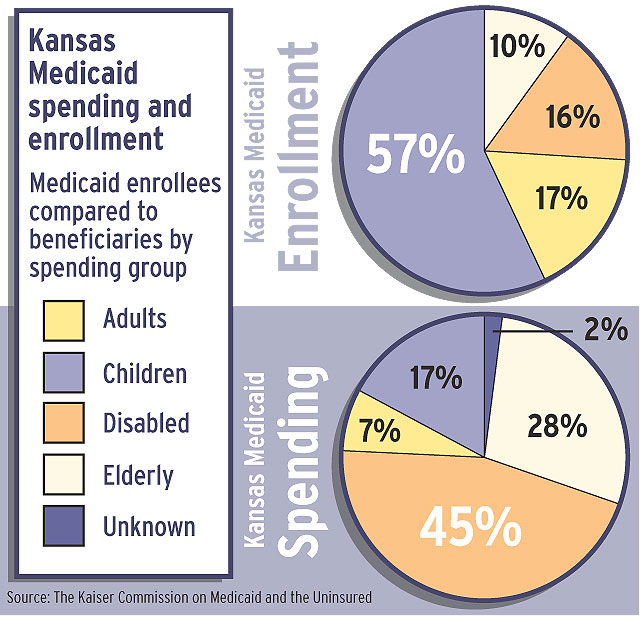
“A lot of people don’t realize it – because of the stereotypes – but in Kansas, Medicaid is mostly pregnant women and children,” said Jerry Slaughter, executive director of the Kansas Medical Society.
State reports show that in Kansas, Medicaid pays for one out every three births.
Medicaid is a government-funded program – 60 percent federal, 40 percent state – that underwrites health care for the poor.
“In the scheme of things, pregnant women and delivering babies aren’t that expensive,” Slaughter said.
Most of the system’s cost drivers, he said, lie with children and adults with “profound, chronic or multiple illnesses – the sickest of the sick.”
‘Little steps’ needed
Slaughter said he has high hopes for the authority.
“I get the sense they’re not looking for the silver bullet that we’ve all spent the past 30 years looking for – and that’s not there,” he said.
The authority’s chairwoman, Marcia Nielsen, expects reform to come in “little steps” rather than giant leaps.
“We have a lot of little victories to win before you’re going to see big, bold headlines,” she said.
Nielsen is assistant vice chancellor for health policy at Kansas University Medical Center.
The authority, she said, will not shy away from the politics that’s sure to accompany reform.
“I spent 10 years in Washington,” said Nielsen, a lifelong Democrat – her father is a retired meatcutter, her mother is a secretary – and a former member of Nebraska’s U.S. Sen. Bob Kerrey’s staff. “If there’s one thing I learned, it’s that reform and politics go hand in hand.”
Nielsen said the authority enjoys the blessings of the governor’s office as well and the Democrat and Republican factions – moderates and conservatives – in the Legislature.
“I’m not going to make any guarantees,” she said, “but I think the way stars are lining up, there are some very real opportunities before us.”
For Nikki King, who runs Health Care Access, Lawrence’s clinic for the uninsured, reform can’t come soon enough.
“Right now, our wait times are six weeks for regular appointments (referrals). It’s three months for women’s health – things like breast and cervical cancer screenings,” King said. “Basically, we’re full.”
State Government

3 of the 7 people seeking the open Kansas Supreme Court seat are from Lawrence; you can watch them interview live Thursday
KU proposing 5% increase in tuition, fees for next school year; enrollment expected to be flat
Department of Corrections signs $88.9M inmate healthcare contract
TOPEKA — The Kansas Department of Corrections signed a two-year contract with a private healthcare company based ...
Douglas County judge temporarily blocks enforcement of Kansas law banning gender-affirming care for minors; Kobach says he’ll appeal

New legislation will allow providers to administer drug used to reverse opioid overdoses past its expiration date