Lakes drained to aid barge traffic
Plan blasted; reservoirs could drop 6 ft.
It’s the hottest time of the year and the federal government is taking water from the lakes that feed the Kansas River. State officials are upset and want it to stop, but say there is nothing they can do about it.
“We’ve been opposed to it the whole time,” said Earl Lewis, an operations manager for the Kansas Water Office. “It doesn’t make a whole lot of sense, frankly.”
On Wednesday, the sluice gates at Perry Reservoir were opened to send water down the Kaw to the Missouri River to help boost its flow enough to better support barge traffic.
And the flow of water from Perry, Milford and Tuttle Creek reservoirs will continue to pick up until as much as 4,000 cubic feet of water per second is flowing. The river only puts out 200 cubic feet of water per second in the dry summer.
That means the lake levels at Perry and the others will likely drop 3 feet or more, depending on how much rain falls the rest of the summer and how much water the U.S. Corps of Engineers decides the Missouri River needs.
Critics of the process say the lakes are nowhere near large enough to make a dent in Missouri River traffic, and that lowering the levels hurts both recreation on the lakes and the fish and wildlife that rely upon them.
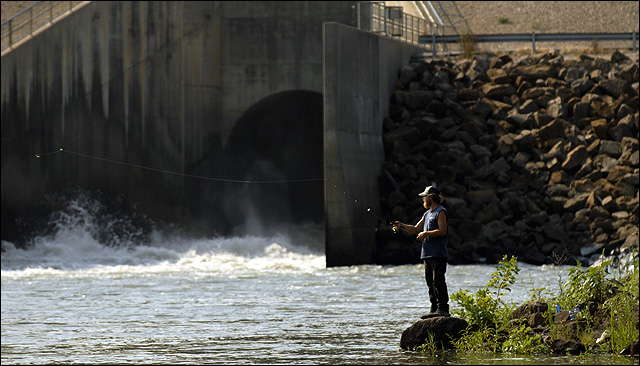
Perry resident Frank Tibbet casts his line out into the Delaware River early Wednesday evening just south of where the Perry Lake spillway connects with the Delaware and eventually leads to the Kansas River. The Army Corps of Engineers at Perry Lake was ordered to open the sluice gates to send water to the Kansas River and then into the Missouri River in an effort to boost water levels to help barge traffic.
“If you look at the size of the lakes in Kansas as opposed to the size of the river, they’re not the same scale,” Lewis said. “How much do you have to have before these guys feel comfortable?”
When the corps opens the dam gates on the lakes, water pours into the Kaw, through Lawrence and other Kansas river towns and eventually down to the Missouri.
This summer’s round of draining began July 7 and will increase until the mandated flow levels are reached.
Boat repairs
In the process, the lakes – specifically Perry Lake – may drop as much as 6 feet below typical pool levels, leaving swaths of exposed shoreline and boats in need of repairs after bottoming out in the shallower-than-normal waters.
Corps officials admit the massive amounts of water from Perry and other lakes adds only inches to the Missouri’s depth, and then for only a few weeks. The increase is not enough to make a serious difference in a river barge’s ability to navigate up or down the muddy Missouri, officials say.
Steve Adams, a Natural Resource Coordinator for Kansas Department of Wildlife and Parks, said that the drainings have been more frequent in recent years, which can slow the lakes’ recovery time when pool levels drop several feet.
“Now, in the last three or four years, they’re coming in every year and asking for water,” Adams said. “We’re concerned about releasing those waters.”
Recreation industry
Adams said his primary concern was for people coming to the lake to boat and swim.
Recreation as an industry is essential to the state’s economy, Adams said, and when water levels fall during the height of the lake’s busiest season, it hurts local businesses and their patrons.
At Perry Lake Yacht and Marina, manager Brian Best said he has seen the draining’s harmful impact. Store traffic and gasoline sales fall when more and more people damage boats on the lower-than-usual lake and stop coming, he said.
“It’s detrimental to our business,” he said. “It just starts scaring people.”
Even this year, Best said he had seen several engines and boats damaged from hitting bottom. That brings business to the service shops, but not the kind of business Best wants to see, he said.
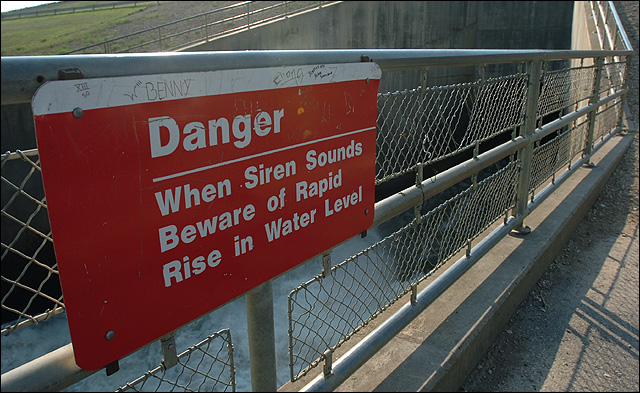
Signs posted along the overlook of the spillway at Perry Lake warn visitors of rapidly rising water levels when the dam is opened. The Army Corps of Engineers began draining water from the reservoir on Wednesday to aid barge traffic on the Missouri River.
And unless the rain begins pouring, the problem isn’t going to get any better through the summer.
“Lake Perry suffers,” Best said. “They should be draining some of the lakes that aren’t used as much for recreation.”
Under pressure
Steve Spalding, a water control official for the corps, said that the corps used all three lakes to boost navigation waters on the river primarily because Congress authorized their use for that purpose. Clinton Lake was not authorized to be tapped to support Missouri River navigation, so it is not subject to the corps’ demands for more Kansas water.
Because of the federal authorization, the corps has been under near-constant pressure from other states along the Missouri River basin to keep all sources of additional water open and operational, Spalding said.
But he acknowledged the Kansas lakes provide a much smaller percentage of water to the Missouri than other, larger reservoirs near Omaha, and that if one of the Kansas lakes was removed from the system, Missouri River levels would not change much.
“If any one of those (Kansas) lakes stopped operating for navigation, navigation would go on,” he said.
Barge traffic low
But Spalding said companies that ship goods along the river created the need for additional water flow, even if that means just 4 or 5 extra inches. The corps tries yearly to meet the barge traffic’s target depth and the water flow needed to get supplies up and down the river.
“They need to have reliability on the river before they can operate on the river,” he said.
Corps data reviewed by the Journal-World shows that barge traffic on the hundreds of miles of river between Sioux City, Iowa, and St. Louis has been low or nonexistent the past month, with only three commercial vessels using the river at one time.
Between June 15 and this week, many of the vessels that typically carry goods, including the Jennie Dehmer and Leslie B, were taken out of service until river levels increased, the records showed.
But Adams said even if the Missouri’s levels were low, they weren’t unusually so and that the corps shouldn’t tap Kansas lakes to boost the river a few inches for so little traffic.
“When you have a couple of boats a month working on the system, it’s hard to understand why that’s being justified.”
City Government

Per aspera: Outgoing Lawrence City Manager Craig Owens looks back on challenges good, bad and traumatic

PHOTOS: Compass rose painting at Lawrence Regional Airport

Lt. Gov. Toland in Lawrence to celebrate downtown affordable housing project, urges city to be ready for more growth

Functional compass rose with sunflower design will be ‘a really wonderful focus point’ for Lawrence airport

City of Lawrence and Douglas County leaders to weigh in on a proposed Fire Medical funding formula next week