Lace-like patterns highlight colorful glassware
In the 1860s, after the Civil War ended, styles reflected the new emotions of the country.
Furnishings became more elaborate, and houses were filled with bric-a-brac and patterned wallpaper, rugs and fabrics. The simple look was out; opulence was in. Glassmakers created new types of colorful shaded glass called by romantic names such as peachblow (red to yellow), amberina (red to amber) and burmese (salmon pink to lemon yellow).
They also made glassware using several colors of glass. Spanish lace, sometimes called queen’s lace or opaline brocade, is easy to identify. The colored glass — usually blue, yellow or red — was decorated with a lace-like pattern of white glass. It was first made in England but was copied by the Northwood Glass Co. at its Indiana, Pa., factory and in Wheeling, W. Va. It was made from 1885 to about 1920. It is hard to find today, and a single piece can sell for more than $1,000.
Q: I found an old, metal school-crossing sign in northern Michigan. It’s 5 feet high, flat and figural. The figure is painted to look like a guard wearing a small black cap, a red uniform, black boots and a white shoulder-strap belt. Across his middle are the words “School Crossing,” and there’s a post at the bottom so the sign can be pushed into the ground. Should I clean and paint the sign? How old is it?
A: You can clean the figural sign if you do it carefully, but don’t paint it. Painting the sign will decrease its value, which could be several hundred dollars. The sign probably dates from the 1930s.
Q: My sister left me a large porcelain vase decorated with hand-painted poinsettias, leaves and gold trim. The bottom has three different marks: “Limoges, France,” “N.R. Gifford” and a circle enclosing the words “W.A. Pickard, Hand-Painted China.” Why so many marks? When was this vase made?
A: The three different marks identify where the porcelain vase was made (a factory in Limoges, France), the American company that imported the unpainted vase (Pickard China) and the artist who painted the decoration (Nathan Roswell Gifford). Gifford worked at Pickard from 1903 until 1910. Wilder Pickard founded his china-decorating business in Chicago about 1895. He imported plain china “blanks” and hired artists to paint decorations on them. Your vase is decorated with a known Pickard pattern called “Poinsettia and Luster.” Depending on its size and condition, it’s worth at least $200.
Q: Several years ago, we began collecting plates decorated with painted pictures of mice sitting on a tree branch. We have found them at flea markets, malls and shops in Minnesota. So far, we have eight plates in various sizes and shapes. The plates are similar in design and color. They all have from three to seven white or gray mice on a brown branch. The background on the plates is off-white to light brown. The marks on the back are all different and include ceramic factories in Germany, Austria, Poland and France. Can you explain this?
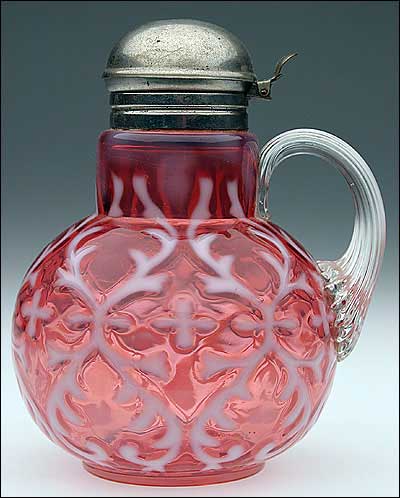
This rare Spanish lace cranberry syrup sold for ,200 in January at a Green Valley auction in Mt. Crawford, Va.
A: It is highly likely that your plates were undecorated when they were imported from Europe. China distributors here imported plain wares in huge numbers from many factories between 1876 and 1915. This helped to meet the demand of mostly amateur china painters. Your mice plates seem to be the work of a single artist or a small group of artists working together. You might have a hard time finding more, but keep your eyes open and check online auctions and sales.
Q: I have a large glass Planters Peanuts jar with a glass cover. The cover has a handle shaped like a peanut in the shell. The clear glass jar has two rounded sides and two sides that are oval and flat. Embossed on the oval sides are the words “Planters Salted Peanuts.” I’m 73 and remember this jar from my childhood. What is it worth?
A: Planters Peanuts items are popular advertising collectibles. The jar you describe dates from about 1930. Today, it sells for more than $200. Beware: Some Planters Peanuts jars are reproductions.
Tip
Never clean alabaster with water. Test a small spot before you use anything. First, use turpentine applied with a soft cloth. If the stain is stubborn, try alcohol.
| Current prices are recorded from antiques shows, flea markets, sales and auctions throughout the United States. Prices vary in different locations because of local economic conditions.Victorian purse made from varnished and strung apple seeds, long strap attached with chain links, 4 inches, $90.Bull Dog canning-jar-rubbers display box, 24 original boxes, blue ground, red letters, bulldog on front, 12 x 10 1/4 inches, $275.Krepps & Co. Egg-Tester, hand-soldered tin, brown-and-yellow ground, picture of woman seated in wicker chair using product, dated 1874, 2 1/2 x 3 1/4 inches, $375.Spanish gilt wrought-iron occasional table, hourglass form, scalloped feet, central openwork baluster, glass top, 96 inches, $455.Chad Valley doll, Princess Elizabeth, blue glass eyes, original dress with blue wool coat and blue felt shoes, 1930s, 18 inches, $460.Sunderland Luster pitcher, pink luster with three black transfers, “A West View of the Iron Bridge at Sunderland,” 2 verses, 8 inches, $860.Charlie McCarthy and Mortimer Snerd private car, streamlined, reverses when bumpers are hit, heads spin, Marx, 1939, 16 inches, $1,155. |
Home and Garden
What to cut back and what to leave standing in your garden’s fall cleanup

Native, pollinating plants popular for fall garden sprucing

Home and Garden: Tips to consider when creating an outdoor area for television watching