Utilities weighed in benefits of expansion
When a builder in Lawrence wants to put up a house – or a factory, or an office building – they can’t just pick a piece of land and start construction.
First there must be connections with water, sewer and electric lines, streets to carry traffic to and from the site, trees to be planted and street signs to be installed; all mandated by the city.
For years, those “public improvements” usually have been built at roughly the same time as the developments they serve.
Developers say they take a close look at the city’s master plans – where City Hall expects and wants future sewers and streets to be built – when deciding where they want to build.
“I think developers look at the sewer master plan, and they try to go where the city is planning to develop,” said Bobbie Flory, executive director of the Lawrence Home Builders Assn. “It’s kind of a hand-in-hand process, really.”
The full description of what services are needed in new developments, and how to pay for them, can be found in Article 21, Chapter 7 of the city codes, online at City Hall’s Web site, lawrenceks.org.
But in recent years, City Hall has been building a case for changing the system: The city would build streets, sewers and other utilities in the parts of town where it wants to see growth, in some cases years ahead of time.
“One reason is making sure we develop infrastructure efficiently and effectively, rather than in sort of an ad hoc fashion,” said former Mayor David Dunfield, who got the ball rolling in 2002 with his Adequate Public Facilities Task Force. “Presumably, if we can plan the system in bigger chunks … we can develop it more economically for everybody.”
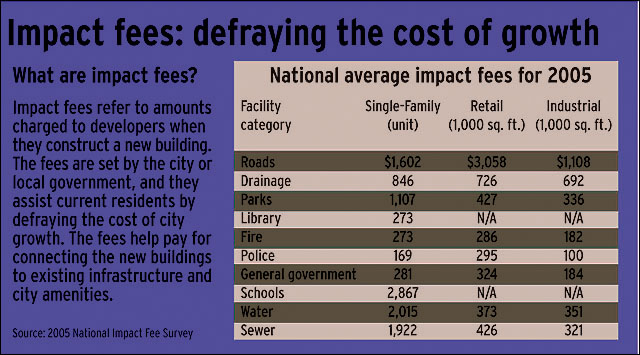
Another goal: Shift more of the cost of the city’s growth to developers. Over the last year, a consultant has been gathering information about Lawrence’s costs of new infrastructure and services needed to accommodate growth, and reviewing the city’s system development charges that attempt to recover some of the costs associated with growth.
The Tischler & Associates report is nearly complete, Assistant City Manager Dave Corliss said.
“They are continuing on the report,” he said. “I think we’ll have something this month or in January that will be a draft report.”
But Flory, of the home builders association, worries the report will be one-sided.
“We have a long-standing concern with the process. We really want this consultant to review the benefits of growth as aggressively as they’re reviewing the costs of growth,” she said.
Her association, hoping to avoid new “impact fees,” did a study in 2001 suggesting that, after development fees and sales and property taxes are added up, taxpayers bear little of the cost of building a housing subdivision.
“New development is, in almost every subdivision they looked at … creating a net gain to the city,” Flory said.
Some sort of change appears to be in the offing, however. Mayor Boog Highberger last month proposed annexing large chunks of land into the city, in order to better plan services like streets for Lawrence’s new neighborhoods.
Highberger said he thought the new process would make it easier for the city to plan, which should ensure new areas of town are served by streets and infrastructure that make sense. Plus, Highberger said the change would bring Lawrence in line with how other communities, including most in Johnson County, plan for growth.
But such proposals are likely to meet resistance. Flory said developers will want to retain control over how and when streets are designed and built.
“I think the development community has the ability to be more efficient with how the infrastructure is installed,” she said. “They have to really watch their bottom dollar on the costs, because they have to pass those costs along.”
City Government

Rising Rates: A three-part investigative series examines why Lawrence water and sewer bills have been soaring
Some leaders are now stating a new reason for why Lawrence’s utility rates are soaring: The city didn’t grow enough

Lawrence City Commission could start the process of finding a construction manager for new fire station

Lawrence is charging water, sewer customers a special tax not required by state or city law

Lawrence housing market strains residents as development fails to keep up, city’s affordable housing study finds