

Kansas’ prehistoric past imagined in sea of glass
Emporia ? Go ahead, walk around the reef. Just one more time. Something new is bound to draw itself to your attention.
Something like the glass eel, peeking out of a hidden cave.
Or maybe the small octopus in the rocks, its arms curling in an invisible current.
Or even the surprise sculpture, hidden … but no, that would be telling. An artist has to keep some secrets, after all.
Were it not for the glass and ceramic ecosystem, someone might think this were a reef off Australia, or Hawaii, or maybe San Diego. Someone would be wrong.
This is Kansas. Or at least, it’s artist Alan R. Keck’s vision of what Kansas used to be 10 million years ago, when much of the state was a Cretaceous-era ocean.
“I guess it was born out of my love for sea life and the archaeology of the region,” said Keck, an Emporia High School art teacher whose exhibit “From An Ancient Seabed” appeared last month at the Emporia Arts Center. “I really love the colors and the textures of sea life and reefs, so I try to capture that in my work.”
Keck’s an unlikely ocean-lover. He grew up in Dodge City, where moisture is scarce and the Arkansas River runs low when it runs at all. Blame the occasional childhood fishing trip for catching his interest. For that matter, blame two folks he knew only through the television screen: Harold “The Fisherman’s Friend” Ensley and undersea explorer Jacques Cousteau.
One look at that soft blue ocean and Keck was hooked. He still is, to the point of beginning scuba-diving lessons two years ago.
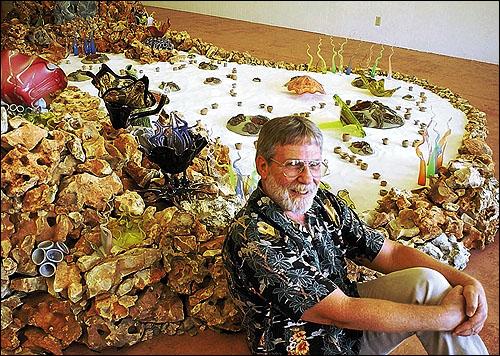
Alan R. Keck sits with his art display at the Emporia Arts Center. The display, made with glass and ceramic, depicts what Kansas may have looked like when it was an ocean bottom.
“You get down under water and you’re breathing and you just think Wow!” Keck said. “It’s amazing.”
Keck learned glassblowing 16 years ago, about the time he was hired to teach it at Emporia High School. About 10 years ago, his new art began merging with his old passion, and he began shaping the inhabitants of his imaginary underwater world.
The first was “Mother of Pearls,” in which a small bed of clams is beginning to move away from its mother. Others followed, including the “Cornucopia Clam” with its horn of plenty shape and a ceramic and glass body, and a number of sand dollars with an odd and deliberate resemblance to crop circles.
“Who knows what’s making those?” Keck joked.
Each bit could stand on its own as a pedestal piece. But grouped together, it becomes a true environment, especially since there’s not just one of anything. There’s an eel here, but also one there. The octopus on the rocks in one place has a similar, but not identical, counterpart elsewhere on the reef.
The rocks of the reef reinforce the feeling. They come from about 10 miles outside of Cottonwood Falls and many have small fossils embedded.
In the sand nearby, small tracks cross the landscape. At first it seems deliberate, until Keck starts chuckling. “A cricket,” he explains, “must have been hiding out in one of the rocks.”
“I like the tracks,” he added. “It looks like a shrimp or something has been skittering around the ocean floor.”
Once the pieces had been created and the materials assembled, it took four days of work to build the reef and another day to clean up afterward.
“I look at it as one piece,” he said. “To me, they’re all part of a much greater whole.”
The exhibit closed last month, but there’s always the possibility that it could be built again somewhere else. There are so many different ways it could be set, Keck said.
“I would love, more than anything, to take all these pieces to the Florida Keys or some other beautiful setting and film it in a natural scene, he said. But that’s probably out of the question.
State Government
Corporate income tax collections falling sharply in Kansas; Republican, Democratic leaders disagree on what it means
TOPEKA — Corporate income tax collections in Kansas have almost halved since last year, while other sources trend ...
Candidate’s campaign manager created website with documents used to attack rival
TOPEKA — Kansas U.S. Senate candidate Patrick Schmidt’s campaign manager left his digital footprint on ...
GOP secretary of state files to run for governor

9 nominees vying to fill vacancy created by Judge Pokorny’s retirement

As filing deadline nears for 2026 elections, some Douglas County races feature just one candidate
State lawmakers extend emergency declaration over hantavirus exposure
TOPEKA — Kansas legislative leaders on Tuesday approved the governor’s request to extend an emergency ...