

Report card changes no elementary matter
Not all parents enamored of redesign
School officials say the new, redesigned report cards issued to elementary students this week are a big improvement over those they replaced.
But not everyone likes the change.
“It’s just a horrible new report card,” said parent Clara Morrison. “It takes the childhood fun out of it. They can’t tell if they got an A or a B. A report card like this is appropriate for high school, but not first-graders.”
Morrison’s daughter, Gabriela Bongard, is in first grade at Sunflower School.
District officials said Morrison was the exception. Most people they’ve heard from, they said, are pleased with the new cards, which were redesigned for the first time in at least a decade. The new version contains much more detail about student progress, but is more complicated.
The new report cards were unveiled this week to the district’s 5,000 elementary students. That coincided with parent-teacher conferences at the end of the first quarter.
Principals, school board members and some parents said Thursday their initial reaction to the cards was positive.
“We have heard nothing but good things,” said David Williams, principal of Prairie Park School. “People seem to think they’ve got a clear, accurate picture of how their kids are doing so far.”
The elementary report cards were expanded to include more analysis of student progress at each grade level. The changes reflect a national trend toward “standard-based” cards tied to state curriculum standards and assessments.
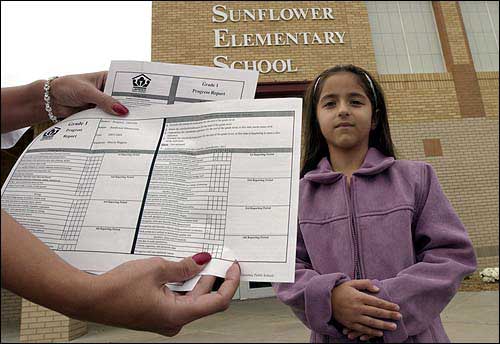
Redesigned report cards sent home to Lawrence elementary students at the end of the first quarter are being criticized by some parents, including Clara Morrison, Lawrence, mother of Sunflower School first-grader Gabriela Bongard, pictured above. Morrison feels the district's progress report is difficult to read for younger students because it assigns no letter grades. Gabriela was photographed with her report cards Thursday outside of her school.
Junior high school and high school report cards weren’t revised.
Morrison said she didn’t like that the new report cards mean students in kindergarten through third grade receive only numbered scores on a scale of 1 to 4 in dozens of academic categories. They’re no longer given “S,” “I” or “N” marks for “satisfactory,” “improvement shown” or “needs improvement.” Nor were those substituted with the standard A, B or C grade.
“I’m trying to look at it from a first-grader’s perspective,” Morrison said. “It just loses the child.”
Grade cards for students in fourth, fifth and sixth grades were recast to include assessment of academic skills with the number system, but students at this age also are assigned letter grades.
Austin Turney, the Lawrence school board president, said letter grading on primary-grade report cards was intentionally deleted.
“To add it is not a good thing, because it becomes a single bottom line,” he said.

 District revamps report cards (8-5-03)
 6News video: Lawrence rehauls report cards
The district spent about a year reworking the grade cards. Input was gathered from at least 50 Lawrence teachers. Information about the report-card reforms was distributed to parents before their release.
Parent-teacher conferences also were lengthened to allow for more questions about the grading system.
“I thought the teacher explained it well,” said Denise Fish, who has a fifth-grade son at Prairie Park.
Fish said dropping the letter grading for primary-age students wouldn’t have been an issue for her or her son. She said her son was more concerned about the verbal reaction of a parent or teacher to his school work.
“What it meant to him was me saying, ‘Great job,'” she said.
Sunflower Principal Jill Smith said there hadn’t been a flood of complaints from parents about the report cards. But it will take time for everybody to become familiar with the new progress reporting system, she said.
“I think it’s a learning process,” Smith said.
City Government
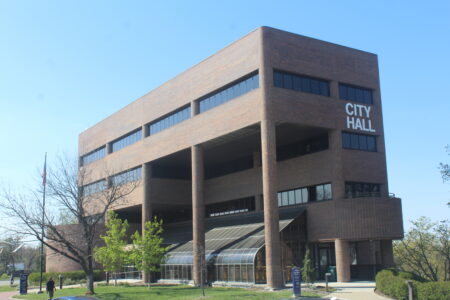
Lawrence City Commission to consider earlier public comment period once a month, new civility standards for commissioners

Garage door manufacturer Amarr seeks help from City of Lawrence to buy its current facility; it could eventually expand with 50 to 75 new jobs
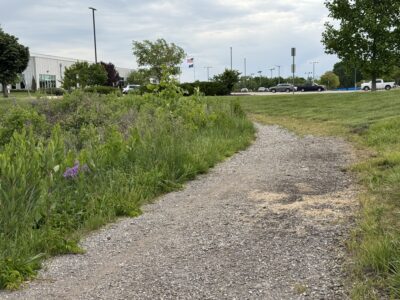
Recent trail closure at Rock Chalk Park reveals city has abandoned cost-sharing agreement with KU
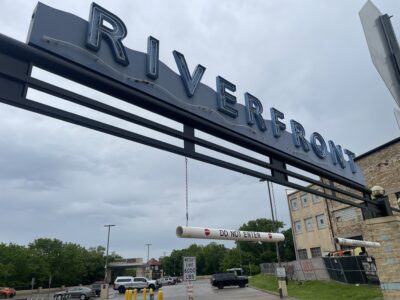
Lawsuit settlement would have City of Lawrence take control of Riverfront building; city and its contractors would pay $2.5 million in total
During new demolition moratorium, University Place hopes to strengthen protections for its older homes