A chronicle of presidential feats and failures
Creators of Bill Clinton's Little Rock museum claim exhibits will measure both
LITTLE ROCK, ARK. ? The world’s largest museum design firm promises its work on the Clinton Presidential Library will strike a balance between entertainment and education, between the former president’s feats and failures.
Award-winning designer Ralph Appelbaum said he wants to create a museum that touts Clinton as a visionary whose policies and leadership defined a generation.
“What I’ve been extraordinarily impressed by is that he’s a great teacher,” Appelbaum said in an interview from his office in New York City. “We’ve done 120 or so projects, and it’s rare to find the kind of engagement that he’s put into this. He’s been our curator, not just our client.”
But Clinton’s hands-on approach and project leaders’ effusive defense of his record have raised questions about the historical objectivity of the museum, which opens in November 2004.
Officials from the Clinton Presidential Foundation, which is paying for the $160 million construction project, say Clinton’s impeachment will be displayed prominently, in one of 14 alcoves, in the same manner as the administration’s major policy initiatives.
However, Appelbaum said, they haven’t yet figured out how to handle the Monica Lewinsky affair. Foundation president Skip Rutherford says impeachment is a minor issue and Clinton’s record of economic growth and racial reconciliation should be the library’s focus.
“Everyone entering the library knows that this was an extraordinarily politicized and contentious time in America. So, impeachment is given equal weight with other great themes, like investing in the future, the globalized economy and building one America,” said Appelbaum, whose firm has won design awards for the U.S. Holocaust Memorial Museum in Washington, D.C., the Newseum in Arlington, Va., and the American Museum of Natural History in New York.
On handling impeachment, Rutherford said the library will probably take its cue from “The American Presidency: A Glorious Burden,” an exhibit at the Museum of American History in Washington, that displays artifacts and documents from Clinton’s impeachment trial.
“We used the interplay of objects, graphics and text to make it as balanced as possible,” said curator Harry Rubenstein. “The challenge for the Clinton people will be to be honest. If they try to ignore the issue or spin it in a way the public finds hard to accept, it will taint the whole institution.”
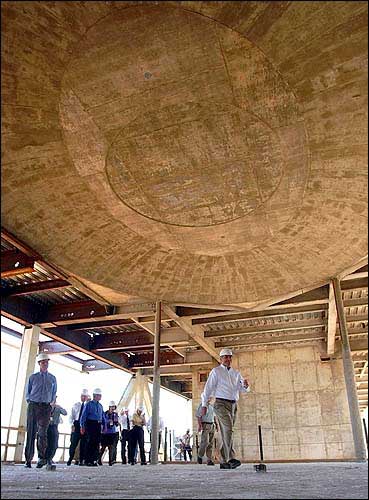
Skip Rutherford, president of the Clinton Presidential Foundation, right, walks on the floor of what will be a reconstruction of the Oval Office at the Clinton Presidential Library site in Little Rock, Ark. The library is slated to open in November 2004.
‘Bridge to the 21st century’
James Gormley, chairman of the history department at Washington & Jefferson College in Washington, Pa., said all presidential libraries tend to downplay “the dirty laundry,” but warned that “scholars will point out if there’s a big gap, if Paula Jones or Whitewater aren’t handled, and it would cast a real pall over the historical adequacy of the museum.”
Clayton Brown, professor of American history at Texas Christian University, said he sympathized with the planners’ dilemma of handling Clinton’s well-publicized indiscretions, even though he was not a Clinton fan.
“There’s no question that each presidential library tries to present that president in the most positive light,” Brown said. “That doesn’t particularly rub historians the wrong way. We know most of it is entertainment value for the general public.”
Brown, who recently conducted extensive research at the Truman Library in Independence, Mo., said treatment of historical documents is more critical.
The four-story main museum building is 150,000 square feet, with an exposed steel frame and a glass facade. The north end of the first floor, which is closest to the Arkansas River, is cut away so about half the length of the second through fourth floors are cantilevered to the water’s edge like a pontoon, held up by two H-shaped supports.
Looking eastward from downtown, the modern structure will appear to blend into an 1899 railroad bridge, creating a physical image to go with Clinton’s rhetorical device of “a bridge to the 21st century.”
A cylindrical column through the center of the building will create an oval theater on the second floor and a full-scale replica of Clinton’s Oval Office on the third. A great hall on the south end will be able to seat 325 for conventions, possibly to relive state dinners and other White House events.
A second layer of steel beams is being placed across the long facade where a second glass wall will defray the sun’s heat and conserve energy. A series of solar panels will sit on the roof of the adjacent archives building, making the whole complex a partly “green” one.
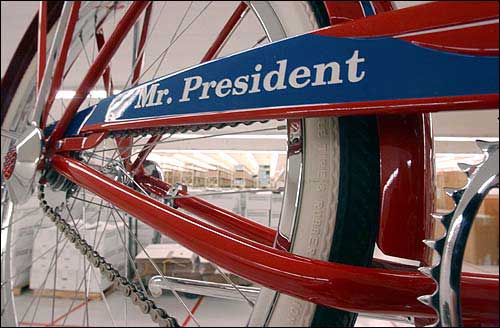
A restored 1947 bicycle given to President Clinton while he was in the White House sits in storage at the Clinton Presidential Materials Project in Little Rock, Ark. The bicycle is among the items that will be housed in the Clinton Presidential Library.
The railroad bridge will be part of the 30-acre presidential city park with a pedestrian walkway. The foundation is considering setting up a cocktail and cafe deck in the middle of the river. The old Choctaw Railroad Station is on the property and will be renovated to house the University of Arkansas Clinton School of Public Service, where the former president is expected to teach a class.
From bills baseball cards
The library is 35 percent complete. As its construction continues, Clinton insiders are debating the layout of the main exhibition space and the balance of content.
Rutherford said an advisory council of key members of Clinton’s administration — including chief of staff John Podesta, national economic adviser Gene Sperling, domestic policy adviser Bruce Reed, national security adviser Sandy Berger and White House counsel Bruce Lindsey — has focused on policy while Rutherford has advocated “fun things.”
“It’s like they’re talking at length about displaying the president’s transportation bill,” Rutherford said. “I know that’s important, but how many people coming through will read about that? So I say, ‘What about the leisure visitor? What’s going to be in there for him or her?”‘
Rutherford will not disclose the list, which he says actually includes 110 items, but said it includes Mickey Mantle’s rookie baseball card, which sits behind glass in the National Archives’ massive materials depository in Little Rock.
Some 40,000 gifts to Clinton are being held by the National Archives, such as a mother-of-pearl Nativity scene from Palestinian leader Yasser Arafat, ancient oil lamps from the mayor of Jerusalem and a saxophone from former Polish President Lech Walesa.
David Alsobrook, director of the Clinton materials collection and a former archivist at the Carter Center in Atlanta and ex-director of the Bush Library in Houston, agreed that the Clinton museum must avoid the “flat displays with lengthy texts” that could bore the average visitor.
“When I was growing up in south Alabama, I never had an opportunity to visit the Smithsonian, so the great thing about a presidential library is it brings a slice of that to us regular people in the hinterlands,” he said.
Collection will shift
Appelbaum emphasized the museum’s more intellectual pursuits, but also said there would be a section for children to play some of Chelsea Clinton’s childhood games and a partial re-creation of the former president’s White House music room, where he kept collections of Mississippi Delta music and early rock ‘n’ roll.
The main policy areas, the 1992 and 1996 election campaigns and impeachment will be on the main museum floor, while the mezzanine will include selected gifts and photographs of such White House holiday celebrations as an Easter egg roll, the lighting of a menorah and the pardoning of a Thanksgiving turkey.
Scholars and Clinton supporters alike say Clinton’s story is still being written and expect the library, like all chroniclers of history, to evolve and improve its objectivity as time passes.
“I can’t go into my modern U.S. history class and say I know exactly what happened in the Kennedy assassination, but I can give a pretty fair description of what happened with Lincoln or McKinley,” Brown said.
“Clinton’s caught up in that, too, because he’s still living, his wife just came out with her book and people are very emotional. We probably won’t be able to judge what should really go into the library for another 30 to 40 years.”
Arts and Entertainment

On a day full of downtown events, business owners hope the Midsummer Night on Mass sale will be bigger than usual
Scaffolding comes down at Liberty Hall in downtown Lawrence after months of repair work

Go, See, Do: Juneteenth celebration, parade, soccer, markets, festivals and more
Theatre Lawrence’s Youth Troupe will perform ‘Between The Lines’ musical for summer show
Lawrence Music Alliance to sponsor live music acts ahead of select World Cup watch parties