

A look at cameras tracking the comings and goings of Lawrence motorists; study shows how much the average Lawrence consumer should spend on Christmas
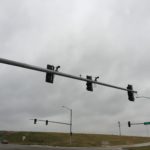
photo by: Chad Lawhorn
License plate scanners are pictured attached to the top of the traffic signals at the SLT and Iowa Street interchange.
Today’s column is spurred by a reader question. A reader saw something that looked odd along the new South Lawrence Trafficway, and no, it wasn’t my F150 continuously missing my exit on the eastern terminus of the road. (Have you learned by now that when heading east on 23rd Street you must be in the left lane in order to keep heading toward Kansas City? The right lane puts you on the westbound SLT, and causes people in the vehicle to say bad things about you and something about how even a monkey would have learned it on the fourth try.)
But what the reader was questioning is less conspicuous. There is an odd-shaped camera atop one of the traffic signal poles at the SLT and Iowa Street interchange. There are cameras atop many traffic signals in Lawrence. They help with the timing of the lights and also allow the city to monitor road conditions and such.
This camera, though, looked different, and the reader suspected it was a license plate scanner, which is a device that captures the license plate information of every vehicle that passes by and stores the data for use by law enforcement. The readers, for instance, can send police an almost instantaneous alert when a vehicle with a flagged license plate passes by a camera.
I checked with the Lawrence Police Department, and indeed the camera is a license plate reader. While the camera is new, the idea of the Lawrence Police Department using license plate scanners is not, I was told. The department began using the license plate readers in 2009. The recent installation at the SLT interchange is the seventh license plate reader the department has installed in the city. Information from the police department also indicates that some police vehicles are equipped with the scanners. (I’ve asked for an estimate of how many police vehicles have the technology, and will pass it along when I receive information.) UPDATE: Although the department has written procedures for how vehicle-mounted license plate readers could be used, the department doesn’t yet have any vehicle mounted scanners, a police spokeswoman said.
License plate readers have gotten some national media attention over the years. The Washington Post wrote an article in 2011 that noted many law enforcement agencies didn’t have any formal policies on how to use the information that was collected or how long the information should be kept. That’s not the case in Lawrence, though. The department has a three-page policy that spells out how the technology should be used by the department. Among the rules are:
• Data should not be kept for a period of more than 60 days, unless it is “has become, or it is reasonable to believe it will become, evidence in a criminal action.” In those cases the data is downloaded onto a portable device and booked as evidence.
• All data is stored on a password-protected server that records each time someone accesses the system.
• Department members are allowed to access the data only for official and legitimate law enforcement business.
• The data is not available to the general public as it may contain confidential criminal case information.
You can see the full policy here. It is worth noting that I’m uncertain whether the policy has been in place the entire time the department has had the technology. The policy is undated. I’ve asked for clarification on that point. UPDATE: Indeed, the Lawrence Police Department was a bit late in adopting a policy. A police department spokeswoman confirmed the policy was not adopted until June 2016. It is unclear what guidelines the department had in place for the camera’s use prior to the policy.
Nationally, among groups like the American Civil Liberties Union, the license plate reader technology has created privacy concerns related to police departments having so much access to the travel patterns of innocent individuals.
Sgt. Amy Rhoads, a public affairs officer for the Lawrence Police Department, said the department is mindful of the balancing act between privacy and using the technology to solve crimes. She said the technology primarily is used in conjunction with felony investigations, but also could be utilized for purposes of identifying stolen vehicles, stolen license plates, missing persons, and suspect identification.
“We have used ALPR technology as a tool to apprehend serious criminals who have committed major crime in our city,” Rhoads said. “The ALPR technology is restricted to legitimate law enforcement usage and can help increase the reach of major investigations, helping to enhance public safety.”
One thing you may be wondering about in terms of usage is whether the cameras could be used to capture the license plates of motorists who run a red light. Some states have technology where you get a ticket in the mail for running a red light or some other type of offense. License plate readers are used as part of those type of systems, but such tickets aren’t issued in Lawrence or elsewhere in Kansas. My understanding is that Kansas doesn’t have a state law that allows for such red light cameras.
As we have reported, though, license plate readers are used in Lawrence to issue other types of tickets. Last year the University of Kansas began using license plate reader technology to issue parking tickets on campus.
As we have reported, the city of Lawrence is set to hire a firm to begin studying the parking system in downtown Lawrence and around the university. It will be interesting to see if license plate reader technology is part of the solution. I know I’ve been in cities where instead of paying a meter in front of my car, I’ve paid at a digital kiosk which required me to enter my license plate. I assume license plate readers are then used to quickly check for any vehicles in a parking lot that haven’t paid.
Such use probably will require some discussions about how governments store and use the data. A recent article in The Atlantic magazine, though, raised the question of whether the real issue may be how private companies are using the license plate readers. The article noted one private company has a database of more than 4.2 billion sightings, and it is growing at a rate of 120 million data points a month. The private company, Vigilant, sells its database to law enforcement or private companies that may have a use for the data.
In other news and notes from around town:
• It is that time of year where lists are made and they are checked twice. I don’t know if it is a sign that we have been naughty, but a new study suggests that the average Lawrence consumer should spend less on Christmas gifts than consumers in many other cities.
The folks at the financial website WalletHub have put out a list that shows what average consumers in various cities should spend on the holidays based upon debt, expense and income data for each community.
The good news is that we all may know some folks in Shawnee. The Johnson County community had the ninth highest holiday budget of the 570 cities that were studied. The average consumer in Shawnee could spend $1,843 for the holidays without feeling much of a pinch.
How about it Lawrence? $563. That ranked Lawrence No. 340 on the list 570 cities. A holiday budget of $563 sounds about right — if you are only purchasing egg nog for the holidays.
Obviously, you should make of this report what you choose. I pass it along because it is an interesting way to look at debt, expense and income levels of various communities. The report relies on Census data, but WalletHub also has a relationship with the financial services firm TransUnion, which has credit data on scores of individuals.
So, here’s a look at how some regional communities fared.
• No. 9: Shawnee: $1,843
• No. 37: Overland Park: $1,388
• No. 107: Olathe: $923
• No. 142: Lee’s Summit, Mo.: $853
• No. 171: Ames, Iowa: $774
• No. 181: Independence, Mo.: $755
• No. 303: Boulder, Colo.: $592
• No. 304: Kansas City, Mo.: $591
• No. 333: Iowa City: $569
• No. 340: Lawrence: $563
• No. 342: Wichita: $562
• No. 356: St. Joseph, Mo.: $550
• No. 379: Columbia, Mo.: $532
• No. 389: Topeka: $527
The results are calculated by looking at average incomes, ages, debt-to-income ratios, monthly income to monthly expenses ratios, and savings to monthly expenses ratios. As I said before, make of it what you will. I encourage you to spend as much as you want. But, to be safe, I plan to kiss up to the Shawnee folks.
Town Talk column

With his new high-tech wellness center, longtime financial planner wants to help people invest in their bodies
Transit sales tax election was Lawrence’s closest in 2026, and without KU and downtown, it could have been much closer
New report shows more vacant commercial space in downtown, North Lawrence; one of those big vacancies could be filled soon
National Weather Service move to Lawrence ramping up; developer Phil Bundy still pursuing a STAR bond project and more news and notes
A former lieutenant governor and his granddaughter fell in love with this Lawrence bar, and now they’re helping preserve it