Facing angry voters, GOP Senate candidates vow to fix budget mess; repealing tax cuts an option
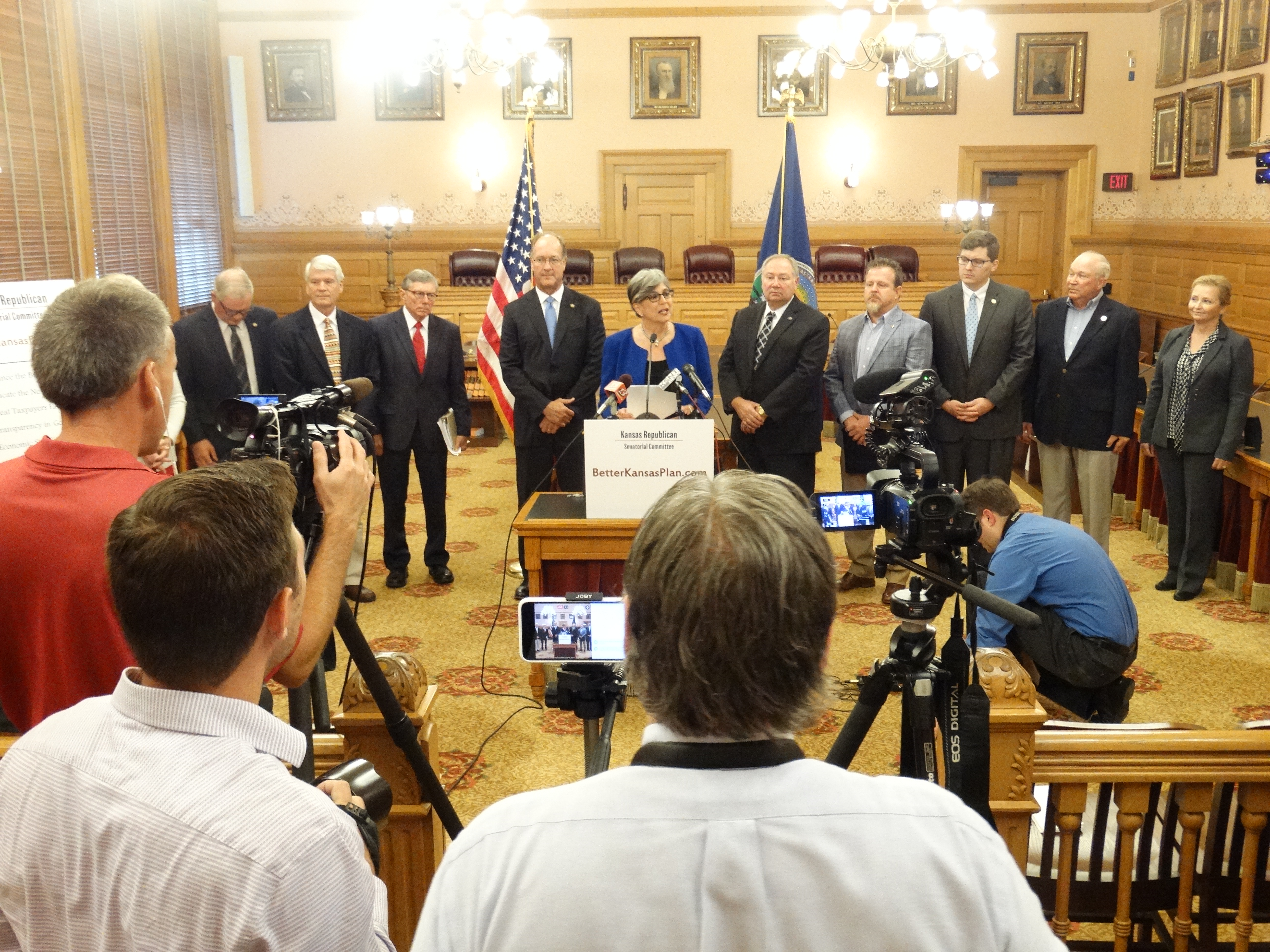
photo by: Peter Hancock
Senate President Susan Wagle and several other GOP Senate candidates say everything
Topeka ? Responding to what she described as a wave of negative feedback from voters this election year, Republican Senate President Susan Wagle of Wichita stood with 25 other GOP Senate candidates Wednesday and vowed to balance the state budget next session, even if that means dialing back some of the tax cuts that the GOP-dominated Senate approved four years ago.
“We are here as Republican nominees for the State Senate to tell Kansans, we have heard you, we have listened,” Wagle said during a Statehouse news conference Wednesday.
The group included some incumbent conservatives, including Sen. Julia Lynn of Olathe, who supported the tax cuts of 2012 and 2013, as well as moderates who defeated incumbent conservatives in the GOP primaries in August.
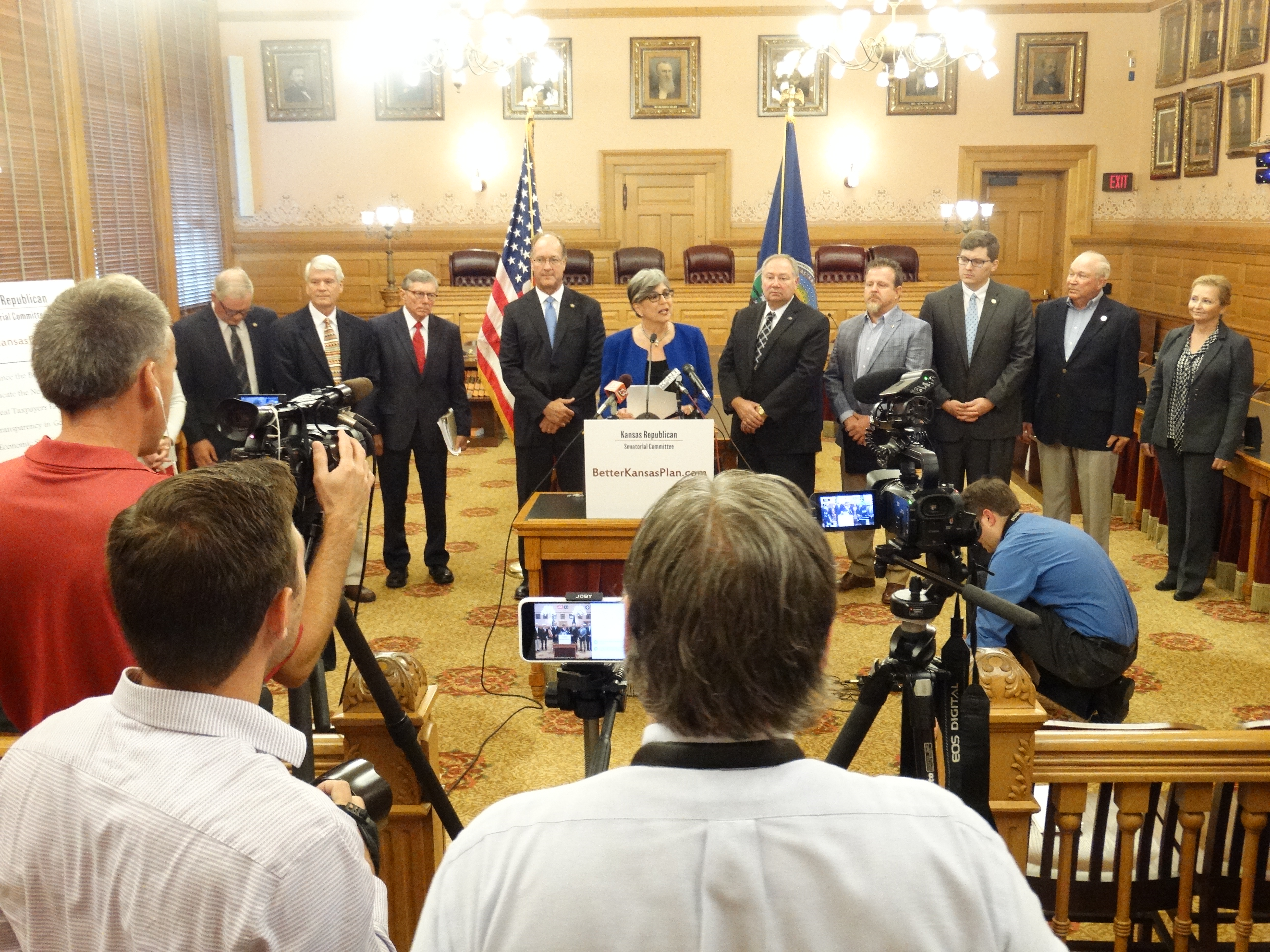
photo by: Peter Hancock
Senate President Susan Wagle and several other GOP Senate candidates say everything
“I ran on the tax policy,” said Randall Hardy of Salina, who defeated Sen. Tom Arpke in the primary. “My approach was, we needed to repeal the 2012 tax policy, the ‘march to zero.'”
The GOP group said they were committed to a plan, which reads more like a set of guiding principles calling for balancing the budget and returning to a broad-based tax policy in which all people with incomes pay income taxes.
“We can all agree that if John performs the same job as his neighbor Joe, and John doesn’t pay taxes and Joe does, that’s no fair system,” Wagle said.
That was a reference to a major tax policy change that exempts certain kinds of business owners from paying taxes on the income from those businesses.
The law applies to so-called “pass-through” entities in which the net income of the business is treated as the personal income of the owner. It applies to individuals running a cottage industry out of their home, as well as to law firms, medical practices and most farming operations that are set up as limited partnerships, limited liability corporations, or businesses often called “S-corporations” that are organized under a particular sub-chapter of the federal tax code.
Officials in the Legislature’s nonpartisan research staff have estimated that the pass-through exemption is costing the state between $200 million and $250 million a year.
But the costliest element of the 2012 tax cuts was the so-called “march to zero” that eliminated the state’s top tax bracket and drastically lowered rates on the remaining two, with a formula designed to gradually ratchet down the income tax rate to zero.
That, researchers say, currently costs the state more than $700 million a year compared to the original tax formula.
Wagle did not specifically commit to repealing the pass-through exemption, and she repeatedly said she does not believe lawmakers can balance the budget with tax increases alone.
Legislative researchers have said the current budget is structurally out of balance by more than $300 million, which is roughly the amount currently being taken out of the highway fund, delayed payments into the state retirement system and other kinds of budget maneuvers.
Add on top of that whatever amount the Kansas Supreme Court may order in the pending school finance lawsuit, and some officials say the state may need $1 billion or more to fully fund next year’s budget.
“That’s why everything is on the table,” she said. “We can’t tax our way out of it. We can’t cut our way out of it. The loophole doesn’t fix it. It’s going to have to be a number of different bills that come together and balance the budget.”
In a separate news conference in her office, Wagle admitted that GOP candidates have been getting an icy reception from voters when they campaign door-to-door in their districts.
And she compared it to the kind of anger voters expressed during her first legislative campaign in 1990 in the wake of statewide property reappraisal and classification that led to huge property tax increases for many homeowners.
“The anger that we are experiencing now is greater than the anger I encountered in 1990,” she said.
“We have people, and I’m sure it’s happening with both parties, but doors are being slammed in faces,” she said. “The one question is, are you an incumbent? And they’re just angry. And between us, between all of those (candidates) who were standing there, we’ve knocked on a lot of doors.”
But Democratic Sen. Laura Kelly of Topeka said Wednesday that she has not been getting that kind of reception, not even in heavily Republican parts of her district like the towns of Silver Lake and Rossville west of Topeka.
“Many voters are very aware of their legislators’ records, and they’re holding accountable the ones who have been allies with the governor and created the mess we’re in,” Kelly said.
No matter what happens in the elections Nov. 8, the Kansas Senate is certain to look much different next year than it has for the last four years. That’s because eight incumbent Republicans are stepping down from the Senate this year, and six more were defeated in the Aug. 2 primaries.
That’s nearly half of the 32 Senate seats that Republicans currently hold, and it remains unclear whether Wagle, long allied with the conservative wing of the party, will be able to win another term as Senate President.
But none of the GOP candidates who attended the news conference Wednesday indicated that it was designed to shore up support for Wagle in the leadership races that will occur after the election. And Wagle herself denied that she was even thinking about leadership races.
“My goal is to bring back a majority,” she said. “I’m really not worried about leadership races right now because there’s not going to be a race for Senate President if we don’t have a majority of Republicans.”
State Government

Douglas County judge temporarily blocks enforcement of Kansas law banning gender-affirming care for minors; Kobach says he’ll appeal

New legislation will allow providers to administer drug used to reverse opioid overdoses past its expiration date

Report: Lawrence woman detained for 30 hours by custom officers regarding illegal voting in local election
Former western Kansas mayor ordered to report to ICE detention facility due to voting issue
COLDWATER, Kansas — The former mayor of Coldwater has been ordered to report to federal immigration detention ...
Moody’s upgrades state credit rating to ‘positive’
TOPEKA — The state of Kansas’ credit rating upgrade from stable to positive by a leading financial research ...