Risk of Zika in Douglas County a concern as CDC publishes mosquito map
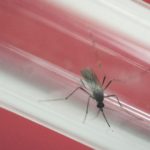
In this May 23, 2016, file photo, an Aedes aegypti mosquito sits inside a glass tube at the Fiocruz institute where they have been screening for mosquitos naturally infected with the Zika virus in Rio de Janeiro, Brazil. (AP Photo/Felipe Dana, File)
Douglas County has been named a hotspot for a mosquito species that can carry the Zika virus. While the risk of a Zika outbreak is currently minimal, local health officials are taking precautions.
“If a mosquito bites an infected person, that could be the start of the transmission, and so we’re really working on the public education, because the risk is there,” said Kim Ens, director of Clinic Services for the Lawrence-Douglas County Health Department.
The Centers for Disease Control on Thursday published a map that shows a county-by-county breakdown of where scientists have collected Aedes aegypti mosquitoes, a type of mosquito thought to be spreading Zika in Latin America and the Caribbean. Another type of mosquito known for spreading the virus, the Aedes albopictus, has also been found in the area, according to Christopher Rogers, who monitors mosquito populations for the Kansas Biological Survey.
“Basically, I’ve got it pretty much everywhere in the county,” Rogers said, noting that so far he has only found the Aedes aegypti in Lawrence, but that it may also occur other places in Douglas County.
Aedes mosquitoes
•Have white bands on torso and legs
• Active during the day
• Prefer humid, shady conditions
• Typically nest in cavities in trees
• Also nest in other shaded areas with collected water
— Source: Christopher Rogers, of the Kansas Biological Survey
The presence of the Aedes mosquitoes only makes transmission possible, not guaranteed. For a mosquito to transmit the virus, there would need to be an infected person present in the area. Out of the about 700 Zika cases in the United States — all of which are from people traveling to countries where Zika is prevalent — only two are in Kansas, according to the CDC. Ens said there are currently no cases of Zika reported in Douglas County.
Zika is especially worrisome because it can cause severe birth defects if a pregnant woman is infected. Zika infection during pregnancy can cause a condition called microcephaly, which results in babies being born with abnormally small heads and severe brain defects, according to the CDC.
The map published by the CDC shows that Douglas, Johnson, Shawnee and Wyandotte counties all are in the highest category for the Zika mosquitoes. More specifically, the map indicates that scientists have found the mosquito during three or more years in the past two decades. However, Rogers said that information could be misleading because specific monitoring for the two Aedes mosquitoes that can carry Zika only began this year. Before that, the Aedes mosquitoes were only recorded coincidentally in traps designed to catch other species of mosquito, such as those that carry the West Nile virus.
“With the start of the mosquito season, we have been doing additional specialized trapping that focuses on those two species that have the potential to carry Zika,” Rogers said. “In the past, there wasn’t a lot of information about those two species because they weren’t medically important in the state.”
Beginning to regularly track the two types of mosquito that can carry Zika will be important going forward, Rogers said.
“At this time, Zika virus, as far as we know, is not in transmission in mosquitoes in Kansas, but if it does happen, we need to know what the mosquitoes are doing now before there is a problem,” Rogers explained.
Both types of Aedes mosquitoes prefer biting humans and are active during the day. The most common symptoms of Zika are fever, rash, joint pain and red eyes, according to the CDC. The illness is usually mild with symptoms lasting for several days to a week after being bitten by an infected mosquito.
Ens said one of the health department’s prevention efforts is educating those who have traveled to areas where Zika is prevalent on how to avoid transmitting it. Because most people who have Zika don’t have any symptoms, travelers need to take precautions to avoid being bitten by mosquitoes for at least two weeks after returning home, Ens said.
“We would instruct them that if they’re going to go outside they need to use repellent also, so if there is an Aedes mosquito out there, that it wouldn’t bite them and then be able to transmit the infection,” Ens said. Zika can be transmitted sexually for up to six months, so travelers also should not have unprotected sex to avoid transmitting to another person, Ens said.
Ens said the health department is providing information about Zika to area health care providers and more details are also available on the department’s website.
City Government

Lawrence Police Department receives KDOT’s top traffic safety award for second straight year

Lawrence City Commission approves extra layers of oversight for data centers, asks for patience on further regulations

Lawrence to participate in program that helps nonprofits rehabilitate abandoned properties as affordable housing

Lawrence’s first bike lanes with physical barriers are installed on Ninth Street

Opinion: Don’t give up on trying to use Costco to take tens of millions of dollars from the state of Kansas